Call us:


Choosing the right IELTS course by Cambridge qualified
instructor Dhaka can be one of the most important decisions for a Bangladeshi
student who dreams of studying, working, or settling abroad. IELTS is not only
an English test. It is a life-changing step. Many students in Dhaka start their
IELTS journey with fear, doubt, and confusion. They ask simple but serious
questions. Can I get Band 7? Can I improve my speaking? Will my writing be
accepted by the examiner? How can I balance IELTS preparation with university,
job, family pressure, and financial limits? These questions are very real.
An IELTS course by Cambridge qualified instructor Dhaka becomes valuable when it gives more than notes and model answers. It should give direction, feedback, confidence, and a clear study path. A student from Mirpur, Dhanmondi, Uttara, Mohammadpur, or Old Dhaka may have good grammar knowledge but still struggle to speak naturally. Another student may read English well but fail to write a clear Task 2 essay. This is why expert guidance matters.
Why IELTS Matters for Bangladeshi Students
For many Bangladeshi students, IELTS is connected with a
bigger dream. It may be admission to a university in the UK, Canada, Australia,
the USA, Europe, or New Zealand. It may be a scholarship. It may be a migration
plan. It may even be a career upgrade inside Bangladesh, where strong English
communication helps in corporate jobs, NGOs, banking, airlines, and
multinational companies.
IELTS checks four skills.
- Listening
- Reading
- Writing
- Speaking
The test uses a 9-band scale. A Band 7 means a good user of
English. A Band 8 means a very good user. A Band 6 means a competent user. Many
universities accept Band 6 or 6.5, but competitive programs often ask for 7 or
above. Some students think IELTS is only about English. In reality, IELTS is
also about test strategy, time control, question understanding, idea
development, and examiner expectations.
A student named Farhan from Mohammadpur had good English
from school. He watched English movies and followed football interviews. But
when he took a mock IELTS test, he got only 5.5 in Writing. His problem was not
only grammar. His ideas were not organised. His examples were too general. His
conclusion repeated the introduction. After guided practice, he learned how to
plan, write, review, and improve. This is where a structured IELTS course
becomes useful.
What Makes a Cambridge Qualified Instructor Different
An instructor with Cambridge-related training usually
understands language teaching in a deeper way. The focus is not only on
memorising answers. The focus is on how students learn English, how they make
mistakes, how they build fluency, and how they develop accuracy over time.
A Cambridge qualified instructor can help students in several ways.They can identify the real weakness behind a low band score.
- They can explain grammar in simple classroom language.
- They can train students to write naturally instead of copying templates.
- They can teach speaking through practice, correction, and confidence building.
- They can help students understand IELTS assessment criteria.
This matters because many Bangladeshi students learn English
in a grammar-heavy system. They know rules. They know definitions. But they
often feel shy when they speak. They may write long sentences but fail to make
a clear argument. A skilled teacher understands this background and teaches
from the student’s actual level.
An IELTS course by Cambridge qualified instructor Dhaka
should therefore be practical, not just impressive in name. The class should
include real feedback, mock tests, personalised correction, speaking drills,
writing review, vocabulary building, and clear home tasks.
Introducing IELTS Professor and Sayedul Abrar
IELTS Professor is presented as an IELTS preparation
platform that focuses on quality instruction and student-centred guidance. One
of the key academic names associated with it is Sayedul Abrar, Head of
Academic, IELTS Professor.
Sayedul Abrar is a highly qualified English teacher from
Bangladesh. He brings over a decade of experience in language education.
According to the provided academic profile, Abrar holds a Master’s degree in
Applied Linguistics from the University of Cambridge. He also holds a CELTA
certification from International House London under the University of
Cambridge. His teaching focus includes IELTS preparation and Corporate English
training.
This combination is important. Applied Linguistics helps a teacher understand how language works and how learners improve. CELTA helps a teacher plan lessons, manage classes, check student progress, and use communicative teaching methods. Corporate English experience also helps because many IELTS candidates need English not only for exams but also for interviews, academic discussion, workplace communication, and visa-related confidence.
The Real Challenges Bangladeshi Students Face
IELTS preparation in Bangladesh is not always easy. Many
students face pressure from many sides at once. Some are studying at
university. Some are doing jobs. Some are preparing for admission deadlines.
Some are waiting for scholarship decisions. Some have family members who expect
fast results.
- The first challenge is financial pressure. IELTS exam fees,
coaching fees, university application fees, document costs, and visa costs can
create stress. A student may think, “I cannot afford to fail.” This fear can
reduce confidence.
- The second challenge is speaking anxiety. Many students
understand English but feel nervous when speaking with a teacher or examiner.
They worry about pronunciation, grammar mistakes, and being judged.
- The third challenge is weak writing practice. Writing is
often the hardest module for Bangladeshi candidates. Students may memorise
essays, but IELTS exam questions change. If the candidate cannot think and
write independently, the score may not improve.
- The fourth challenge is cultural adjustment. Students
planning to study abroad need more than IELTS. They need to understand
classroom participation, independent learning, group discussion, punctuality,
academic honesty, and communication with teachers.
- The fifth challenge is misinformation. Many students hear
that one secret trick can bring Band 7. This is not true. IELTS needs clear
training, repeated practice, and honest feedback.
How a Good IELTS Course Should Be Structured
A good IELTS course should not begin with random practice.
It should begin with diagnosis. The teacher should first understand the
student’s level. Is the student weak in grammar? Is the problem vocabulary? Is
the problem time management? Is the student writing too much but saying too
little? Is the student fluent but inaccurate in speaking?
After diagnosis, the course should move skill by skill.
- In Listening, students should learn how to follow
instructions, predict answers, understand distractors, and check spelling.
- In Reading, students should learn scanning, skimming,
keyword matching, paraphrase understanding, and time control.
- In Writing Task 1, students should learn how to describe
trends, compare data, organise reports, and use accurate language.
- In Writing Task 2, students should learn how to understand
the question, plan ideas, write topic sentences, support arguments, and avoid
memorised answers.
- In Speaking, students should practise real questions,
follow-up answers, idea expansion, fluency, pronunciation, and natural
expression.
An IELTS course by Cambridge qualified instructor Dhaka
should also include feedback after practice. Practice without feedback is like
driving without a mirror. You may move forward, but you may not know what is
going wrong.
Story of a Bangladeshi Student Who Improved
Let us imagine a student named Nusrat from Dhanmondi. She
wanted to apply for a Master’s program in Canada. Her target was Band 7 overall
with no band less than 6.5. She had good reading skills but was afraid of
speaking. In her first mock test, she paused too much. She gave short answers.
She said, “I do not know” whenever the topic felt unfamiliar.
Her instructor did not tell her to memorise answers.
Instead, he taught her how to build answers using simple steps. For example,
when asked about a favourite place, she learned to answer with location,
reason, memory, and feeling. She practised speaking for two minutes every day.
She recorded herself. She listened again. She corrected repeated mistakes.
In writing, she learned that a good essay does not need very
complex words. It needs a clear position, logical ideas, and accurate
sentences. After eight weeks, her mock speaking score improved from 5.5 to 7.
Her writing improved from 6 to 6.5. She finally reached her target.
This story is not magic. It is the result of guided
practice. It shows why expert instruction can save time and reduce confusion.
Why Cambridge Training Helps in IELTS Writing
Writing is the module where many students lose marks. They
often use memorised introductions like “In this modern era” or “Nowadays it is
a burning question.” These phrases do not make writing strong. Sometimes they
make the writing sound unnatural.
A Cambridge-trained teaching approach usually focuses on
meaning first. The student learns how to answer the question directly. Then the
student learns how to organise ideas. Then the student improves grammar and
vocabulary.
For example, if the question asks whether governments should
invest more in public transport, a weak answer may discuss traffic, pollution,
economy, and technology without a clear position. A stronger answer will state
a clear opinion and support it with two focused reasons.
Bangladeshi students should remember one thing. IELTS
Writing is not a test of how many big words you know. It is a test of
communication. If the examiner can follow your argument easily, your chance of
getting a better score increases.
Speaking Confidence for Dhaka Students
Many students in Dhaka say, “I understand English, but I
cannot speak.” This is common. The reason is simple. Most students do not get
enough speaking practice in real life. They read, write, and listen, but they
rarely speak English in a safe environment.
A good IELTS speaking class should make students speak from
the first day. The teacher should correct mistakes without making students feel
ashamed. The class should include pair work, individual speaking, cue card
practice, follow-up discussion, pronunciation support, and fluency drills.
One student from Uttara may speak too fast. Another student
from Jatrabari may translate from Bangla while speaking. Another student from
Savar may give only one-line answers. Each student needs different feedback.
This is why small group practice or personal feedback can be very helpful.
An IELTS course by Cambridge qualified instructor Dhaka
should not make students dependent on memorised answers. The goal should be
natural speaking with clear ideas.
Practical Advice for Students with Financial Constraints
Many Bangladeshi students prepare for IELTS with a limited
budget. This is normal. If money is a concern, students should plan carefully.
- First, do not register for the exam before knowing your
level. Take a mock test first. If your target is Band 7 and your current level
is 5.5, you may need more time.
- Second, invest in the right course instead of buying too
many books. One good course with proper feedback can be more useful than ten
unused books.
- Third, use free official sample materials for practice. But
do not only practise alone if you do not understand your mistakes.
- Fourth, make a weekly plan. Study one module each day and
keep one day for review.
- Fifth, share resources with friends. You can practise
speaking together, check each other’s timing, and discuss essay ideas.
Finally, remember that failing once can cost more than
preparing properly. A thoughtful course decision can save exam fees, time, and
emotional stress.
Cultural Preparation Alongside IELTS
Students who plan to go abroad should also prepare for
cultural change. In many foreign universities, students are expected to ask
questions, join discussions, work in groups, and think independently. Some
Bangladeshi students feel shy at first because they come from a teacher-centred
system.
IELTS speaking practice can help with this. Writing practice
can also help because students learn how to express opinions with reasons.
Listening practice helps them understand different accents. Reading practice
helps them handle academic texts.
This is why IELTS is more than a score. It is preparation
for real academic life. A strong course can help students build confidence
before they enter a foreign classroom.
How to Choose the Right IELTS Course in Dhaka
Before joining any course, ask a few direct questions.
- Who will teach the class?
- What is the teacher’s qualification?
- Will I get writing feedback?
- Will I get speaking practice?
- Are mock tests included?
- How many students are in one batch?
- Will the course cover both Academic and General Training needs?
- Will the instructor explain band descriptors?
- Can I get a study plan based on my target score?
Do not choose a course only because it is cheap. Also, do
not choose a course only because it is expensive. Choose a course that gives
value. A good instructor should be able to explain your weakness clearly and
show you how to improve.
This is where IELTS Professor can be considered by students
looking for expert-led preparation. With Sayedul Abrar as Head of Academic, the
platform can appeal to learners who want guided preparation from a teacher with
Cambridge-linked academic and professional training.
What Students Should Expect from IELTS Professor
Students considering IELTS Professor should expect a
learning environment focused on skill improvement. A strong IELTS course should
include clear lesson plans, regular practice, module-wise strategy,
feedback-based writing development, speaking confidence building, and mock test
evaluation.
Since Sayedul Abrar has experience in IELTS preparation and
Corporate English training, students may also benefit from
communication-focused teaching. This can help students who want to improve not
only their test score but also their real-life English.
An IELTS course by Cambridge qualified instructor Dhaka
should ideally help students understand their target and create a realistic
path. For example, a student targeting Band 6 may need a different plan from a
student targeting Band 7.5. A student weak in writing needs more correction. A
student weak in listening needs more accent training and spelling practice.
Common IELTS Mistakes and How to Avoid Them
Many students repeat the same mistakes for months because
nobody corrects them properly. Here are some common problems.
- They memorise essays instead of learning structure.
- They ignore spelling in Listening.
- They spend too much time on one Reading passage.
- They use fake complex words in Writing.
- They give short answers in Speaking.
- They do not review mock test results.
- They practise without a clear target.
The solution is not only hard work. The solution is smart
work. Students should keep an error notebook. After every practice test, they
should write down mistakes. For example, “I lost marks because of plural form,”
or “I could not identify paraphrase,” or “My essay lacked examples.” This habit
can slowly change performance.
A Simple 8-Week IELTS Study Plan
A student with basic English can follow this simple plan.
- Week 1: Take a diagnostic test and understand the IELTS format.
- Week 2: Build Listening and Reading strategies.
- Week 3: Start Writing Task 1 and Speaking Part 1.
- Week 4: Practise Writing Task 2 structure and Speaking Part 2.
- Week 5: Work on grammar, vocabulary, and paragraph development.
- Week 6: Take full mock tests and review mistakes.
- Week 7: Focus on weak modules and improve timing.
- Week 8: Practise final mocks and prepare exam-day strategy.
This plan may change based on student level. A student at
Band 5 may need more time. A student already at Band 6.5 may need targeted
correction. The main point is that preparation should be organised.
Why Feedback Is More Important Than Practice Alone
Many students practise for hours but do not improve. The
reason is simple. They repeat the same mistakes. They write essays but nobody
checks them. They speak but nobody corrects their fluency, grammar, or
pronunciation. They read passages but do not understand why answers are wrong.
Feedback changes this cycle. A good teacher can show the
exact problem. For example, a student may think vocabulary is the issue, but
the real issue may be task response. Another student may think pronunciation is
poor, but the real problem may be lack of idea development.
An IELTS course by Cambridge qualified instructor Dhaka
should help students see these hidden problems. Once students understand the
cause, improvement becomes easier.
Exam-Day Mindset for IELTS Candidates
Exam day can be stressful. Many students sleep late the
night before the test. Some revise too much and become tired. Some panic during
Listening if they miss one answer. This can affect the whole test.
Students should prepare mentally. Sleep well. Reach the test
centre early. Carry required documents. Listen carefully to instructions. If
you miss one answer in Listening, move on. Do not let one mistake destroy the
next ten answers. In Reading, control time. In Writing, leave a few minutes for
checking. In Speaking, do not try to sound like a native speaker. Just speak
clearly and naturally.
IELTS is a test of performance, not perfection.
Summary
Choosing the right IELTS course can shape a student’s
future. Bangladeshi candidates need clear guidance, honest feedback, regular
practice, and emotional confidence. IELTS Professor, with Sayedul Abrar as Head
of Academic, offers a strong example of expert-led preparation. A good course
should help students improve skills, understand mistakes, manage pressure, and
move toward their target band with a clear plan.
FAQs
1. What is the best way to start IELTS preparation in
Dhaka?
- The best way to start is by taking a diagnostic mock test.
- This will show your current level in Listening, Reading, Writing, and Speaking.
- Many students start with random practice, but this often wastes time.
- After the mock test, you should identify your weakest module.
- Then you can choose a course or study plan based on your target score.
- If your goal is Band 7, you need guided feedback from the beginning.
2. Why should I choose a Cambridge qualified IELTS
instructor?
- A Cambridge qualified instructor usually has formal training in English language teaching
- This can help students learn through proper methods, not only shortcuts.
- Such instructors often understand grammar, fluency, lesson planning, and feedback better.
- They can explain mistakes in a clear and useful way.
- For Bangladeshi students, this is helpful because many learners lack speaking and writing feedback.
- A qualified instructor can make preparation more focused and less confusing.
3. Is IELTS Professor suitable for Bangladeshi students?
- IELTS Professor can be suitable for students who want structured IELTS preparation.
- The platform is connected with Sayedul Abrar, Head of Academic, IELTS Professor.
- His background includes Applied Linguistics from the University of Cambridge and CELTA from International House London under the University of Cambridge.
- His experience in IELTS preparation and Corporate English training may help students build exam and communication skills.
- Students should contact the institute to learn about batch size, course duration, mock tests, and feedback system.
- This will help them decide whether the course matches their target.
4. How long does it take to prepare for IELTS?
- The preparation time depends on your present English level and target band.
- If you are already near Band 6.5, you may need 6 to 8 weeks of focused practice.
- If your level is around Band 5, you may need 3 to 6 months.
- Writing and Speaking often take longer because they need feedback.
- Students with university classes or jobs should plan more time.
- It is better to prepare properly than to rush and repeat the exam.
5. Why do many Bangladeshi students struggle in IELTS
Writing?
- Many students struggle because they memorise essays instead of learning how to think.
- They often use long sentences without clear meaning.
- Some students do not understand the question properly.
- Others write general examples that do not support the main idea.
- Bangladeshi students also get less academic writing practice in school and college.
- Regular correction from an expert teacher can improve this problem.
6. How can I improve IELTS Speaking if I feel shy?
- You can improve speaking by practising in a safe and regular way.
- Start with simple daily topics like family, study, food, travel, and hobbies.
- Record your answers and listen to them again.
- Notice pauses, repeated words, and grammar mistakes.
- Practise with a teacher or partner who can give feedback.
- Do not memorise full answers because examiners can often notice unnatural
speech.
7. Can I get Band 7 without joining a course?
- Some students can get Band 7 through self-study if their English is already strong.
- However, many students need guidance, especially in Writing and Speaking.
- A course is useful when it gives feedback, mock tests, and strategy.
- Self-study can help with Listening and Reading, but Writing needs correction.
- Speaking also improves faster when someone trained listens and comments.
- So, a course is not always required, but it can reduce risk and save time.
8. What should I ask before joining an IELTS course?
- You should ask who will teach the class and what qualifications the teacher has.
- You should ask whether writing correction is included.
- You should also ask about speaking practice and mock tests.
- Batch size is important because large batches may reduce personal feedback.
- Ask whether the course follows Academic or General Training needs.
- A serious institute should answer these questions clearly.
9. Is IELTS Academic harder than IELTS General Training?
- IELTS Academic and General Training have the same Listening and Speaking sections.
- The Reading and Writing sections are different.
- Academic Reading usually has more academic texts.
- Academic Writing Task 1 includes graphs, charts, tables, maps, or processes.
- General Training Writing Task 1 is a letter.
- The right test depends on your purpose, such as study, work, or migration.
10. How can students manage IELTS preparation with
financial pressure?
- Students should first take a mock test before booking the real exam.
- This reduces the chance of wasting exam fees.
- They should choose a course that gives real feedback instead of only lectures.
- They can use free official practice materials for extra study.
- Group speaking practice with friends can also reduce cost.
- A smart plan is more useful than buying many books without using them.
11. What is the role of mock tests in IELTS preparation?
- Mock tests help students understand their real exam readiness.
- They show timing problems, module weakness, and repeated mistakes.
- A mock test without review is not enough.
- The teacher should explain why the score is low and how to improve it.
- Students should take mocks at regular intervals, not every day.
- The purpose is to measure progress and adjust the study plan.
12. How important is vocabulary for IELTS?
- Vocabulary is important, but it should be natural and accurate.
- Many students try to use difficult words to impress the examiner.
- This can reduce the score if the words are used wrongly.
- It is better to learn topic-based vocabulary with examples.
- For Writing, vocabulary should help explain ideas clearly.
- For Speaking, simple but flexible language is often more effective.
13. Can working professionals join IELTS preparation?
- Yes, working professionals can prepare for IELTS with a flexible plan.
- They may need evening or weekend classes.
- Their main challenge is time management.
- A professional may also need English for workplace communication, not only IELTS.
- This is where an instructor with Corporate English experience can help.
- A realistic weekly routine is important for busy learners.
14. How can IELTS help with cultural adjustment abroad?
- IELTS builds skills that are useful in real academic life.
- Listening helps students understand lectures and different accents.
- Speaking helps students join discussions and ask questions.
- Writing helps students prepare for assignments and reports.
- Reading helps students handle academic articles and textbooks.
- So, IELTS preparation can also prepare students for study abroad culture.
15. How can I contact IELTS Professor for course
information?
- Students can contact Sayedul Abrar, Head of Academic, IELTS Professor.
- The provided email address is [email protected].
- The provided phone number is 01681193440.
- Before joining, students should ask about course duration, fees, class schedule, and feedback system.
- They should also ask whether mock tests and writing corrections are included.
- This will help them choose the right IELTS course by Cambridge qualified
instructor Dhaka based on their personal needs.
Find Your Courses
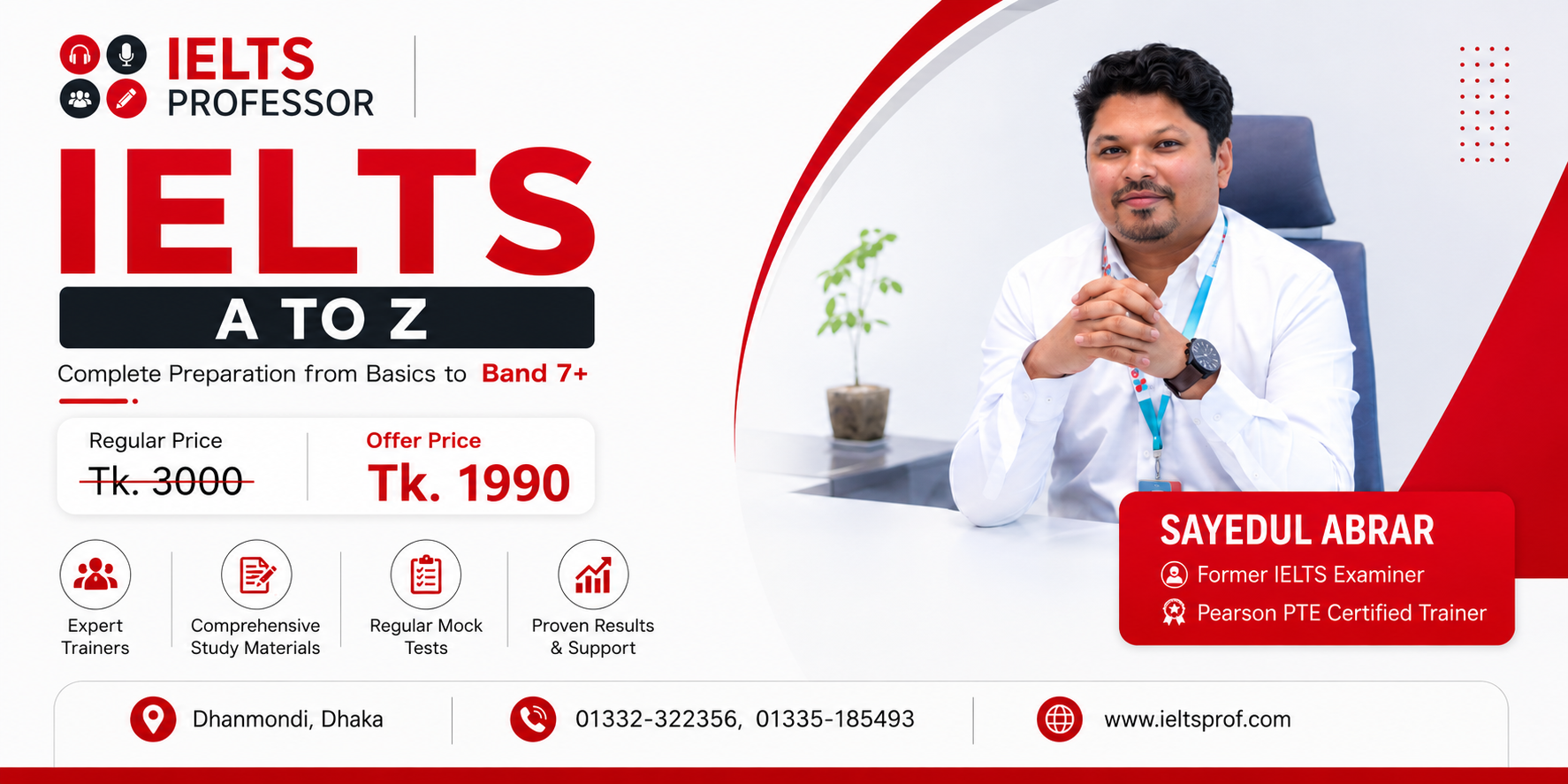
IELTS A to Z
৳ 1990.00
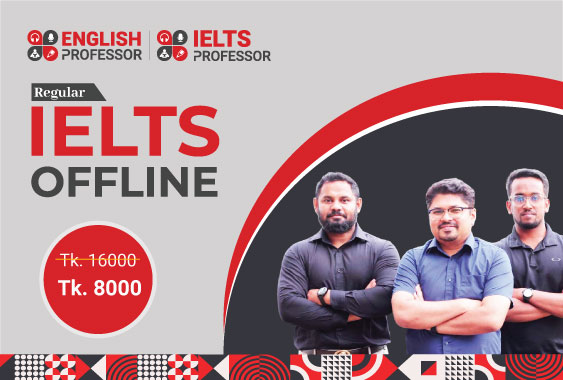
7+ IELTS Offline Regular
৳ 8000.00
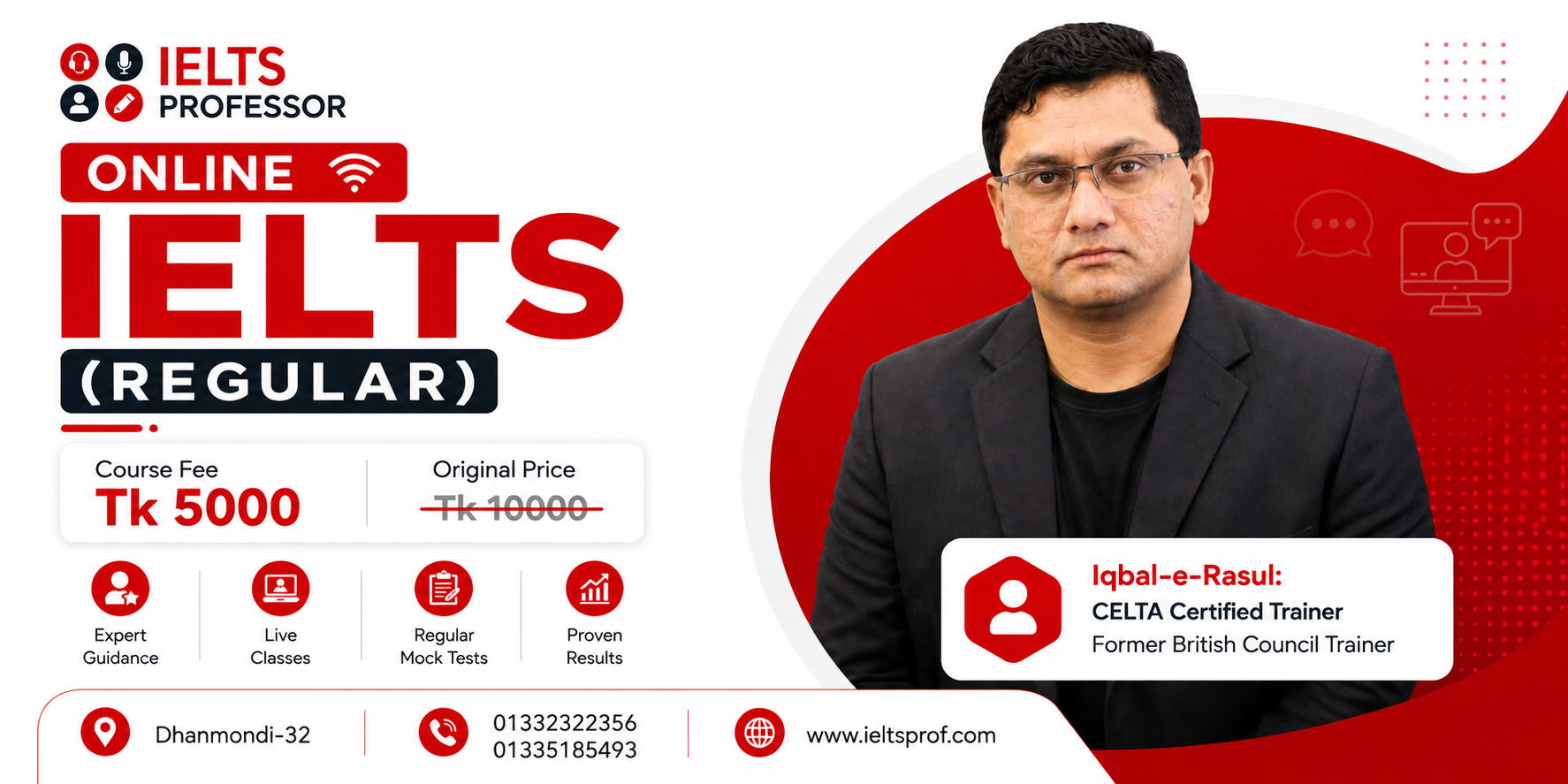
Online IELTS (Regular)
৳ 5000.00

Spoken English
৳ 3500.00
IELTS Regular Executive
৳ 8000.00
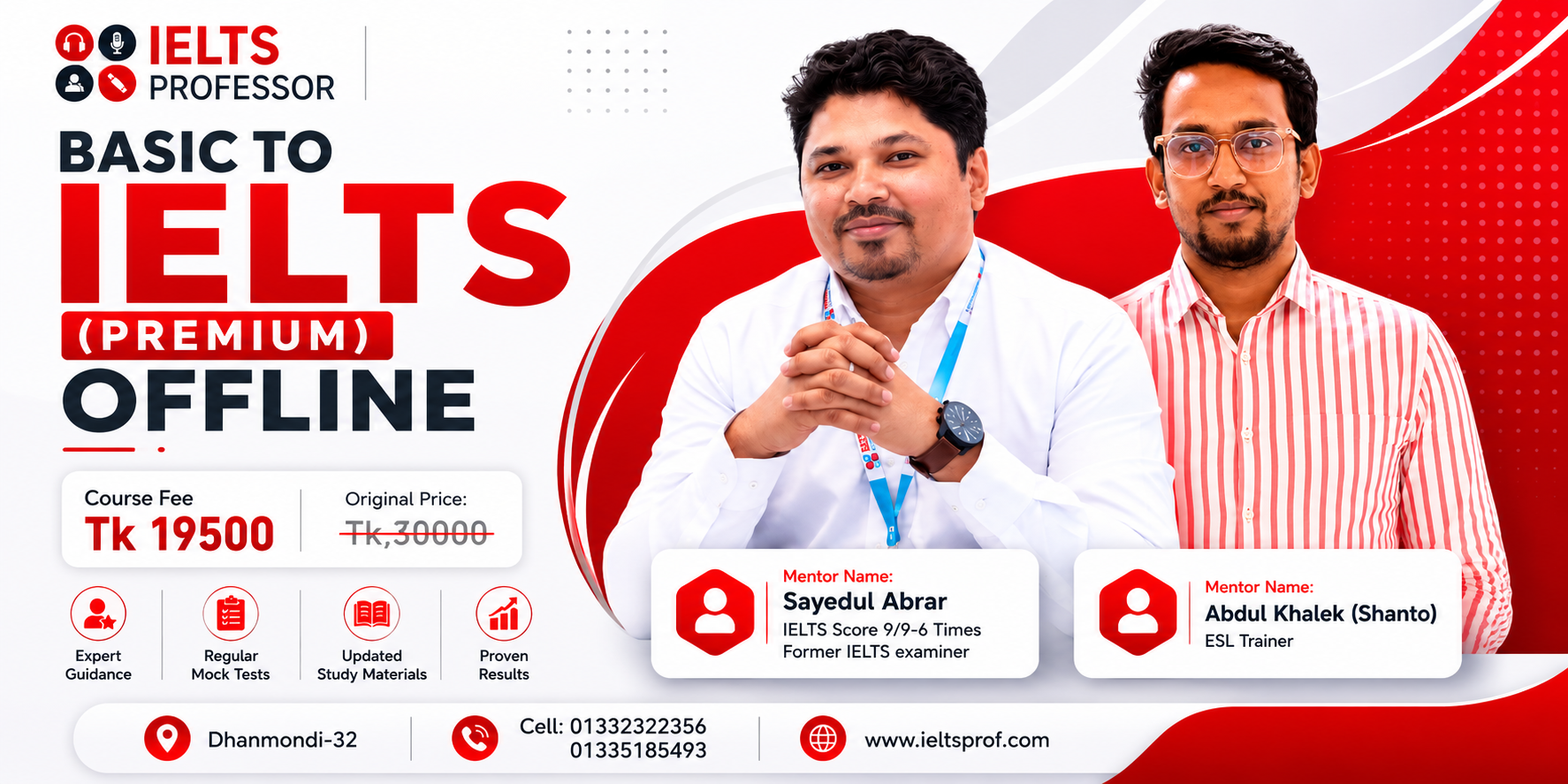
Basic to IELTS
৳ 19500.00
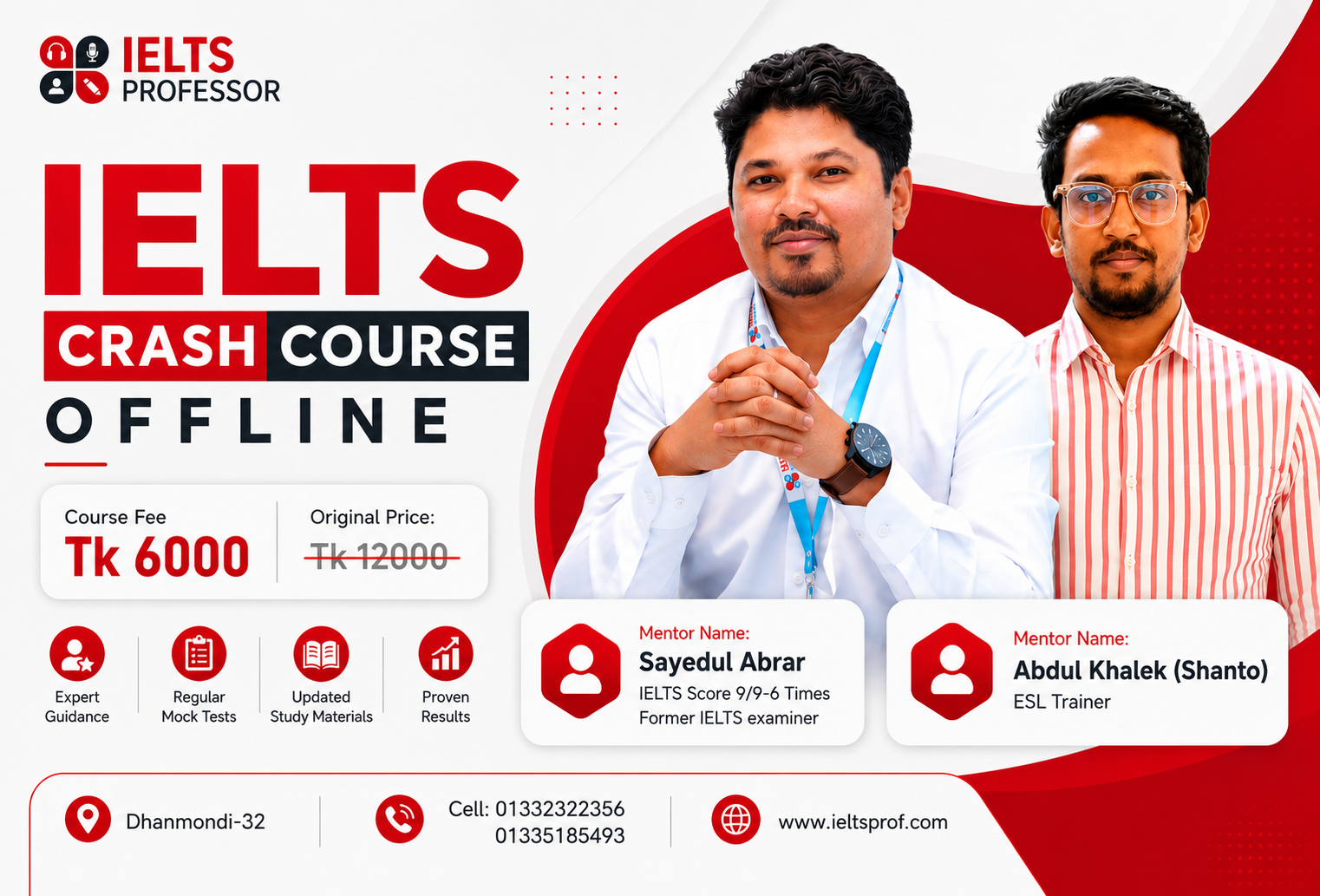
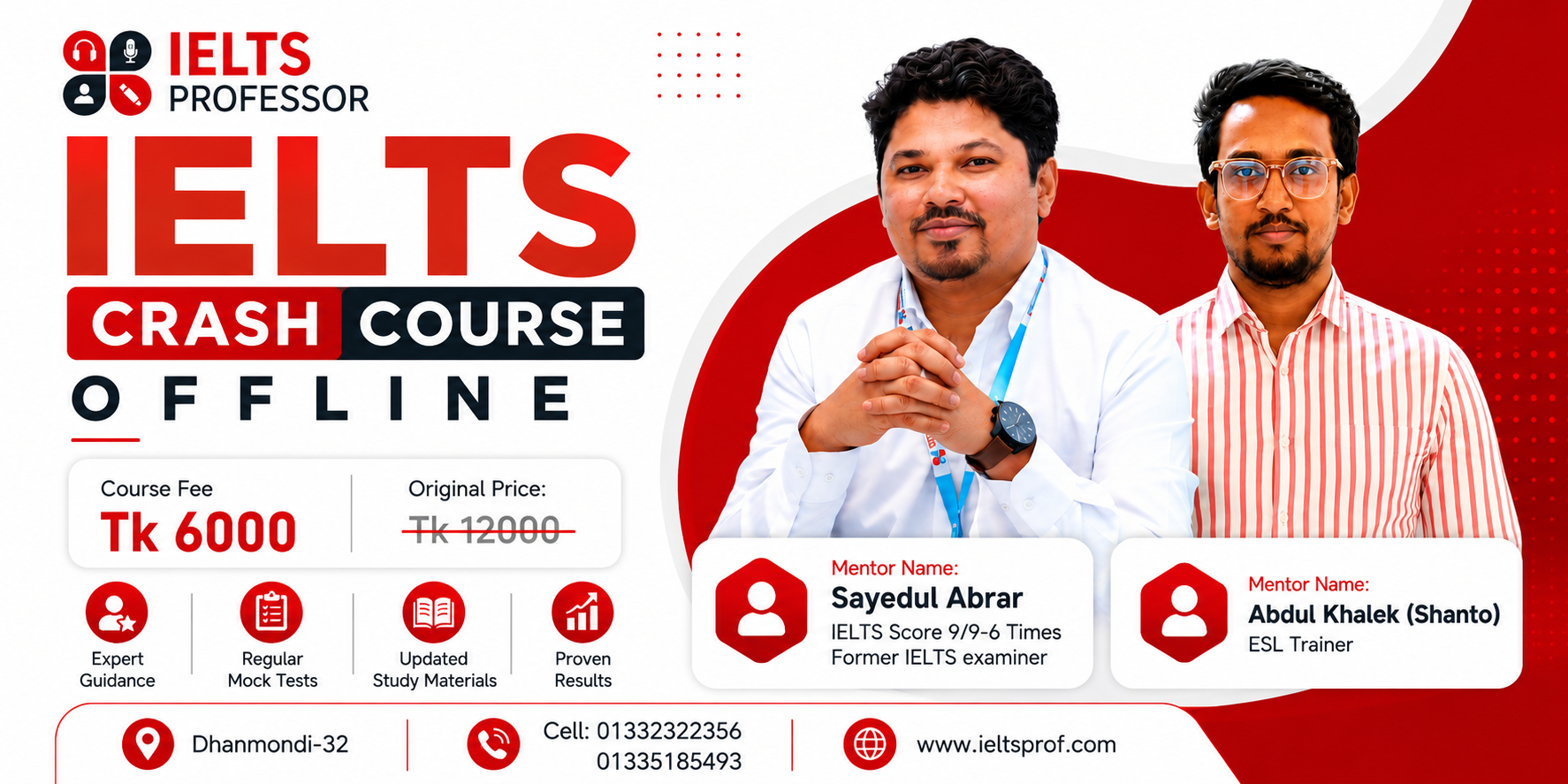
IELTS Crash Course
৳ 6000.00
All in One Vocabulary
৳ 200.00

Premium 7+ IELTS Offline
৳ 14000.00