Call us:


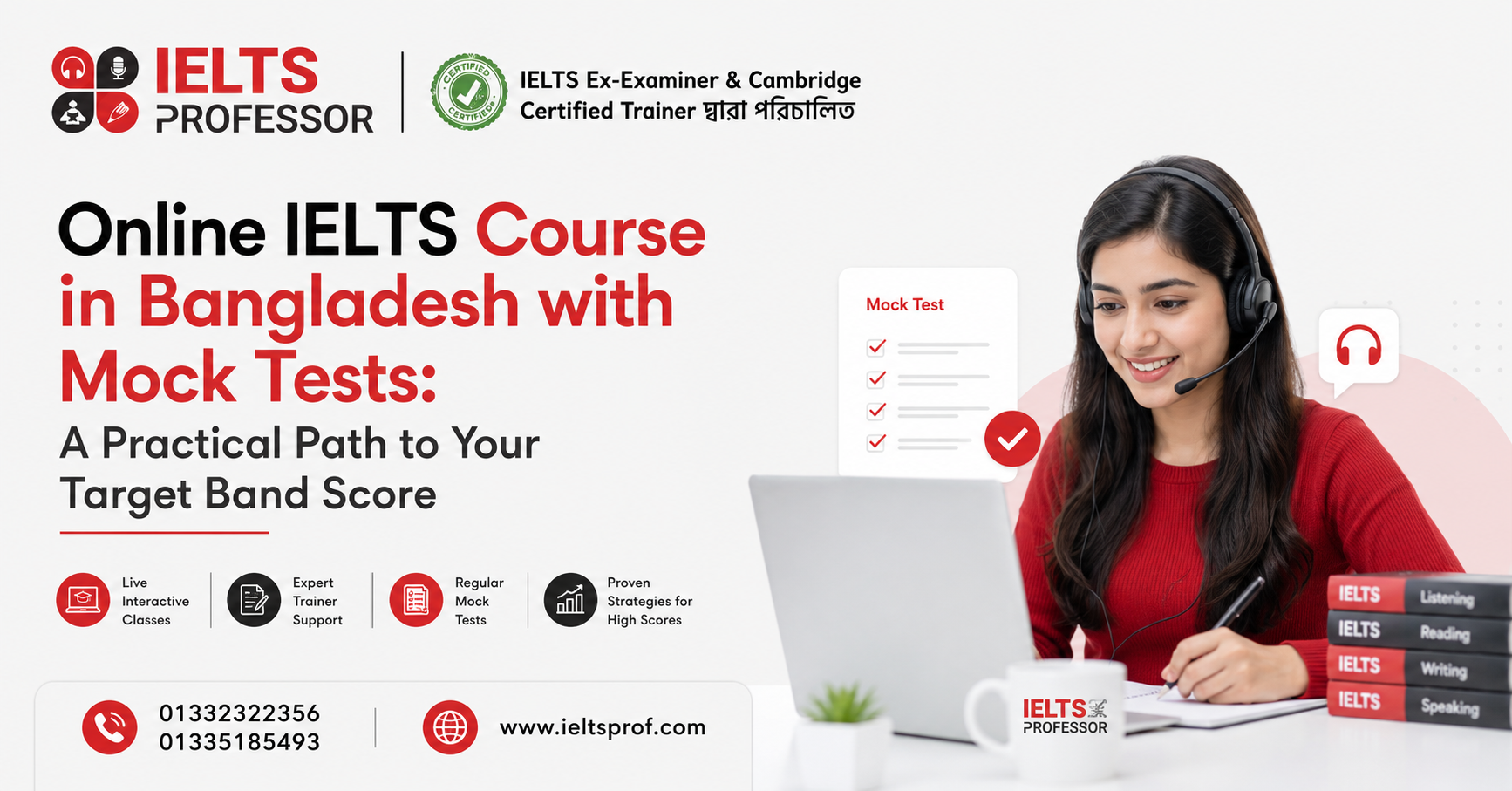
Choosing an Online IELTS course in Bangladesh with mock
tests is no longer only a convenient alternative to classroom learning. For
many Bangladeshi students, professionals, and migration applicants, it has
become the most practical way to prepare for an international English test. A
learner living in Dhaka may struggle with traffic and a busy class schedule. A
student in Rangpur, Barishal, Cumilla, or a rural district may not have access
to an experienced IELTS instructor. A working professional may return home too
late to attend a physical class. Online learning can reduce these barriers.
However, joining an online course does not automatically produce a high band score. Students need clear lessons, regular practice, expert feedback, realistic IELTS mock tests, and a study system that measures progress. IELTS assesses four skills: Listening, Reading, Writing, and Speaking. The Academic and General Training tests share the same Listening and Speaking components, while their Reading and Writing sections are different.
The need for flexible digital education is also growing.
DataReportal estimated that Bangladesh had 82.8 million internet users at the
end of 2025, with internet penetration reaching 47 percent. Yet many learners
still face unstable connections, limited devices, family pressure, financial
limits, and fear of speaking English. A humane online IELTS programme must
understand these realities and support learners step by step.
Why Online IELTS Preparation Is Growing in Bangladesh
IELTS is used for higher education, professional
registration, employment, and migration. More than four million people take the
test globally each year, according to the British Council. For Bangladeshi
applicants, a good result may support an application to a university in the
United Kingdom, Australia, Canada, New Zealand, Europe, or another destination.
The problem is that quality instruction is not equally
available across Bangladesh. Most established training centres are concentrated
in major cities. Even students living in Dhaka may spend two or three hours
travelling to and from a coaching centre.
An Online IELTS course in Bangladesh with mock tests can
solve several practical problems:
- Students
can attend lessons from home.
- Recorded
materials can be reviewed more than once.
- Learners
outside major cities can access trained instructors.
- Working
applicants can study in the evening.
- Parents
may save transportation and accommodation costs.
- Students
can practise computer-based test skills.
- Regular
online mock exams can show whether progress is real.
Online learning is especially useful for women whose
families may not feel comfortable with late travel, students with physical
limitations, and employees who cannot follow a fixed daytime routine. However,
these benefits appear only when the programme has structure. A collection of
videos without feedback is not a complete IELTS course.
What IELTS Candidates Actually Need to Learn
IELTS preparation should not be treated as memorising a few
templates. It is a language proficiency test that measures how well a person
can understand and communicate in English.
The IELTS Academic test includes four sections. Listening
takes about 30 minutes, Reading takes 60 minutes, Writing takes 60 minutes, and
Speaking usually takes between 11 and 14 minutes.
A serious course must therefore develop several abilities at
the same time.
Listening Skills
Students must follow conversations and monologues delivered
in different accents. They need to identify names, numbers, locations,
opinions, changes of direction, and specific details.
Bangladeshi students often understand written English better
than spoken English because school education commonly focuses on grammar and
written examinations. Regular listening practice can gradually reduce this gap.
Reading Skills
IELTS Reading requires more than reading every sentence
slowly. Candidates must locate information, identify main ideas, recognise
paraphrases, follow arguments, and manage time.
Many learners lose marks because they search for the exact
words used in a question. In the passage, the same meaning may be expressed
through different words. A well-designed online IELTS preparation programme
should train students to recognise this relationship.
Writing Skills
Writing is often the most difficult area for Bangladeshi
candidates. Students may have ideas but struggle to organise them clearly.
Others memorise complicated sentences that sound unnatural and contain
grammatical errors.
Writing improvement requires:
- Clear
paragraph organisation
- Relevant
ideas
- Accurate
grammar
- Suitable
vocabulary
- Proper
sentence connection
- Direct
response to the task
- Detailed
correction from a qualified instructor
Automatic scores can be useful for practice, but they should
not fully replace human feedback. A teacher can explain why an argument is
weak, why a paragraph lacks focus, or why a memorised phrase does not fit the
topic.
Speaking Skills
Many students know English grammar but become nervous when
speaking. They worry about pronunciation, making mistakes, or being judged by
others.
A supportive teacher should not embarrass a learner. The
teacher should create frequent speaking opportunities, correct errors
carefully, and help the student speak naturally. Fluency does not mean speaking
extremely fast. It means expressing ideas with reasonable ease, clarity, and
continuity.
Why IELTS Mock Tests Are Central to Improvement
Mock tests are not merely extra course features. They are diagnostic tools. They show what happens when knowledge, timing, concentration, and pressure come together.A student may answer Reading questions correctly during relaxed practice but fail to complete all three passages within 60 minutes. Another learner may write a strong essay in 50 minutes but struggle when only 40 minutes are available. A candidate may speak comfortably with friends but become silent during a formal interview.
Regular IELTS mock tests reveal these differences.
A useful mock test should reproduce actual test conditions
as closely as possible. It should have clear timing, realistic question types,
suitable difficulty, and a meaningful evaluation process. After the test,
learners need more than a score. They need to understand:
- Which
question types caused the most errors
- Whether
time was used effectively
- Which
grammar problems appeared repeatedly
- Whether
vocabulary was accurate or forced
- Whether
the writing response answered the full task
- Whether
speaking answers were developed naturally
- What
to practise before the next mock test
Official IELTS materials confirm that Listening contains
four parts with ten questions in each part. Therefore, a mock test that
contains only a few random questions cannot fully reproduce the demands of the
actual section.
A Story from Outside Dhaka
Consider the hypothetical experience of Rafi, an engineering
graduate from Bogura. He wanted to apply for a master’s programme abroad, but
the nearest suitable physical coaching option required long travel. His family
was already concerned about application fees, test fees, and university
expenses.
Rafi first prepared through free videos. He watched many
lessons but followed no fixed sequence. Some days he studied for four hours,
while on other days he did nothing. After two months, he attempted a mock test
and received approximately Band 5.5.
He then joined a structured online IELTS course. His
diagnostic assessment showed that he understood grammar but had serious
problems with Reading timing and Writing Task 2 organisation. His instructor
created a weekly plan. Rafi completed two Reading passages on weekdays,
submitted one essay every week, attended speaking sessions, and took regular
full mock tests.
His first two mock results did not improve much. This
disappointed him. However, the feedback showed that he was now making fewer
careless mistakes. By the sixth mock test, his performance became more stable.
He eventually reached the level needed for his application.
The important lesson is not that every learner will achieve
the same score. The lesson is that organised preparation gives students
evidence of progress. Rafi stopped guessing and began working on visible
weaknesses.
How Online Mock Tests Build Test-Day Confidence
An Online IELTS course in Bangladesh with mock tests helps
students become familiar with pressure before the real examination. This is
especially important for candidates planning to take IELTS on computer.
The British Council currently offers IELTS on computer in
several Bangladeshi cities, including Dhaka, Chattogram, Khulna, Rajshahi,
Jashore, Feni, Rangpur, Cumilla, and Sylhet. Students should still check
current availability while booking because locations and dates can change.
Online practice can develop:
Keyboard Confidence
Some students type slowly or make frequent spelling
mistakes. Regular computer-based Writing practice helps them become more
comfortable with editing, paragraphing, and monitoring word count.
Screen Reading Ability
Reading long passages on a screen feels different from
reading on paper. Students need practice scrolling, locating information, and
maintaining focus.
Time Awareness
A visible timer can create pressure. Mock exams teach
students how to continue calmly instead of repeatedly checking the clock.
Mental Endurance
The real test requires sustained concentration. Full-length
practice builds the ability to remain alert across several sections.
Emotional Control
A learner may know the correct strategy but forget it when
anxious. Repeated simulations make the test environment feel less unfamiliar.
Common Challenges Faced by Bangladeshi Students
Financial Pressure
IELTS preparation is only one part of a larger study-abroad
budget. Students may also need to pay application fees, document processing
costs, translations, medical expenses, and visa charges.
A student should not select a course only because it has the
lowest price. A very cheap programme may become expensive if it provides no
feedback and leads to repeated test attempts. Learners should compare the
number of live classes, mock tests, writing corrections, speaking sessions,
materials, and support services.
Weak English Foundations
Some candidates join an IELTS course before they can write a
clear paragraph or understand an everyday English conversation. Test tricks
cannot repair every basic weakness.
Such learners may need a foundation stage covering sentence
structure, common vocabulary, pronunciation, reading habits, and basic writing.
A responsible institute should identify this need instead of making unrealistic
promises.
Fear of Speaking
Many Bangladeshi learners rarely use English outside class.
They may fear that friends will laugh at their accent or mistakes.
The practical solution is frequent low-pressure speaking.
Students can record one-minute answers, practise with a partner, describe daily
activities, and attend guided speaking sessions.
Unstable Internet and Electricity
Online learners may experience weak mobile data, power cuts,
or shared devices. They should download materials in advance, keep audio files
available offline, and choose a quiet backup location for important mock tests.
Family and Social Responsibilities
A student may study while caring for parents, helping in a
family business, attending university, or working full-time. Instead of copying
another person’s routine, the learner should create a realistic weekly plan.
Ninety focused minutes each day can be more effective than
an exhausting seven-hour session once a week.
- How to Select a Reliable Online IELTS Course
- Before paying, students should ask direct questions.
Does the Course Begin with an Assessment?
A diagnostic test helps the instructor understand the
student’s current level. Without this step, all learners may receive the same
advice even though their problems are different.
Are Classes Live, Recorded, or Both?
Live lessons allow interaction. Recorded lessons support
revision. A useful course may combine both.
Who Checks Writing?
Students should know whether essays receive individual human
correction. General model answers alone cannot show a learner’s personal
errors.
How Is Speaking Practised?
Speaking requires actual conversation. Look for individual
interviews, pair activities, group discussions, and recorded feedback.
Are Mock Tests Full-Length and Regular?
A course should explain how often tests are held, how they
are evaluated, and whether students receive section-wise feedback.
Is Progress Recorded?
A learning management system can help teachers and students
track attendance, submissions, mock scores, and feedback.
Are Claims Realistic?
No ethical institute can guarantee the same score for every
learner. Results depend on the learner’s starting level, effort, attendance,
feedback use, preparation time, and test-day performance.
About IELTS Professor
IELTS Professor presents itself as an English language
institute in Bangladesh co-founded by a University of Cambridge-qualified
professional and a British Council teacher trainer. According to information
supplied by the institute, it began its journey near the end of 2022 to help
learners achieve their desired IELTS band scores.
Its stated mission is to help people communicate fluently
and confidently in English through high-quality teaching, personal attention,
innovative methods, and a supportive environment. Its vision is to build an
inclusive learning community where language does not prevent people from
accessing education, employment, or international opportunities.
The institute reports that it has taught thousands of
learners. It further states that many test-taking students achieve average
results around Band 6.5 or 7, while approximately one-quarter reach Band 7.5 or
8. These are promotional performance claims provided by IELTS Professor and
should be reviewed alongside current student records, verified testimonials,
course terms, and individual learner circumstances.
Online IELTS Course in Bangladesh with Mock Tests at IELTSProfessor
The teaching model described by IELTS Professor focuses on
guided practice rather than shortcuts. The institute states that its programmes
include a large number of classes. The supplied course information mentions 101
classes in one mode and 85 in another, although prospective learners should
confirm whether these figures refer to current online and offline packages.
Its instructors are described as experienced teachers who
either hold a CELTA qualification or are pursuing one. The institute also
states that its teachers have IELTS scores of at least 7.5 and substantial
teaching experience. Students should ask to see current instructor profiles
when selecting a batch.
The programme reportedly includes:
- A
curriculum based on IELTS skills and question types
- Cambridge
materials and past-question patterns
- Interactive
Listening, Reading, Writing, and Speaking activities
- Regular
practice outside class
- Full
and sectional IELTS mock tests
- Small
groups of approximately 12 to 25 learners
- Continuous
feedback through a learning management system
- Study
groups, workshops, and one-to-one support
- Digital
resources and independent practice tools
- Progress
reviews and final test simulations
These elements can make an Online IELTS course in Bangladesh
with mock tests more effective because they connect instruction, practice,
evaluation, and correction.
How IELTS Professor Describes Its Band 7 Plus Preparation Process
IELTS Professor describes a multi-stage preparation system.
- First, students take a diagnostic test and may attend an
individual interview. This helps identify goals, current ability, and major
difficulties.
- Second, the curriculum is divided into Listening, Reading,
Writing, and Speaking modules. Each lesson targets a particular skill,
strategy, or question type.
- Third, students complete integrated activities such as
discussions, role-plays, essays, reading tasks, and listening exercises. This
encourages practical language use instead of isolated memorisation.
- Fourth, learners study test-taking strategies. These include
time management, question analysis, answer planning, and error checking.
- Fifth, students complete regular IELTS mock tests and
receive feedback. Weaknesses can then be included in the next study plan.
- Sixth, learners may receive personal support through
tutorials, study groups, workshops, and digital resources.
- Finally, full simulations and last-stage reviews help
students prepare for the pressure of the actual test.
The phrase “Band 7 assurance” should be understood as a
structured effort toward a target, not an automatic score guarantee. Even the
strongest course requires attendance, practice, revision, and personal
responsibility.
Another Learner’s Story: From Silence to Speaking Confidence
Imagine Nusrat, an undergraduate student from Cumilla. She
could read English articles and achieve good grammar marks, but she avoided
speaking. During her first mock interview, most of her answers contained only
one or two sentences.
Her teacher did not immediately force her to answer
difficult abstract questions. She began with familiar topics: her hometown,
university, family routine, favourite teacher, and future plans. She recorded
one answer each evening and listened to it the next morning.
At first, Nusrat disliked hearing her own voice. After
several weeks, she noticed repeated pauses and unclear endings. Her instructor
helped her expand answers using a simple pattern: direct answer, reason,
example, and brief conclusion.
By the time she completed several mock speaking tests, she
was not using memorised speeches. She had learned how to develop an idea
calmly. Her confidence came from repetition and feedback, not from pretending
that she was never nervous.
A Practical Eight-Week Study Framework
An Online IELTS course in Bangladesh with mock tests can
follow a plan similar to this:
Weeks One and Two
Complete a diagnostic test. Learn the format of all four
sections. Review grammar, sentence construction, spelling, and essential
vocabulary.
Weeks Three and Four
Study question types in detail. Begin timed Reading and
Listening practice. Write one Task 1 and one Task 2 response each week. Attend
regular speaking sessions.
Weeks Five and Six
Increase timed practice. Complete sectional mock tests.
Analyse errors by category rather than only recording scores.
Week Seven
Take one or two full IELTS mock tests. Review timing,
concentration, and weak question types. Continue targeted correction.
Week Eight
Complete final simulations. Reduce unnecessary new learning.
Review common mistakes, test-day procedures, identification requirements, and
personal strategy.
This plan may need to be extended for students with weaker
foundations. A learner should not book a test simply because a course is
ending.
Measuring Progress Properly
A score can rise or fall slightly between mock tests.
Therefore, one result should not control a student’s emotions.
Track several indicators:
- Accuracy
by question type
- Time
used per passage or task
- Number
of unanswered questions
- Repeated
grammar errors
- Writing
organisation
- Speaking
hesitation
- Vocabulary
accuracy
- Performance
across three or more tests
When these indicators improve together, the student is more
likely to be developing stable ability.
IELTS partners generally recommend treating results as
evidence of English ability for two years, although individual organisations
may set their own acceptance policies. Students should therefore plan their
test date in relation to admission and visa timelines.
Summary
A well-structured Online IELTS course in Bangladesh with
mock tests can make quality preparation available to learners across the
country. The strongest programmes combine assessment, live instruction,
realistic practice, individual feedback, progress monitoring, and emotional
support. Students should avoid shortcuts and select a course based on teaching
quality rather than advertisements alone. IELTS Professor presents a detailed
preparation model built around trained instructors, extensive classes, small groups,
mock testing, and continuous evaluation. The final result, however, still
depends on disciplined practice and thoughtful use of feedback.
Frequently Asked Questions
1. Is an online IELTS course as effective as a physical course?
- An online IELTS course can be equally effective when it
includes live instruction, feedback, interaction, and regular assessment.
- The learner must attend classes consistently instead of
treating recorded lessons as optional videos.
- Writing should be checked by an instructor who explains
individual mistakes.
- Speaking sessions must involve real conversation rather than
only watching demonstrations.
- Mock tests should reproduce timing and pressure as closely
as possible.
- The student also needs a quiet study space, a stable
routine, and reliable access to course materials.
2. Why should I choose a course that includes IELTS mock tests?
- IELTS mock tests show how you perform under time limits and
examination pressure.
- Daily exercises may feel easy because you can pause, check
answers, or take extra time.
- A full mock exam reveals whether you can maintain
concentration across the whole test.
- It also identifies weak question types and repeated errors.
- Detailed feedback helps you decide what to study next.
- Without mock testing, many learners book the real exam
before their performance becomes stable.
3. How many mock tests should I take before the real IELTS test?
- There is no single number that is correct for every student.
- A beginner may need several sectional tests before
attempting full simulations.
- A more advanced candidate may focus on four to eight
carefully reviewed full mock tests.
- The quality of analysis is more important than completing a
large number quickly.
- After each test, identify errors, practise the weak areas,
and test again.
- Book the real examination when your scores remain near the
target across multiple tests.
4. Can I prepare for IELTS only by watching free online videos?
- Free videos can explain question types, grammar rules, and
useful strategies.
- However, they usually do not create a personal study plan
for your weaknesses.
- They cannot always check whether your essay directly answers
the task.
- They also provide limited opportunities for a realistic
speaking interview.
- Many students watch hundreds of lessons but complete very
little timed practice.
- Free resources work best when combined with discipline,
feedback, and regular mock assessments.
5. How long does IELTS preparation normally take?
- Preparation time depends on your present English level and
target score.
- A student near Band 6 may progress faster than someone with
major foundation problems.
- Daily study time, attendance, feedback, and reading habits
also affect the timeline.
- Some learners may prepare in eight to twelve weeks, while
others need several months.
- A diagnostic assessment offers a more realistic estimate
than a general advertisement.
- Do not select a test date until your mock performance
supports the score you need.
6. Can a weak English student achieve Band 7 through an online course?
- A weak learner can improve greatly, but Band 7 may require a
longer foundation period.
- Test strategies alone cannot replace grammar, vocabulary,
comprehension, and communication skills.
- The student should first learn to write clear sentences and
understand everyday spoken English.
- Regular reading and listening outside class are also
necessary.
- Personal feedback helps the learner correct repeated errors
before they become habits.
- Progress is possible, but responsible teachers should not
promise an automatic score.
7. How can I practise IELTS Speaking from home?
- Attend live speaking sessions and practise with a reliable
partner several times each week.
- Record short answers and listen for pauses, repetition,
unclear words, and incomplete ideas.
- Use familiar topics before moving to abstract questions.
- Develop answers with a reason and a relevant example instead
of memorising long scripts.
- Ask an instructor to conduct timed mock interviews.
- Daily ten-minute speaking practice is usually more useful
than one long session every two weeks.
8. What should I do if my internet connection is unstable?
- Download lesson notes, recordings, and practice files
whenever a strong connection is available.
- Keep mobile data as a backup for live classes and important
mock tests.
- Inform the instructor immediately when a technical problem
affects attendance or submission.
- Use audio-only access when video is unnecessary and
bandwidth is limited.
- Choose a library, office, relative’s home, or study centre
for full simulations.
- Do not attempt an important online mock test when your
connection is already failing repeatedly.
9. Should I take IELTS Academic or General Training?
- IELTS Academic is commonly used for higher education and
some professional purposes.
- General Training is often used for migration, employment, or
study below degree level.
- The correct choice depends on the requirement of the
receiving organisation.
- Listening and Speaking are the same in both versions, but
Reading and Writing differ.
- Check the university, employer, professional body, or
immigration authority before registering.
- Do not choose a test only because another person said that
one version was easier.
10. Is computer-based IELTS suitable for Bangladeshi students?
- It can suit students who type comfortably and prefer reading
from a screen.
- Computer practice may make editing Writing answers easier
for some candidates.
- However, slow typing and poor spelling can create additional
pressure.
- Students should practise full Reading and Writing sections
on a computer before deciding.
- The Speaking test still assesses spoken interaction, so
digital skill cannot replace language ability.
- Test format availability and current result timelines should
be checked with the official provider.
11. How can I improve IELTS Writing through an online course?
- Submit complete writing tasks regularly instead of only
reading model answers.
- Ask the teacher to explain task response, organisation,
vocabulary, grammar, and sentence clarity.
- Keep an error notebook containing your repeated mistakes and
corrected examples.
- Rewrite weak paragraphs after receiving feedback.
- Practise planning before writing so that your ideas remain
relevant and logically connected.
- Complete timed tasks only after learning how to produce a
clear answer without excessive pressure.
12. Are unlimited mock tests always useful?
- Unlimited access is valuable only when the tests are
realistic and properly reviewed.
- Repeating tests without studying mistakes may produce little
improvement.
- Students may even remember answers and receive a
misleadingly high score.
- A useful system should provide fresh tasks, accurate timing,
and clear evaluation.
- Writing and Speaking mocks require thoughtful feedback from
qualified people.
- Ask how the institute prepares, supervises, scores, and
reviews its mock examinations.
13. How should a working professional manage IELTS preparation?
- Create a routine based on available energy rather than an
unrealistic daily target.
- Use short morning sessions for vocabulary, reading, or
listening.
- Reserve two or three evenings for writing and speaking
practice.
- Complete full mock tests on weekly holidays when
interruptions are limited.
- Recorded lessons can help when live attendance is
occasionally impossible.
- Consistency over several weeks is more effective than
studying intensely only before the test.
14. What should financially constrained students consider before enrolling?
- Compare total learning value instead of looking only at the
advertised fee.
- Check how many live classes, writing corrections, speaking
sessions, and mock tests are included.
- Ask whether books, digital resources, or support sessions
require extra payment.
- A course with useful feedback may reduce the risk of paying
for repeated IELTS attempts.
- Students should also use official sample questions and free
resources alongside guided instruction.
- Choose a programme that fits the family budget without
depending on unrealistic score guarantees.
15. Why might students consider IELTS Professor for online preparation?
- IELTS Professor describes a structured system that begins
with diagnostic assessment and goal analysis.
- Its stated model includes trained instructors, extensive
classes, small groups, and tailored learning plans.
- It also reports offering regular mock tests, feedback,
digital resources, workshops, and personal support.
- The programme aims to develop all four skills while teaching
timing and question-handling strategies.
- Prospective students should verify the current schedule,
teacher profile, package details, and assessment policy.
- The best outcome will depend on both the quality of
instruction and the learner’s consistent effort.
Find Your Courses
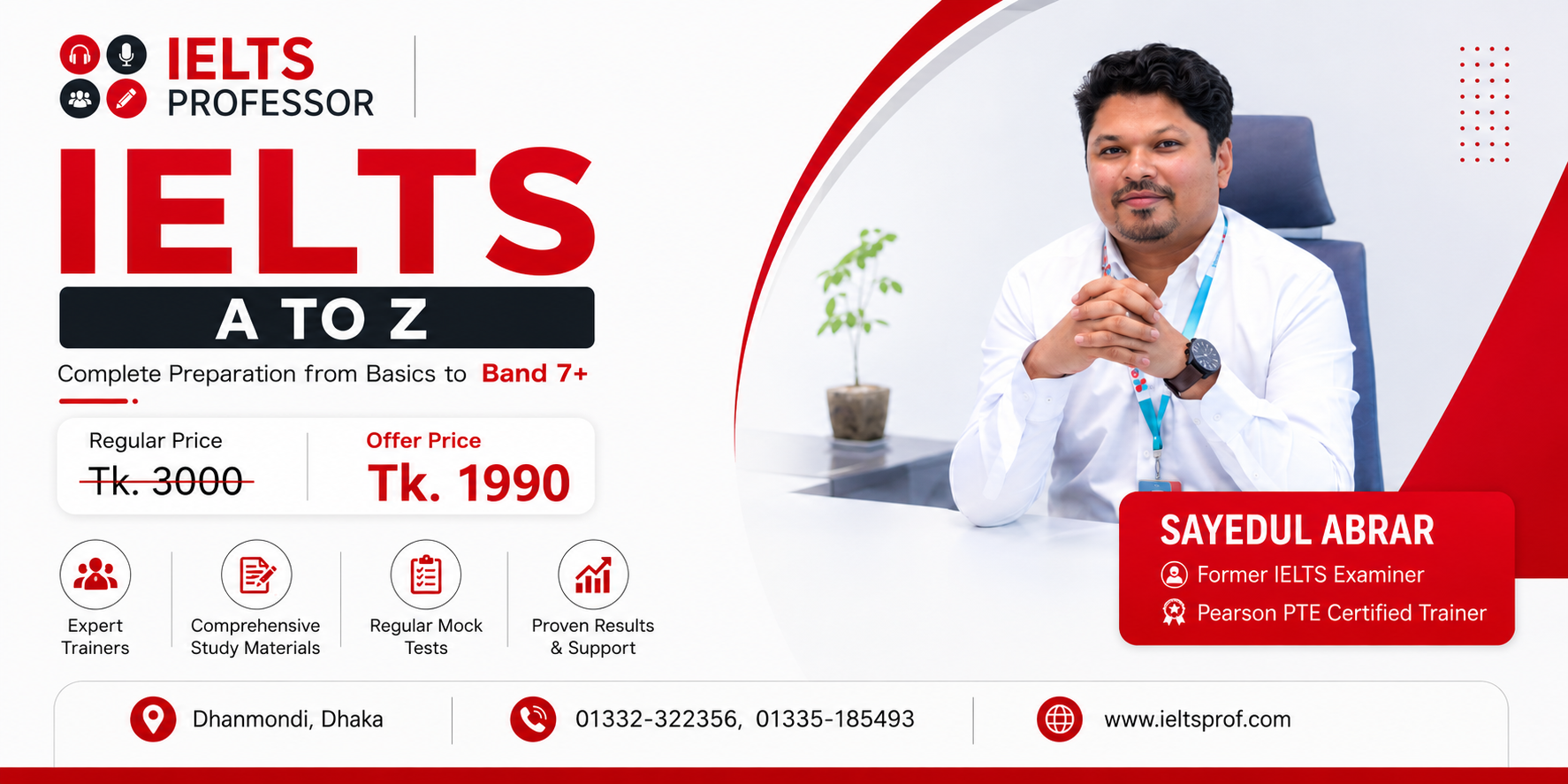
IELTS A to Z
৳ 1990.00
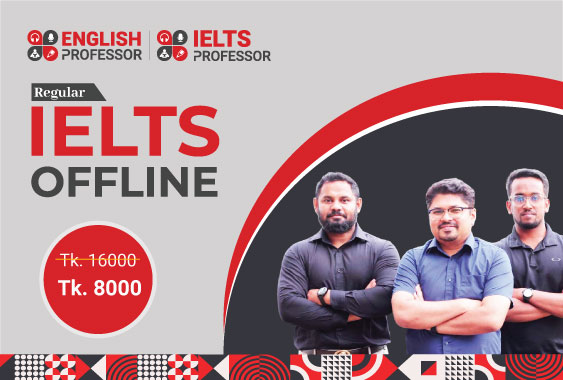
7+ IELTS Offline Regular
৳ 8000.00
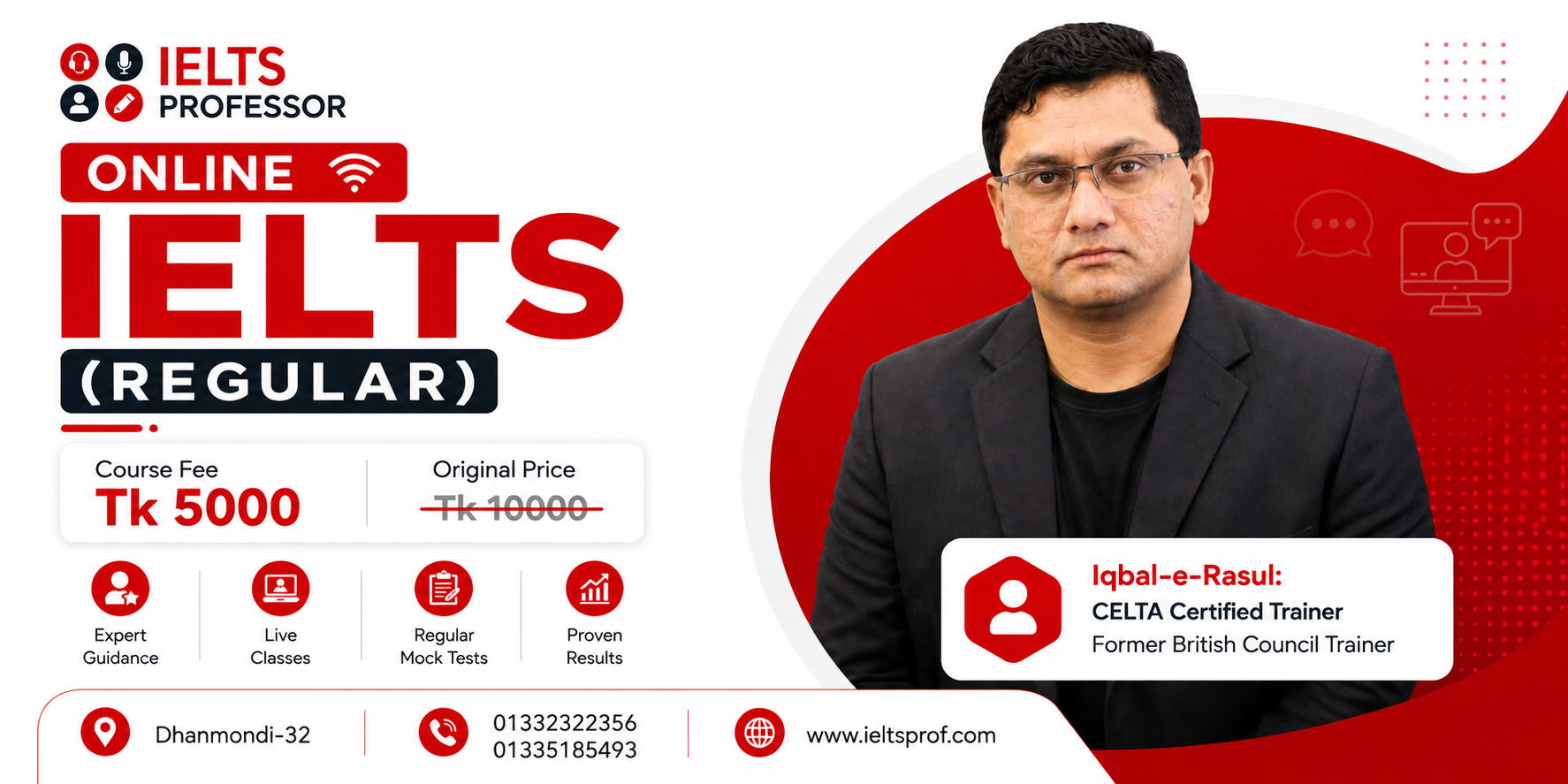
Online IELTS (Regular)
৳ 5000.00
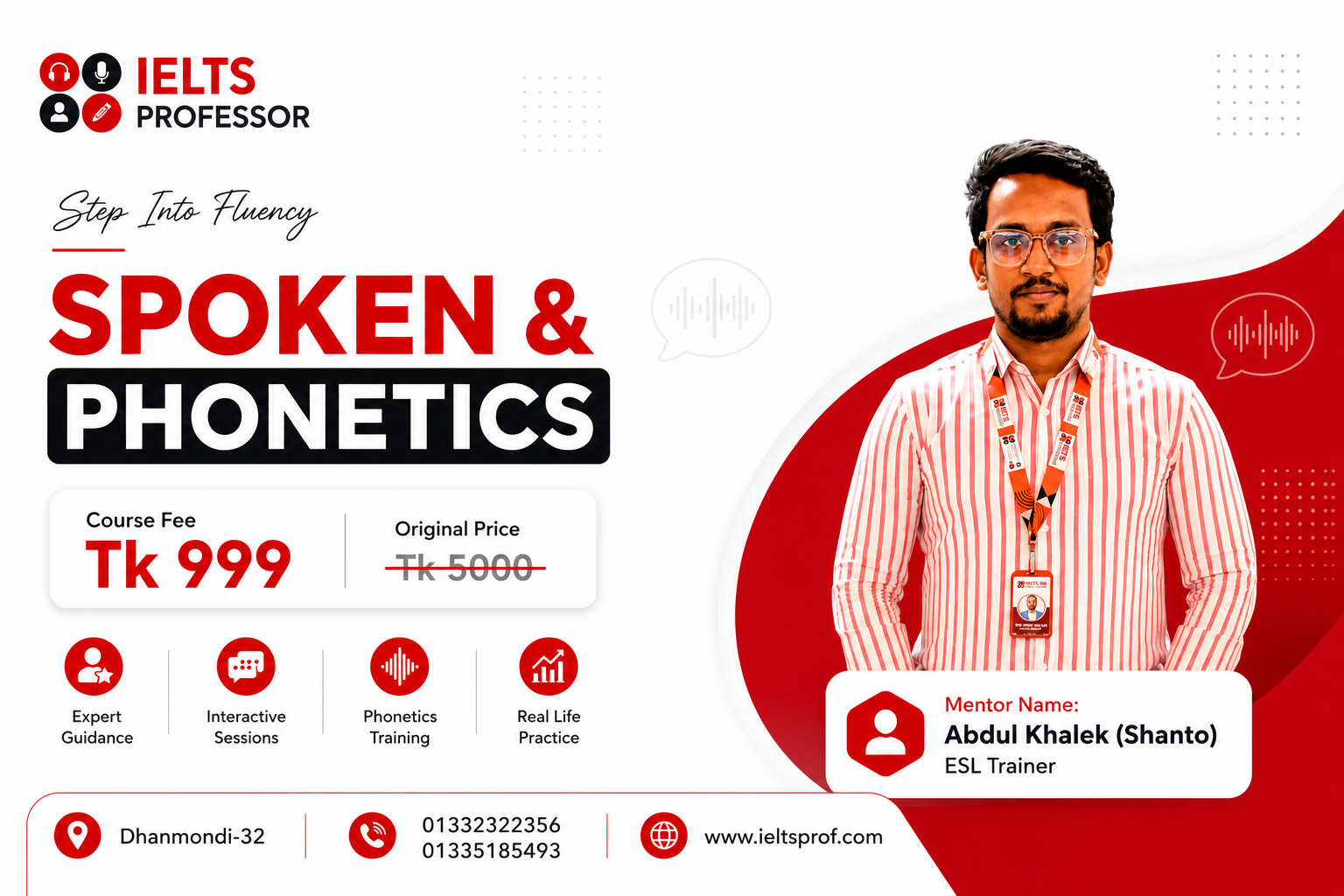
Spoken English
৳ 3500.00
IELTS Regular Executive
৳ 8000.00
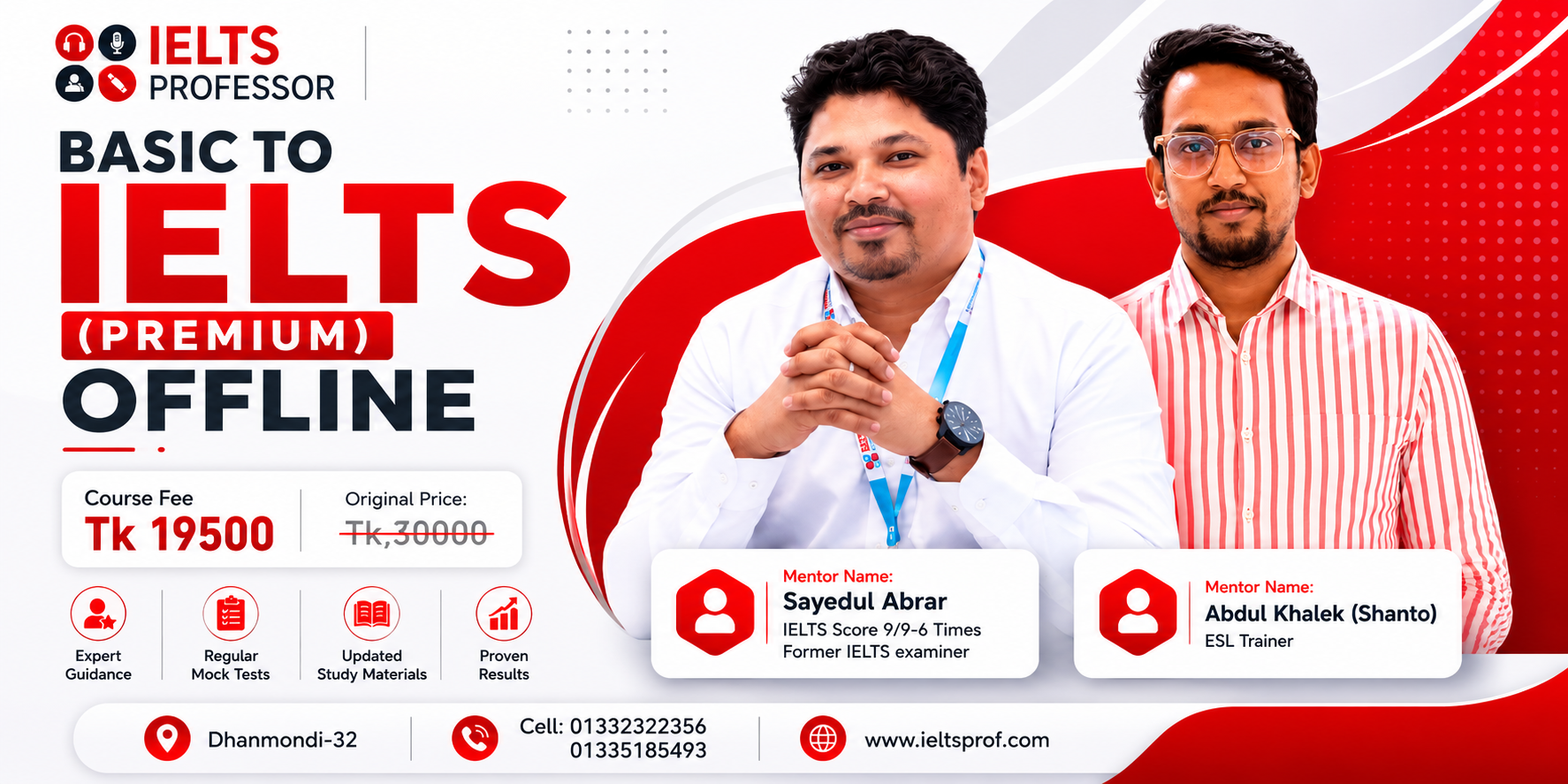
Basic to IELTS
৳ 19500.00
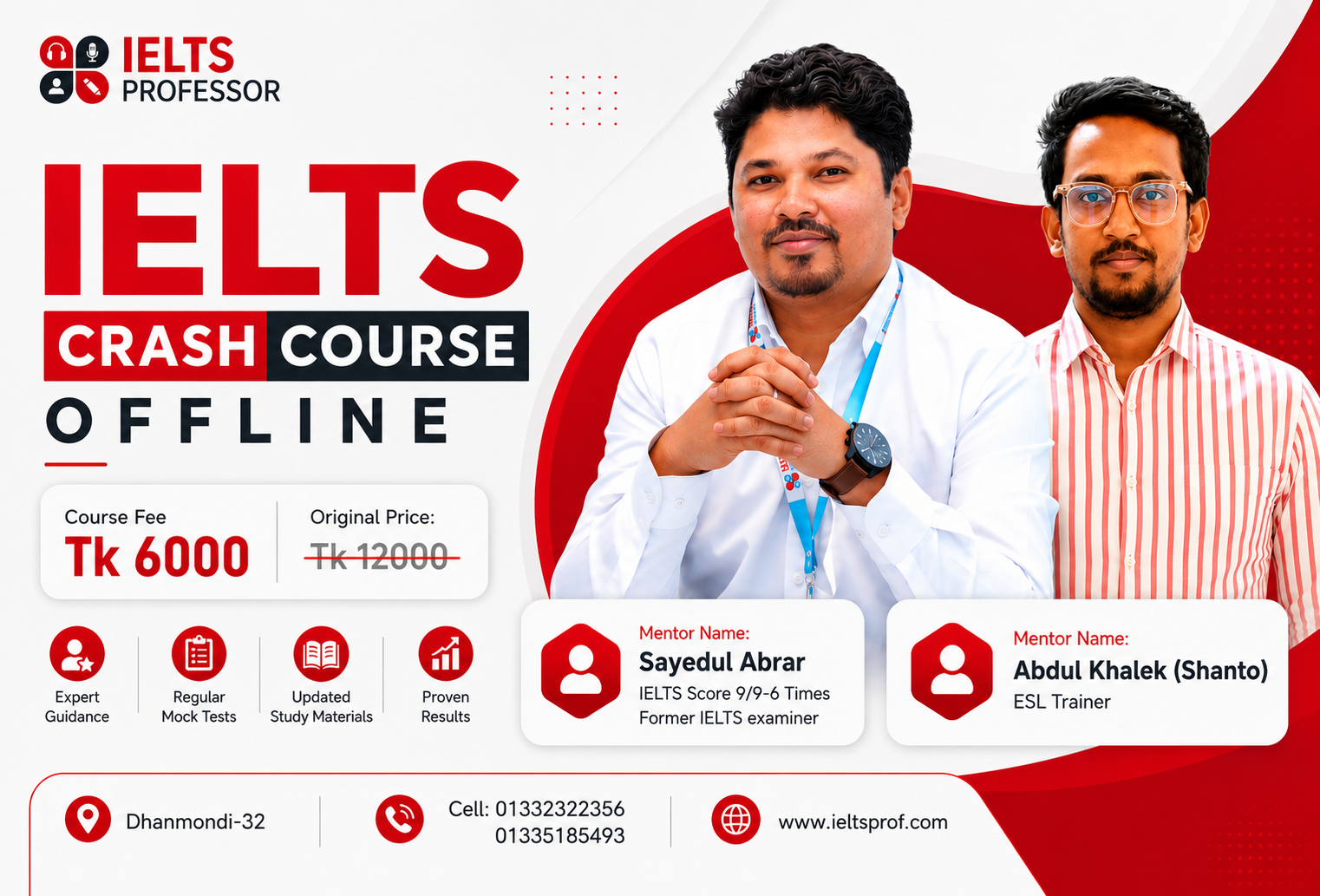
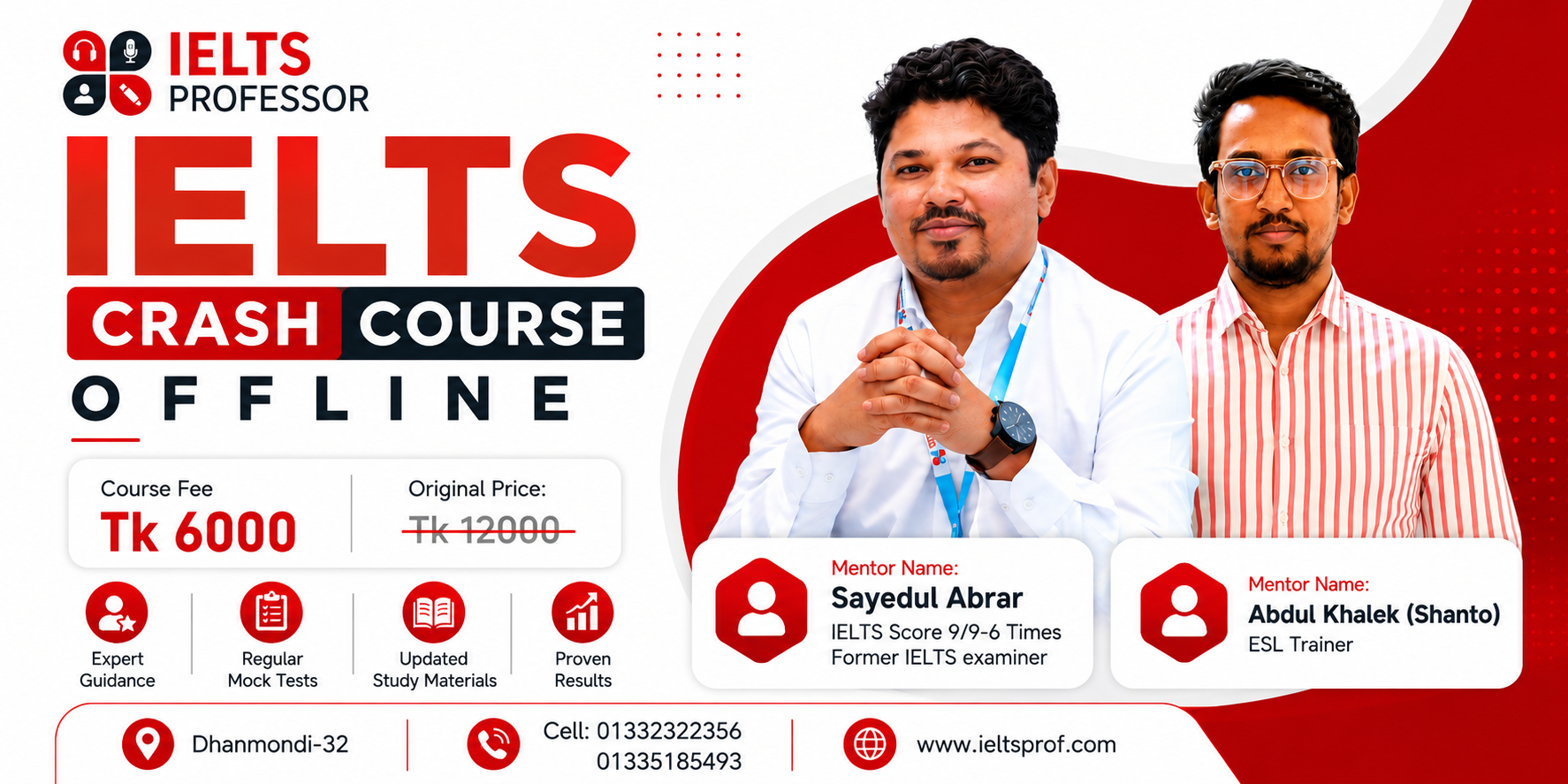
IELTS Crash Course
৳ 6000.00
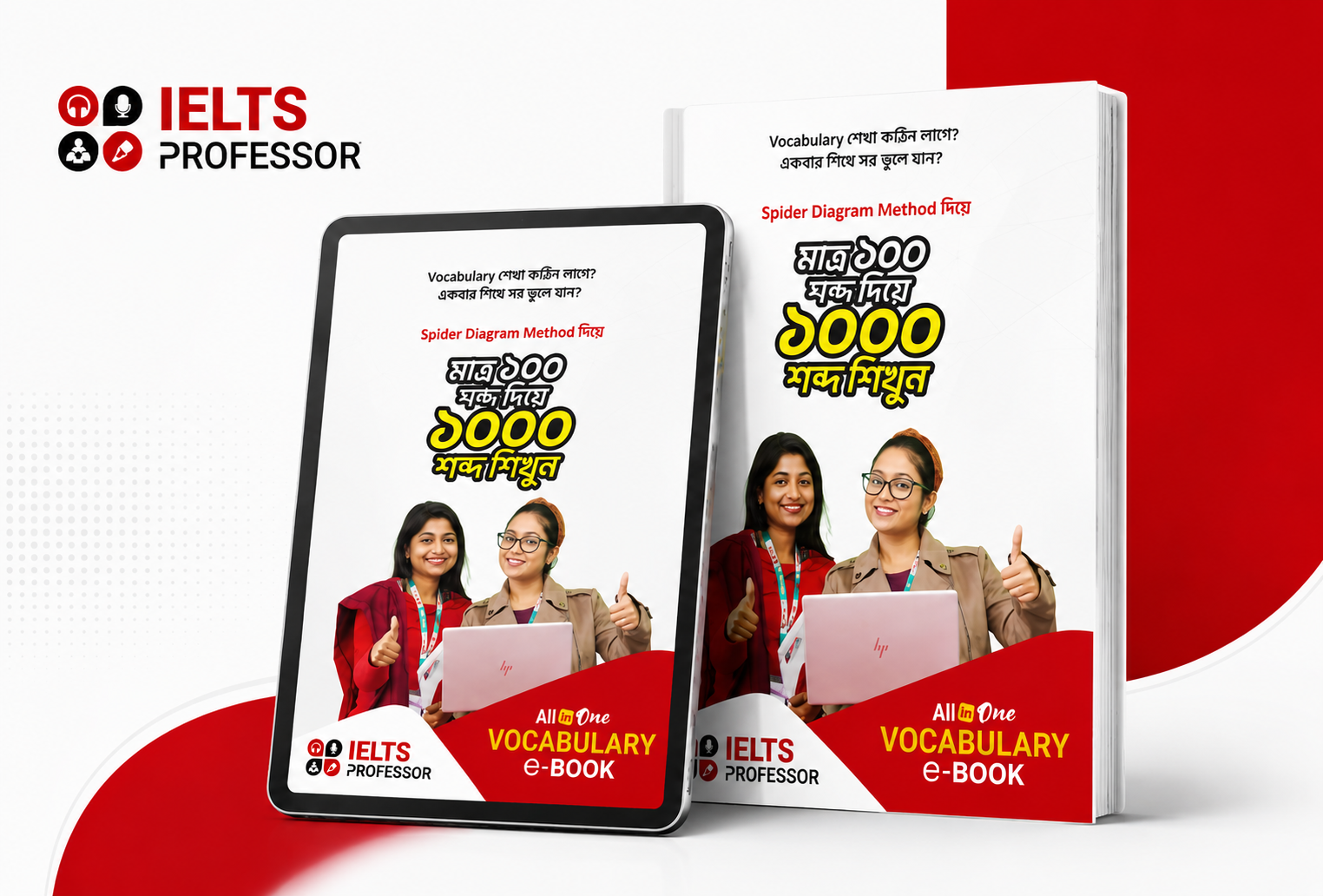
All in One Vocabulary
৳ 249.00
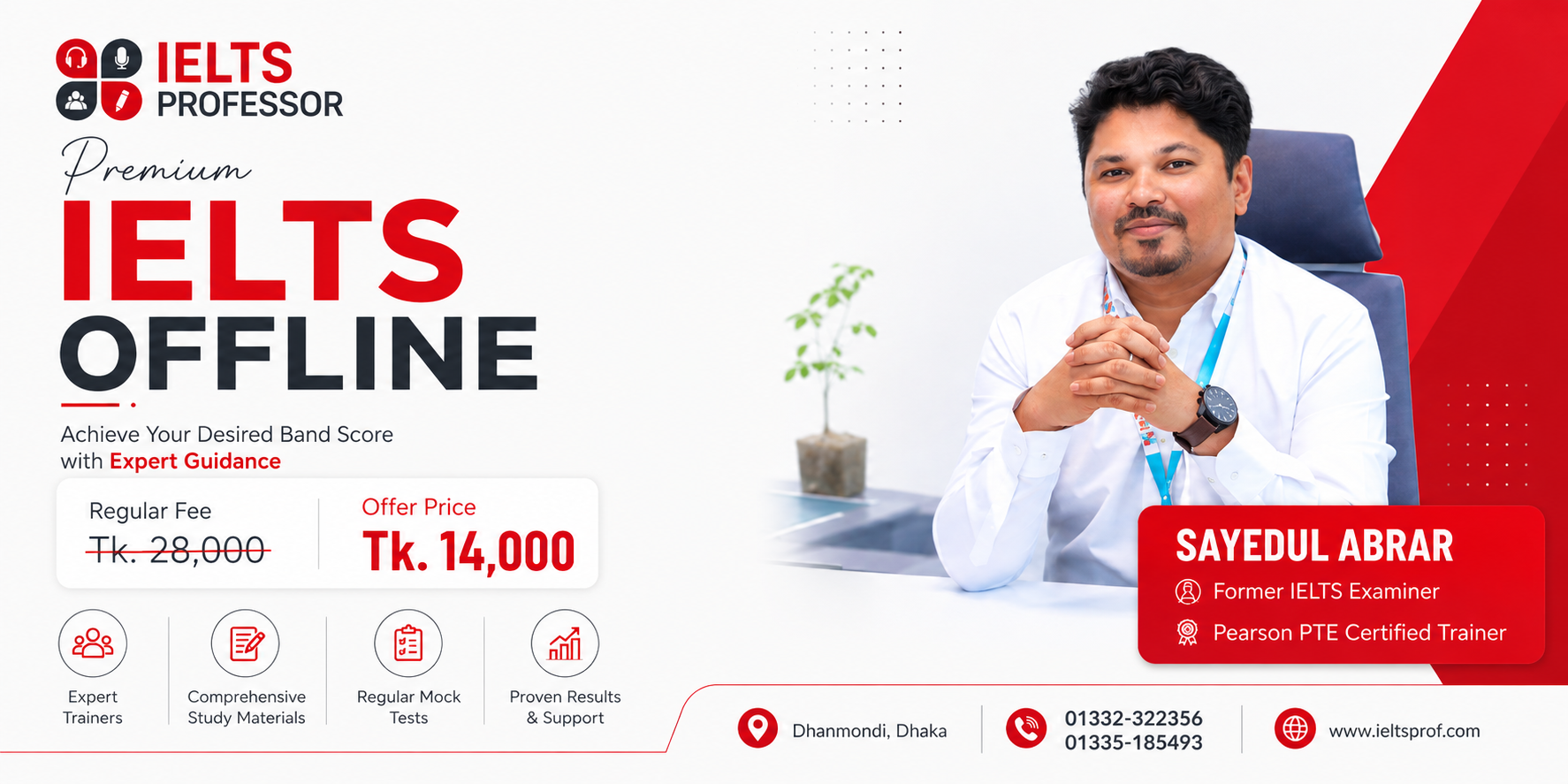
Premium 7+ IELTS Offline
৳ 14000.00