Call us:



Choosing the right English language test is a major decision
for a Bangladeshi student who wants to study, work, or settle abroad. IELTS was
once the most familiar choice in Bangladesh. However, the Pearson Test of
English has become increasingly popular because it is fully computer-based,
offers flexible test dates, and usually provides results quickly. This growing
interest has also increased the demand for a reliable PTE course Bangladesh
students can follow with confidence.
The purpose of this article is not only to describe a
course. It is to explain the complete preparation journey of a Bangladeshi
learner. A student may know English grammar but struggle to speak into a
microphone. Another student may speak well but lose marks because of poor
typing speed, weak time management, or a lack of familiarity with the test
software. Therefore, preparation must connect language ability, computer
skills, examination strategy, and emotional confidence.
A well-designed PTE Course Bangladesh: A Complete Guide to
Preparation, Scores, Costs, and Success should address these connected needs.
It should not depend only on memorised templates or shortcuts. It should help
students understand the test, improve real English, practise under timed
conditions, and correct individual weaknesses.
This article discusses the PTE format, scoring system,
preparation methods, common challenges, course selection, and the role of
qualified instruction. It also introduces the PTE course conducted by IELTSProfessor under the academic leadership of Sayedul Abrar, a Pearson-certified
trainer with extensive language-teaching experience. The central argument is
simple: a student’s success becomes more realistic when clear guidance, regular
practice, honest feedback, and personal responsibility work together.
What Is the Pearson Test of English?
The Pearson Test of English is a computer-based English
proficiency examination. Different forms of PTE are available for different
purposes.
PTE Academic is mainly used by students applying to
universities, colleges, and other higher education institutions. PTE Academic
UKVI is used when a Secure English Language Test is required for a relevant
United Kingdom visa route. PTE Core is mainly connected with Canadian
immigration and citizenship pathways rather than regular university admission.
PTE Academic measures four main language skills:
- Speaking
- Writing
- Reading
- Listening
The examination is completed on a computer at an authorised
test centre. Test takers use a headset and microphone for speaking tasks. They
type their written answers and respond to listening and reading questions on
the computer.
Pearson reports PTE Academic scores on a scale from 10 to
90. Candidates receive an overall score as well as separate scores for
speaking, writing, reading, and listening. Results are typically available
within 48 hours, although individual cases can take longer.
PTE Academic is accepted by more than 4,000 institutions
worldwide. Pearson also states that its tests are accepted for relevant visa
applications by the governments of Australia, Canada, New Zealand, and the
United Kingdom. Students should still check the exact requirements of their
chosen university and visa category before booking a test.
Why Bangladeshi Students Are Choosing PTE
The popularity of a PTE course Bangladesh learners can
access is connected to several practical factors.
First, many students feel comfortable with computer-based
examinations. They prefer typing to handwriting and speaking into a microphone
instead of facing an interviewer. Students who become nervous during
face-to-face speaking tests may find the PTE environment more manageable.
Second, quick results can be helpful when an admission
deadline is close. A student who receives a conditional university offer may
need to submit an English score within a limited period. Faster score delivery
can reduce uncertainty during that process.
Third, PTE offers regular test dates through its
international test-centre network. Pearson reports having more than 500 test
centres globally. However, available dates, local fees, and test-centre
locations can change. Candidates should confirm them through their personal
myPTE account before making financial plans.
Finally, PTE is based on integrated communication. One task
may influence more than one skill score. For example, a speaking activity may
also test listening. This structure appeals to students who can understand and
communicate ideas naturally but may dislike long traditional written
examinations.
Understanding the Updated PTE Academic Format
A quality PTE Course Bangladesh: A Complete Guide to
Preparation, Scores, Costs, and Success must follow the current test structure.
Preparing from old videos or outdated notes can create serious confusion.
PTE Academic contains three major parts:
Speaking and Writing.This is usually the longest part. Pearson describes the Speaking and Writing section as lasting approximately 76 to 84 minutes and containing nine question types.
Activities may include:
- Read
Aloud
- Repeat
Sentence
- Describe
Image
- Retell
Lecture
- Answer
Short Question
- Summarize
Written Text
- Write
Essay
- Summarize
Group Discussion
- Respond
to a Situation
Pearson introduced Summarize Group Discussion and Respond to
a Situation for tests taken from 7 August 2025. The original structure and
earlier question types remained, but these two activities were added to provide
a more authentic assessment of communication.
Reading
The Reading section evaluates comprehension, vocabulary,
grammar, logical connection, and the ability to understand academic texts.
Question types include:
- Reading
and Writing: Fill in the Blanks
- Multiple
Choice, Multiple Answers
- Reorder
Paragraph
- Reading:
Fill in the Blanks
- Multiple
Choice, Single Answer
A candidate must read actively. Simply understanding the
general topic is not always enough. The student must notice grammar, word
partnerships, paragraph order, and the relationship between ideas.
Listening
The Listening section may include:
- Summarize
Spoken Text
- Multiple
Choice questions
- Fill
in the Blanks
- Highlight
Correct Summary
- Select
Missing Word
- Highlight
Incorrect Words
- Write
from Dictation
Listening tasks require attention, spelling ability, memory,
and fast decision-making. Students often underestimate this section because
they believe that watching English films is enough. Entertainment can help
general listening, but examination listening requires accurate note-taking and
controlled practice.
What Makes PTE Different from IELTS?
Both PTE and IELTS test English proficiency, but their
delivery methods are different.
PTE is fully computer-based. Speaking responses are recorded
through a microphone. In IELTS, speaking is normally conducted with an
examiner. PTE students must therefore become comfortable speaking clearly while
other candidates may be speaking nearby.
PTE also contains several integrated tasks. A single
response can contribute to more than one communicative skill. This makes some
activities especially important. Repeat Sentence, Read Aloud, Reading and
Writing Fill in the Blanks, and Write from Dictation often require careful
attention because they involve several abilities together.
Another difference is the scoring scale. PTE Academic scores
range from 10 to 90. IELTS uses a band scale from 0 to 9. A student should not
make a rough conversion and assume that every university will interpret the
scores in exactly the same way. Each institution may set its own overall and
individual skill requirements.
Neither test is automatically easy. The better option
depends on the learner’s English level, computer confidence, study destination,
required score, and preferred communication style.
Common Challenges Faced by Bangladeshi PTE Students
Speaking into a Microphone
Many Bangladeshi learners have studied English for years but
have had few opportunities to speak it regularly. Speaking into a microphone
can feel unnatural at first.
Students may pause too often, speak too softly, or try to
imitate a foreign accent. A natural and understandable Bangladeshi accent is
not automatically a problem. Clear pronunciation, steady rhythm, correct word
stress, and smooth delivery are more important than pretending to sound British
or American.
Weak Typing Skills
Some students understand essay structure but type slowly.
Others make frequent spelling mistakes because they rarely use a physical
keyboard.
Typing practice should begin early. A learner does not need
extreme speed. The goal is to type accurately without looking at every key and
to edit within the available time.
Financial Pressure
Test fees, coaching fees, transportation, study materials,
passport expenses, university application fees, and visa costs can place
pressure on Bangladeshi families.
A student should create a complete budget before booking the
exam. Taking the test repeatedly without sufficient preparation can be more
expensive than joining a structured course and sitting for the test after
reaching a stable mock score.
Students should also check the current official fee because
exchange rates and Pearson’s pricing can change. Local blogs may display old
prices. Pearson advises candidates to select their location through the
official test-centre and fee system to view the applicable amount.
Memorisation-Based Learning
Bangladeshi education often rewards memorisation. As a
result, some candidates search for fixed essays, speaking scripts, and
universal templates.
A simple structure can support organisation. However,
memorising long responses without understanding the question is risky. The
candidate may produce irrelevant ideas, unnatural language, or an answer that
fails to complete the actual task.
Noise in the Test Centre
Several candidates may speak in the same room. A student who
has practised only in a silent bedroom may lose concentration.
Learners should sometimes practise with controlled
background speech. They can play low-volume English audio while completing
speaking tasks. This helps build focus without creating unhealthy or extreme
noise.
Cultural and Communication Differences
Some students hesitate to express opinions because they fear
giving a wrong personal view. Others use indirect language and take too long to
reach the main idea.
Academic communication often values a clear position,
logical support, and direct explanation. A student does not need to abandon
Bangladeshi values. The student only needs to present ideas in an organised and
understandable form.
A Realistic Story of a Bangladeshi PTE Candidate
Consider the hypothetical story of Nusrat, a final-year
business student from Cumilla.
Nusrat received a conditional offer from an Australian
university. She needed an acceptable English score, but her family had already
spent a large amount on applications and document processing. She could not
afford several test attempts.
Her first practice test was disappointing. She spoke too
quietly, typed only 18 words per minute, and lost marks in Write from
Dictation. She initially believed that memorising more templates would solve
everything.
Her instructor advised her to follow a different plan. For
six weeks, Nusrat practised pronunciation for 20 minutes each morning. She
completed ten Repeat Sentence activities and five Write from Dictation
questions every evening. Three days a week, she typed short academic
paragraphs. Every Friday, she completed a timed sectional test.
She also recorded her voice. At first, listening to herself
felt uncomfortable. Soon she noticed that she paused after almost every three
words. She began reading complete meaning groups rather than isolated words.
By the fifth week, her mock score became more stable. She
booked the test only after meeting her target in several timed mocks. Her
success did not come from one secret technique. It came from identifying
weaknesses, following a routine, and receiving specific feedback.
This story represents the central lesson of PTE preparation:
progress becomes measurable when practice has a clear purpose.
How to Choose the Right PTE Course
Not every course provides the same value. Students should
examine the following areas before paying.
Updated Course Content
The course should include the latest question types, test
interface, timing rules, and scoring considerations. Materials prepared before
the August 2025 update should not be used alone.
Diagnostic Assessment
A good instructor should identify the learner’s starting
level. Two students seeking the same score may require very different plans.
One may need vocabulary development. Another may need
fluency training. A third may understand English well but struggle with time
management.
Individual Feedback
General lectures are not enough. Students need comments such
as:
- Your
pronunciation is understandable, but your pauses reduce fluency.
- Your
essay has ideas, but the paragraphs are not connected.
- Your
dictation errors come mainly from missing articles and plural endings.
- Your
reading score is affected by weak vocabulary combinations.
Specific feedback turns mistakes into a learning plan.
Mock Tests
The course should include realistic timed practice. Pearson
also offers official preparation resources, including scored practice tests, a
question bank with hundreds of practice questions, and an official guide.
Official scored practice tests can help candidates compare their readiness with
the actual test style.
Small and Supportive Learning Environment
Large classes may be cheaper, but students can disappear
inside them. A useful class should provide speaking opportunities, answer
checking, and access to academic support.
PTE Course by IELTS Professor and Pearson-Certified TrainerSayedul Abrar
Students searching for a professionally guided PTE course
Bangladesh option may consider the course offered by IELTS Professor under the
academic leadership of Sayedul Abrar.
Instructor Profile:
Sayedul Abrar
Head of Academic, IELTS Professor
Pearson-certified trainer
Learner rating: 5 reviews
Email: [email protected]
Phone: 01681193440
Sayedul Abrar is a highly qualified English teacher from
Bangladesh with more than a decade of experience in language education. He
holds a Master’s degree in Applied Linguistics from the University of
Cambridge. He also holds a CELTA certification completed at International House
London under the University of Cambridge assessment framework.
His professional background includes IELTS preparation, PTE
instruction, general language development, and Corporate English training. This
combination is valuable because PTE preparation requires more than knowledge of
question patterns. It requires an understanding of pronunciation, fluency,
grammar, vocabulary, listening processes, academic writing, and adult learning.
As a Pearson-certified trainer, he is positioned to guide
students according to the current nature of the examination. Learners should
contact IELTS Professor directly to confirm current schedules, course fees,
class format, seat availability, mock-test facilities, and admission
conditions.
What Students Can Expect from a Structured Course
A well-planned course may include:
- Initial
language and PTE diagnostic tests
- Detailed
explanation of every task
- Speaking
practice with microphone techniques
- Pronunciation
and fluency correction
- Academic
vocabulary and collocation development
- Grammar
support for integrated tasks
- Reading
strategies
- Listening
and note-taking practice
- Essay
and summary writing
- Dictation
and spelling development
- Timed
sectional tests
- Full
mock examinations
- Personal
study planning
The value of PTE Course Bangladesh: A Complete Guide to
Preparation, Scores, Costs, and Success lies in combining these elements rather
than treating them as separate tricks.
A Practical Eight-Week Study Plan
Weeks One and Two
Learn the test structure and complete a diagnostic
assessment. Begin daily pronunciation, typing, and vocabulary practice.
Weeks Three and Four
Focus on high-frequency speaking and listening activities.
Practise Repeat Sentence, Read Aloud, Retell Lecture, and Write from Dictation
regularly.
Weeks Five and Six
Develop reading accuracy and writing control. Complete timed
summaries, essays, fill-in-the-blank exercises, and paragraph-order tasks.
Week Seven
Take full mock tests. Review patterns of mistakes instead of
checking only the total score.
Week Eight
Reduce random practice. Revise weak areas, maintain sleep, confirm identification documents, and become familiar with test-day rules.A working student may need ten or twelve weeks instead. A beginner may need several months of general English development before intensive test preparation.
How to Improve Each PTE Skill
Speaking
Record your voice every day. Focus on clear words, natural
stress, and a steady speed. Do not rush so much that words become unclear.
Writing
Learn to write one clear central idea in each paragraph.
Check grammar, spelling, punctuation, relevance, and word limits.
Reading
Read short academic articles and identify the purpose of
each paragraph. Build vocabulary through phrases, not isolated words.
Listening
Listen to short lectures, news reports, and educational
podcasts. Take notes using keywords and symbols that you understand.
Integrated Practice
Combine listening, speaking, reading, and writing. Listen to
a short talk, take notes, explain it aloud, and then write a short summary.
This develops the connected skills required in PTE.
Mistakes Students Should Avoid
Students should avoid booking the test before reaching a
stable practice score. One high mock result is not enough.
- They should not depend entirely on prediction files. Real
test content can differ, and blind memorisation does not build transferable
skill.
- They should not ignore spelling. A small missing letter can
affect several listening and writing activities.
- They should not practise speaking only in their minds.
Speaking improvement requires actual voice production.
They should also avoid comparing themselves constantly with social media success stories. A student who claims to have prepared in seven days may already have had advanced English. Your timeline should reflect your own starting point.Working candidates need a realistic routine. Studying for five hours one day and doing nothing for the next four days is rarely effective.
A practical weekday plan may include:
- 20
minutes of speaking
- 20
minutes of listening and dictation
- 20
minutes of reading or vocabulary
- 20
minutes of writing or typing
Longer mock tests can be completed on weekends. Even 60 to
80 focused minutes per day can create progress when the practice is regular and
reviewed carefully.
Summary
A successful PTE journey requires more than memorised
templates. Students need updated knowledge of the examination, genuine language
improvement, computer confidence, timed practice, and personal feedback. A
structured PTE course Bangladesh students can trust may reduce confusion and
prevent costly repeat attempts. Under experienced guidance, including support
from a Pearson-certified trainer such as Sayedul Abrar at IELTS Professor,
learners can prepare with a clearer strategy. Final success still depends on
regular practice, honest self-review, and booking the examination only when
mock scores become stable.
Frequently Asked Questions
1. Is PTE easier than IELTS for Bangladeshi students?
- PTE is not automatically easier than IELTS.
- It may feel easier for students who type well and prefer
computer-based speaking.
- A learner who becomes nervous in front of an interviewer may
prefer recording answers through a microphone.
- However, PTE requires fast responses, accurate spelling,
technical familiarity, and strong concentration.
- IELTS may suit students who prefer human interaction and
traditional reading or writing formats.
- The best choice depends on your skills, target institution,
visa route, and examination preference.
2. What PTE score do I need to study abroad?
- There is no single score accepted by every university.
- Each institution sets its own overall and individual skill
requirements.
- Foundation or diploma programs may accept a lower score than
competitive undergraduate or postgraduate programs.
- Professional subjects such as teaching, nursing, or law may
have higher language requirements.
- Pearson recommends checking the exact institution rather
than depending on a general score assumption.
- Aim slightly above the minimum so that a small test-day
variation does not destroy your application plan.
3. How long does it take to prepare for PTE?
- Preparation time depends on your current English level and
target score.
- An upper-intermediate learner may prepare within six to
eight weeks of regular study.
- A student with weak grammar, vocabulary, pronunciation, or
listening may need three to six months.
- Working candidates may require a longer period because their
daily study time is limited.
- A diagnostic test should be completed before creating the
timeline.
- Do not book the examination simply because a coaching batch
has ended.
4. Can a beginner join a PTE course?
- A beginner can join, but direct examination practice may not
be enough.
- The learner may first need support in sentence formation,
essential grammar, vocabulary, and basic listening.
- A responsible teacher should explain whether the student is
ready for intensive PTE preparation.
- Beginning with foundation English is not a failure or a
waste of time.
- It often prevents frustration and repeated examination fees
later.
- The best course plan should connect general English
development with gradual PTE task practice.
5. Is the PTE test completely computer-based?
- Yes, PTE Academic is delivered through a computer at an
authorised test centre.
- Candidates read instructions and questions on the screen.
- They use a headset and microphone for speaking and listening
tasks.
- Written responses are typed through a keyboard.
- Because of this format, students should practise with a
desktop or laptop rather than using only a mobile phone.
- They should also learn basic actions such as selecting text,
dragging answers, checking time, and controlling microphone distance.
6. How can I improve PTE speaking at home?
- Begin by recording Read Aloud and Repeat Sentence responses
on your phone or computer.
- Listen for long pauses, unclear endings, repeated words, and
sudden changes in speed.
- Read in meaning groups instead of speaking one word at a
time.
- Practise with moderate background speech so that test-centre
noise does not surprise you.
- Do not force an artificial British, American, or Australian
accent.
- Clear pronunciation, natural stress, steady fluency, and
understandable communication should remain your main goals.
7. Are memorised templates useful in PTE?
- A basic framework can help you organise an essay, summary,
or spoken response.
- However, a template should support your answer rather than
replace real communication.
- Long memorised scripts can become irrelevant when the
question changes.
- They may also produce unnatural sentences and repeated
ideas.
- Learn flexible openings, connections, and paragraph
structures, but understand every sentence you use.
- Your response must answer the actual task clearly and remain
grammatically appropriate.
8. How important is typing speed in PTE?
- Typing ability is important because several responses must
be written within fixed time limits.
- Slow typing can leave too little time for planning and
correction.
- However, accuracy is more valuable than typing extremely
fast with many errors.
- Practise typing academic paragraphs for 15 to 20 minutes
each day.
- Focus on spelling, punctuation, capital letters, and correct
spacing.
- A student who can type confidently without constantly
watching the keyboard will manage the writing section more effectively.
9. Can I prepare for PTE using only YouTube videos?
- YouTube can explain question types and provide useful
practice ideas.
- However, videos cannot always identify your personal
pronunciation, grammar, or timing problems.
- Some online lessons are also outdated and may not include
the latest PTE changes.
- Independent learners should compare advice with official
Pearson resources.
- They should also use realistic scored practice tests and
seek qualified feedback when progress stops.
- Free content is helpful, but a complete preparation system
requires practice, correction, and measurement.
10. How much does a PTE course cost in Bangladesh?
- Course fees vary according to the instructor, class size,
duration, delivery method, and mock-test facilities.
- An online group course may cost less than individual
face-to-face coaching.
- A higher price does not automatically guarantee better
teaching.
- Students should ask what is included, such as materials,
feedback, recordings, mock tests, and support after class.
- They should also compare the course fee with the financial
cost of repeating the official examination.
- For current IELTS Professor fees, contact the institution
directly because schedules and packages may change.
11. How much is the PTE examination fee in Bangladesh?
- The official fee may change because of Pearson pricing,
taxes, currency conversion, and booking conditions.
- Candidates should not rely entirely on an old Facebook post
or coaching advertisement.
- Open an official myPTE account and select Bangladesh and the
preferred test type.
- The booking system should display the applicable fee before
payment.
- Remember to include transportation, preparation, document,
and possible rescheduling costs in your budget.
- Confirm the correct examination type before paying because
PTE Academic, UKVI, Core, and Home serve different purposes.
12. Can I retake PTE if I do not receive my target score?
- Candidates can retake PTE according to Pearson’s current
booking rules and availability.
- However, taking another test immediately is not always a
wise decision.
- First, study the score report and identify whether the main
problem was speaking, writing, reading, or listening.
Complete focused practice and several timed mocks before
booking again.
- Repeated tests without correction can create financial and
emotional pressure.
- A retake should be part of a revised preparation plan, not
an automatic reaction to disappointment.
13. Does PTE accept a Bangladeshi accent?
- PTE does not require a candidate to copy a particular
foreign accent.
- Bangladeshi students can perform well while maintaining
their natural accent.
- The important issues are understandable pronunciation,
correct stress, smooth delivery, and consistent volume.
- Very strong regional pronunciation patterns may require
practice when they make words difficult to understand.
- A qualified instructor can identify which sounds need
attention without trying to erase the learner’s identity.
- The objective is clarity and communication, not imitation.
14. Why should I study with a Pearson-certified trainer?
- A Pearson-certified trainer is more likely to understand the
official test design, task expectations, and current preparation principles.
- This can protect students from outdated strategies and
unsupported claims.
- Certification alone, however, should not be the only
selection factor.
- The trainer should also provide clear teaching, individual
feedback, updated materials, and realistic mock practice.
- Sayedul Abrar combines Pearson-related training with
experience in applied linguistics, IELTS, PTE, and Corporate English.
- Students should still discuss their goals and attend an
assessment before deciding whether the course meets their needs.
15. How do I contact IELTS Professor for PTE preparation?
- Students can contact Sayedul Abrar, Head of Academic at
IELTS Professor, for current course information.
- His email address is [email protected].
- His contact number is 01681193440.
- Ask about class dates, course duration, fees, online or
offline options, batch size, and mock examinations.
- Also explain your target country, university deadline,
previous English score, and desired PTE result.
- Providing these details will help the instructor recommend a
more suitable preparation route.
Find Your Courses

IELTS A to Z
৳ 1990.00

7+ IELTS Offline Regular
৳ 8000.00
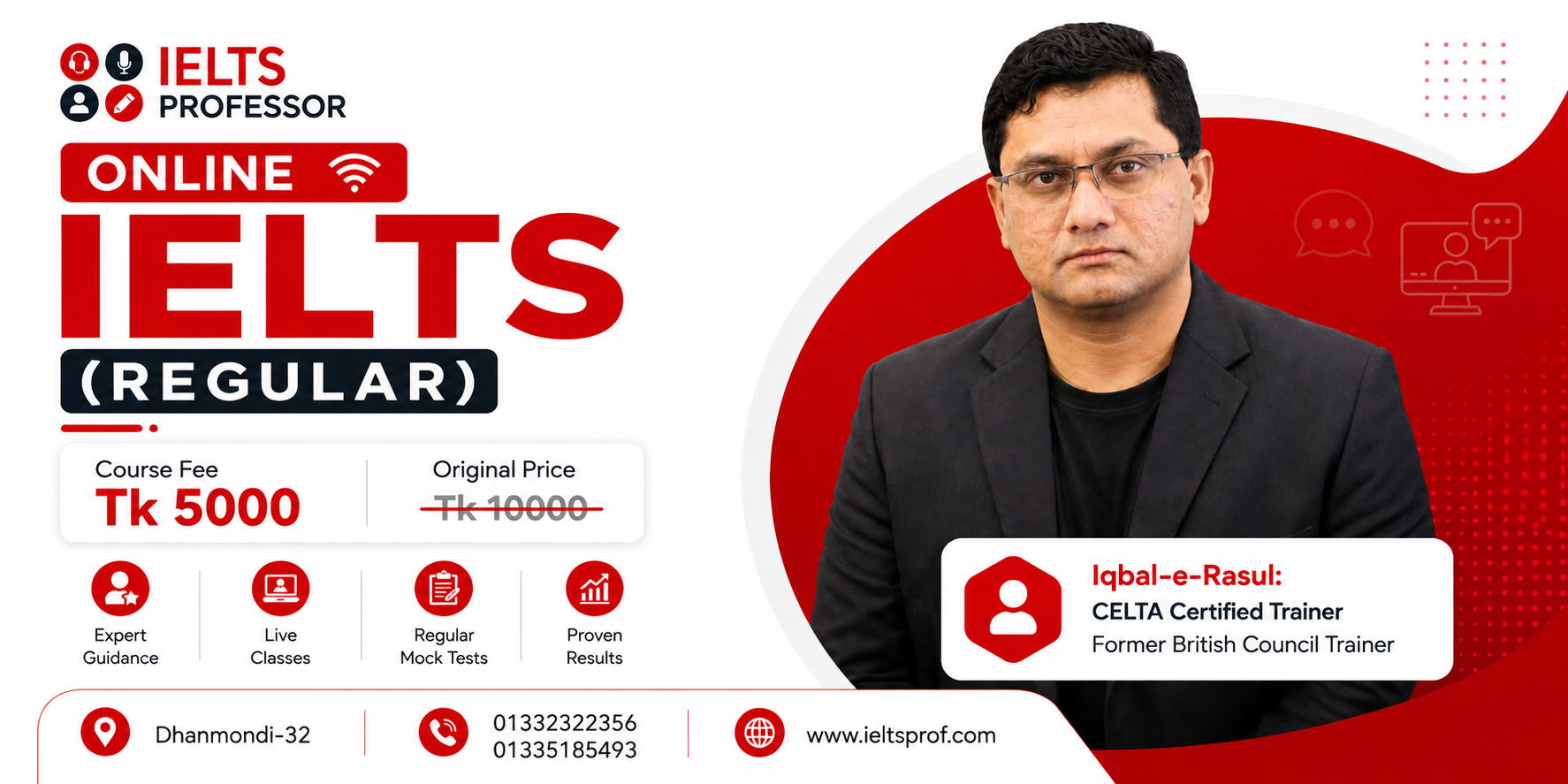
Online IELTS (Regular)
৳ 5000.00
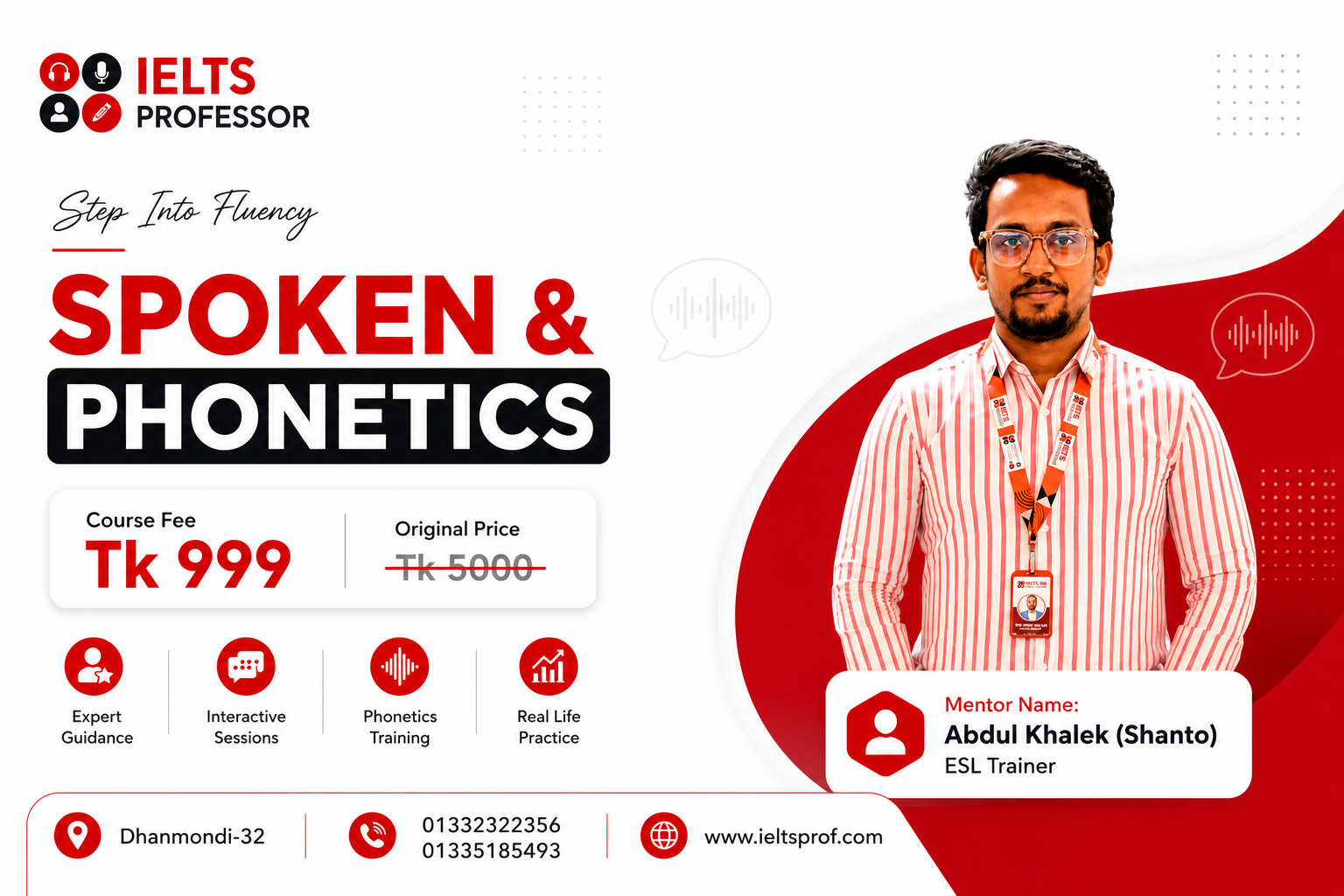
Spoken English
৳ 3500.00
IELTS Regular Executive
৳ 8000.00

Basic to IELTS
৳ 19500.00
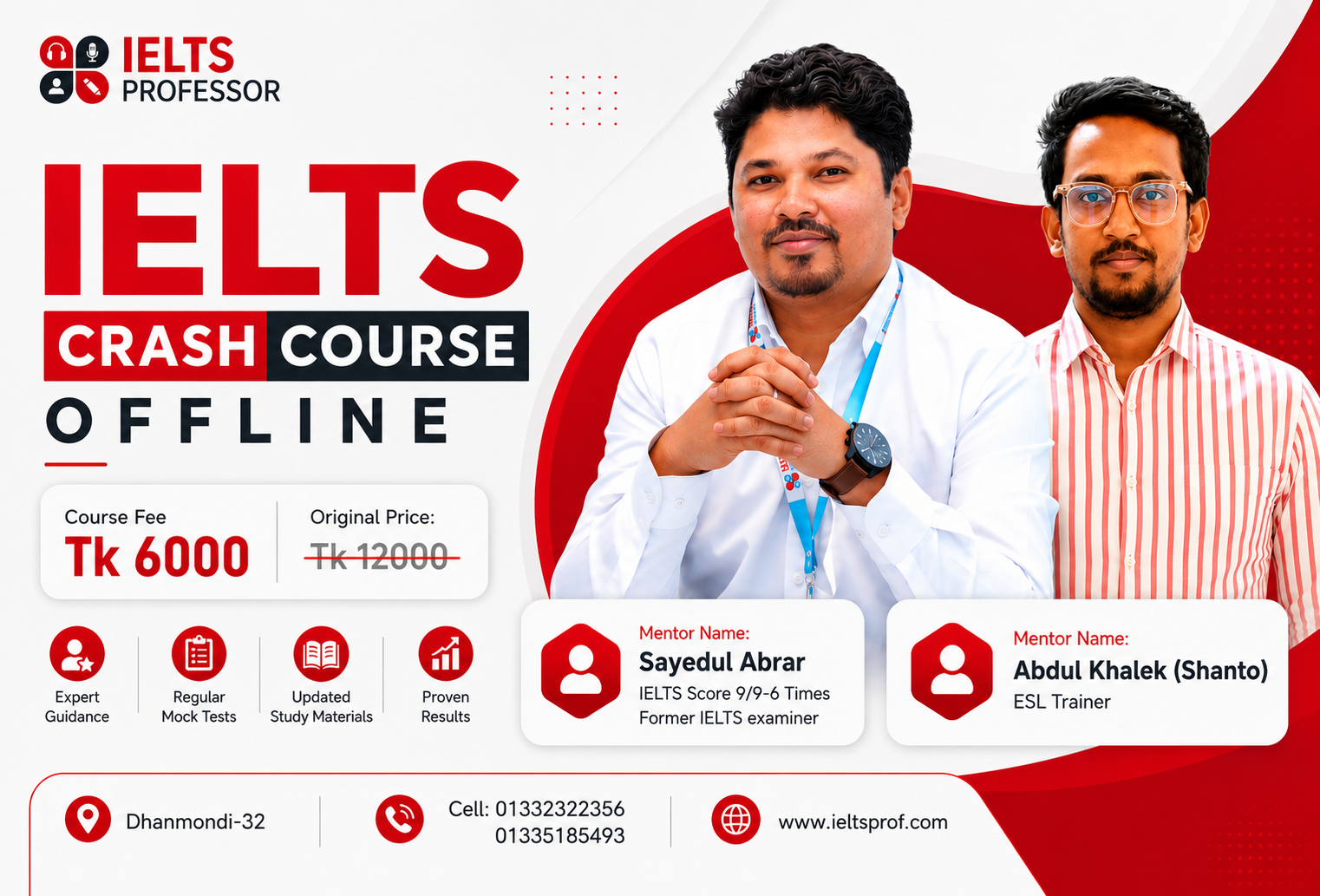
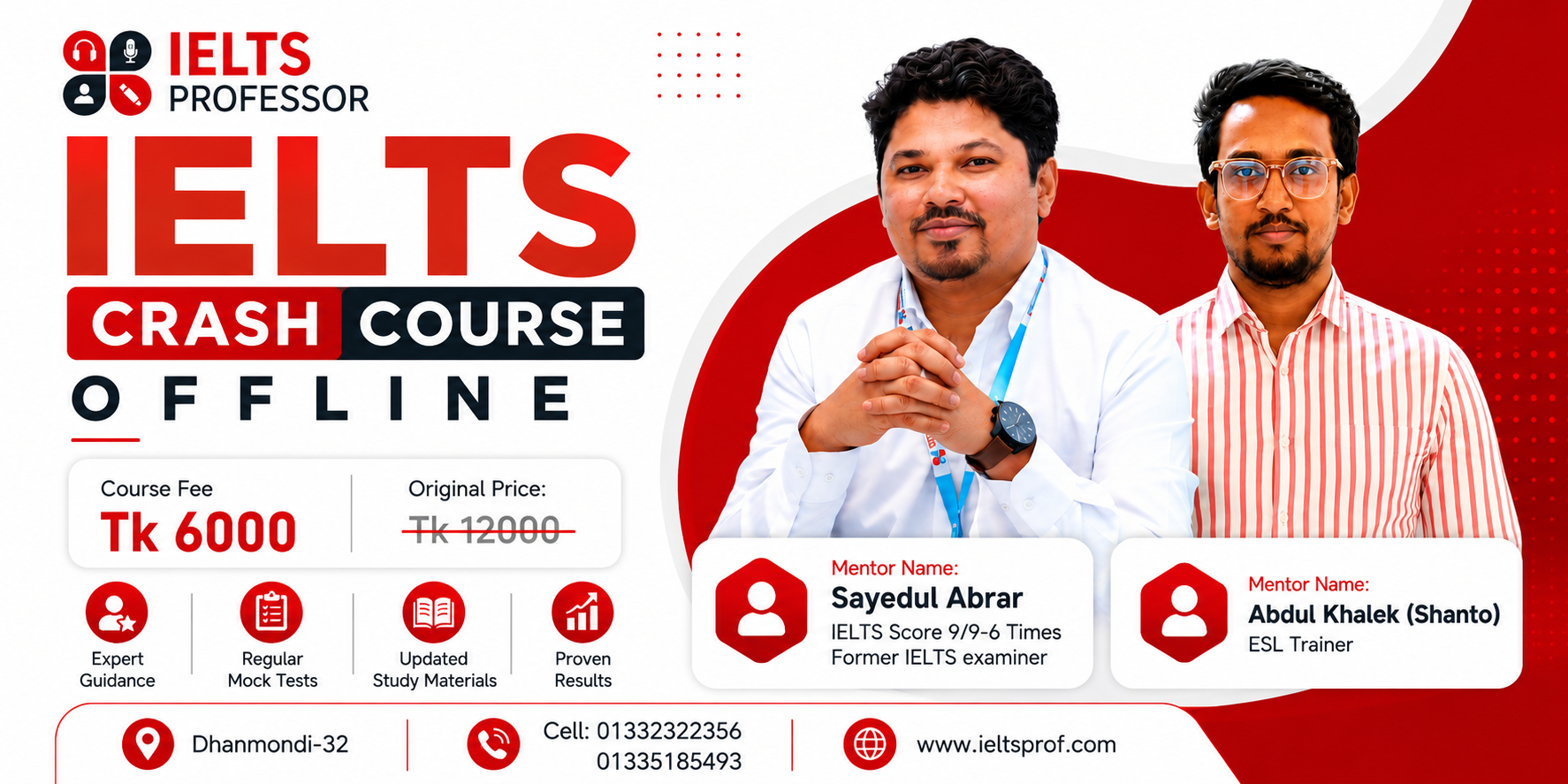
IELTS Crash Course
৳ 6000.00
All in One Vocabulary
৳ 249.00

Premium 7+ IELTS Offline
৳ 14000.00