Call us:


Many students believe that achieving a strong IELTS score
requires an expensive coaching course, a private tutor, or daily travel to a
training centre. This belief often creates unnecessary fear, especially among
students who live outside Dhaka or have limited financial resources. The truth
is that a disciplined learner can understand how to prepare for IELTS athome and achieve a competitive score without joining an expensive
programme.
Learning how to prepare for IELTS at home is not only
about downloading practice questions. It requires a clear understanding of the
test, an honest review of your present English level, a realistic study
schedule, and regular practice under timed conditions. It also requires
patience. English language improvement does not happen in a few days. However,
consistent daily practice can produce visible progress within two or three
months.
For Bangladeshi students, home preparation can solve several
practical problems. Coaching fees, transport costs, traffic congestion,
university classes, office duties, family responsibilities, and limited access
to qualified teachers can make regular coaching difficult. Home study gives
students more control over their time and money. It also allows them to repeat
difficult lessons as many times as necessary.
The central argument of this guide is simple. A student does
not need a perfect environment to begin. A quiet corner, a mobile phone, a
notebook, suitable practice materials, and a serious routine can be enough.
This detailed discussion of how to prepare will
explain how to develop listening, reading, writing, and speaking skills. It
will also discuss common Bangladeshi challenges, realistic study plans,
affordable resources, mock tests, motivation, and practical ways to measure
progress.
Understanding IELTS Before Starting Home Preparation
Before opening a practice book, you must understand what
IELTS actually measures. IELTS evaluates four language skills:
- Listening
- Reading
- Writing
- Speaking
The Academic and General Training versions have the same
Listening and Speaking sections. However, their Reading and Writing sections
are different. Academic IELTS is generally selected by students applying for
higher education or professional registration. General Training is commonly
used for migration, employment, or certain training purposes.
The total testing time is approximately two hours and
forty-five minutes. Listening, Reading, and Writing are normally completed
together without a regular break. The Speaking test takes about 11 to 14
minutes and involves direct communication with an examiner.
IELTS results are reported on a nine-band scale. Candidates receive a separate score for each skill and an overall band score based on the average of the four skill scores.This structure tells us something important. You cannot prepare only by memorising grammar rules. IELTS tests whether you can understand spoken English, read efficiently, organise ideas, write clearly, and communicate naturally.
How to Prepare for IELTS at Home by Knowing Your Starting
Level
The first practical step is to complete a full diagnostic
test. A diagnostic test shows your current strengths and weaknesses.
Do not complete the test casually. Follow the actual time
limit. Sit in a quiet place. Avoid using a dictionary, translation application,
or grammar tool. After finishing, check your Listening and Reading answers. For
Writing and Speaking, compare your performance with official assessment
criteria or ask a qualified person to review a sample.
Create a simple table in your notebook:
|
Skill |
Present
Level |
Main
Problem |
Target |
|
Listening |
Around Band
5.5 |
Missing
plural endings |
Band 7 |
|
Reading |
Around Band 6 |
Slow reading |
Band 7 |
|
Writing |
Around Band 5 |
Weak
organisation |
Band 6.5 |
|
Speaking |
Around Band
5.5 |
Fear and
hesitation |
Band 7 |
This table will stop you from studying without direction.
Consider the hypothetical story of Nusrat, a student from
Cumilla. She planned to apply for a master’s programme in Australia. She spent
one month watching random English videos but did not take a diagnostic test.
When she finally completed a mock examination, she discovered that her
Listening score was already strong, but her Writing score was below her target.
Nusrat then changed her routine. Instead of spending equal
time on all four modules, she gave extra time to essay structure, grammar
correction, and Task 1 practice. After ten weeks, her writing became clearer
and more organised. Her progress came not from studying longer but from
identifying the right problem.
Setting a Realistic IELTS Target
Your required IELTS score depends on your university,
immigration programme, professional authority, or employer. Some students need
an overall score of 6.0. Others may require 6.5, 7.0, or a specific minimum
score in every module.
Do not simply say, “I want a high score.” Set a measurable
target.
A useful target may look like this:
- Overall
target: Band 7
- Listening
target: Band 7.5
- Reading
target: Band 7
- Writing
target: Band 6.5
- Speaking
target: Band 7
- Preparation
time: 12 weeks
- Weekly
study time: 15 hours
A realistic target protects you from two mistakes. The first
is preparing carelessly because you believe IELTS is easy. The second is
becoming hopeless because you believe Band 7 is impossible.
Your target should be challenging but achievable. A beginner
with weak basic English may need several months. A student who already studies
in English may need less time. Avoid comparing your preparation period with
that of friends or online personalities.
Creating a Practical Home Study Environment
You do not need a large study room. You need a place where
you can concentrate.
Choose a chair and table if possible. Keep your phone away
unless it is being used for listening or recording. Inform family members about
your study hours. Use headphones if your home is noisy. Keep your books,
notebook, timer, and water close to you.
Many Bangladeshi students live in shared rooms, hostels, or
busy family homes. Silence may not always be available. In that situation,
identify quieter periods. Early morning can be useful for speaking and writing.
Late evening may be suitable for reading. Listening can be practised during
travel, but full mock tests should be completed in a controlled environment.
A student named Rakib lived with five family members in a
small apartment in Mirpur. He could not practise speaking loudly in the evening
because his younger siblings were studying. He began waking up at 6:00 a.m. and
speaking for thirty minutes before breakfast. He recorded his answers on his
mobile phone from the rooftop. The environment was not perfect, but his routine
was consistent.
This example shows that home preparation is not about
waiting for ideal conditions. It is about using available conditions
intelligently.
Building a Weekly IELTS Study Plan
A good IELTS home study plan should include skill
development, question practice, review, and testing.
Sample Weekly Routine
Saturday
- Listening
practice for 45 minutes
- Review
incorrect answers for 30 minutes
- Vocabulary
review for 20 minutes
- Speaking
Part 1 practice for 20 minutes
Sunday
- Reading
passage under timed conditions
- Review
difficult questions
- Learn
ten useful words in context
- Read
one English news or educational article
Monday
- Writing
Task 2 planning
- Write
one complete essay
- Check
grammar, paragraph structure, and examples
Tuesday
- Listening
practice
- Pronunciation
practice
- Speaking
Part 2 recording
Wednesday
- Reading
practice
- Writing
Task 1 practice
- Grammar
correction
Thursday
- Speaking
mock test
- Review
common hesitation words
- Rewrite
one previous essay
Friday
- Full
or partial mock test
- Weekly
performance review
- Planning
for the next week
This schedule can be adjusted around university, employment,
or family duties. A working professional may study one hour on weekdays and
three hours on Friday. A full-time student may complete two or three hours
daily.
The key is consistency. Studying ten hours on one day and
then stopping for a week is less effective than studying ninety minutes every
day.
How to Prepare for IELTS Listening at Home
IELTS Listening contains different accents, situations, and
question types. You may hear conversations, educational discussions, public
announcements, lectures, or instructions.
Bangladeshi students often face several listening problems:
- Difficulty
understanding unfamiliar accents
- Missing
words when speakers talk quickly
- Confusion
between similar sounds
- Incorrect
spelling
- Missing
plural endings
- Losing
concentration after one difficult answer
- Writing
more words than the instruction allows
To improve, practise active listening rather than passive
listening.
Passive listening means playing English audio while doing
unrelated work. Active listening means paying full attention, predicting
answers, taking notes, checking mistakes, and replaying difficult sections.
Use the following method:
- Complete
one listening section without pausing.
- Check
your answers.
- Identify
every wrong answer.
- Listen
again to the difficult part.
- Read
the transcript if available.
- Write
down the reason for the mistake.
- Listen
once more without looking at the transcript.
Your mistake record may include comments such as:
- I
did not hear the final “s.”
- I
confused fifteen with fifty.
- I
wrote two words when only one was allowed.
- I
lost attention after question 12.
- I
spelled “environment” incorrectly.
This method transforms each mistake into a lesson.
Do not listen only to American entertainment. IELTS may
include British, Australian, New Zealand, North American, and other
internationally understandable accents. Exposure to different speech patterns
will improve flexibility.
Improving IELTS Reading Without Coaching
IELTS Reading is not simply a test of how much English you
know. It is also a test of speed, attention, and decision-making.
In the Academic Reading test, candidates work with three
passages and must manage all questions within 60 minutes. Official IELTS
information describes the Academic Reading section as containing three academic
passages.
Common problems among Bangladeshi candidates include reading
every word, translating sentences into Bangla, spending too much time on one
question, and becoming confused by paraphrasing.
To improve your reading:
Learn to Skim
Skimming means reading quickly to understand the main topic
and structure. Read the title, introduction, first sentence of paragraphs, and
repeated ideas.
Learn to Scan
Scanning means searching for a specific name, number, date,
term, or detail. You do not need to understand every sentence before finding a
particular fact.
Recognise Paraphrasing
IELTS questions rarely repeat the exact wording of the
passage. For example:
- Question:
The project was stopped because it became too expensive.
- Passage:
Rising costs forced the researchers to abandon the project.
The meaning is similar, but the language is different.
Use Time Limits
A practical approach is to spend approximately 20 minutes on
each passage. However, you may finish an easier passage more quickly and use
the saved time later.
Keep a Reading Error Log
Write the question type, your answer, the correct answer,
and the reason for the mistake. After several weeks, patterns will appear. You
may discover that headings, True or False questions, or matching information
questions cause most of your errors.
How to Prepare for IELTS Writing at Home
Writing is often the most difficult module for Bangladeshi
candidates. Many students know grammar rules but cannot organise an answer
within the time limit.
IELTS Writing requires clear ideas, logical organisation,
suitable vocabulary, grammatical control, and direct response to the question.
Using difficult words without understanding them will not guarantee a high
score.
Start with Planning
Before writing an essay, spend a few minutes deciding:
- What
is the exact question?
- What
is my position?
- What
will paragraph one discuss?
- What
will paragraph two discuss?
- What
examples will support my points?
For example, imagine the topic asks whether university
education should be free for everyone.
A simple plan may be:
- Introduction:
Introduce the debate and state position.
- Body
paragraph one: Free education can increase social opportunity.
- Body
paragraph two: Fully free systems may create financial pressure.
- Conclusion:
Support reduced cost and targeted assistance rather than completely free
education.
Planning prevents repetition and unclear paragraphs.
Write Clear Paragraphs
Each body paragraph should have one central idea. A useful
structure is:
- Topic
sentence
- Explanation
- Example
- Result
or connection
Suppose the idea is that online education helps rural
students. You can explain that travel and accommodation are expensive. You can
then describe a student from Rangpur who attends an online course from home.
Finally, explain how this increases access to education.
Avoid Memorised Essays
Memorising complete essays is risky. The exam question may
be different, and memorised language may not fit naturally. Instead, learn
flexible structures and practise generating ideas.
Review Your Own Writing
After writing, ask:
- Did I
answer every part of the question?
- Is my
opinion clear?
- Does
each paragraph have one main idea?
- Did I
give relevant examples?
- Are
my sentences understandable?
- Did I
repeat the same words too often?
- Are
articles, verbs, and punctuation correct?
Writing improvement requires rewriting. Do not complete an
essay and forget it. Correct it and produce a better version.
Practising IELTS Speaking Alone
Many students ask how speaking can be practised without a
partner. The answer is recording.
Use your mobile phone to record answers. Begin with familiar
topics such as family, hometown, education, hobbies, technology, transport, and
future plans.
Listen to the recording and notice:
- Long
pauses
- Repeated
words
- Very
short answers
- Incorrect
verb forms
- Weak
pronunciation
- Lack
of examples
- Unclear
organisation
For IELTS Speaking Part 2, select a topic card and give
yourself one minute to prepare. Then speak for up to two minutes. Do not stop
because of a small mistake. Continue naturally.
A student called Farhan from Chattogram was uncomfortable
speaking English in front of classmates. He feared that people would laugh at
his pronunciation. At home, he began recording one answer every night. During
the first week, he could speak for only forty seconds. After two months, he
could speak for nearly two minutes with examples and connected ideas.
He later began practising with a cousin twice a week. His
confidence improved because private practice had already reduced his fear.
Remember that the Speaking test does not require a foreign
accent. You need clear and understandable pronunciation. Speak naturally. Do
not force an accent that makes you uncomfortable.
Developing Vocabulary in a Useful Way
Some learners memorise hundreds of difficult words but
cannot use them correctly. Effective vocabulary learning should include
meaning, pronunciation, spelling, grammar, and context.
Instead of memorising the word “significant” alone, learn it
through examples:
- There
was a significant increase in online learning.
- Public
transport plays a significant role in urban life.
- The
policy produced significant benefits.
Create vocabulary groups based on common themes:
- Education
- Environment
- Health
- Technology
- Employment
- Urbanisation
- Transport
- Culture
- Crime
- Media
However, do not try to memorise complete answers for these
topics. Learn useful language and practise applying it to different questions.
A personal vocabulary notebook should include:
- Word
or phrase
- Meaning
in simple English
- Example
sentence
- Common
partner words
- Your
own sentence
Review old vocabulary every week. Without review, most new
words will disappear from memory.
Strengthening Grammar for IELTS
You do not need to know every grammar rule before taking
IELTS. You need enough grammatical control to communicate accurately and
clearly.
Focus on common areas:
- Subject
and verb agreement
- Articles
- Singular
and plural nouns
- Verb
tense
- Sentence
boundaries
- Prepositions
- Pronouns
- Punctuation
- Complex
sentences
- Conditional
forms
Bangla and English have different sentence structures.
Bangladeshi students may place words in an unnatural order because they
translate directly. For example:
Incorrect: People technology use for many purpose.
Improved: People use technology for many purposes.
Grammar should be studied through your own mistakes. When a
teacher, friend, or correction tool identifies an error, write the correction
in a grammar notebook. Review repeated mistakes before writing your next essay.
Using Mock Tests Correctly
Mock tests are essential, but taking too many tests without
reviewing them is not productive.
Complete full mock tests after you understand the basic
question types. During the early stage, work on individual skills. Later, begin
full simulations.
For a proper mock test:
- Choose
a quiet place.
- Follow
the official time limit.
- Do
not use a dictionary.
- Do
not pause recordings.
- Complete
Listening, Reading, and Writing in sequence.
- Use
an answer sheet or computer format similar to your selected test.
- Record
your Speaking test separately.
After the test, spend as much time reviewing as you spent
completing it.
Official IELTS organisations provide sample questions and
preparation materials. IELTS is accepted by thousands of organisations
internationally, and official providers continue to offer practice materials
for candidates preparing independently.
How to Prepare for IELTS at Home on a Limited Budget
Financial pressure is a major concern for many Bangladeshi
families. IELTS registration itself is a significant expense. Coaching,
transport, books, mock tests, food, and accommodation can make the process more
difficult.
A student from a district town may also need to travel to a
larger city for certain services. For this reason, efficient home preparation
can reduce unnecessary costs.
A low-cost plan can include:
- One
reliable practice book
- Official
sample questions
- Free
English audio and educational programmes
- A
notebook for errors
- A
mobile phone for recording
- A
timer
- A
study partner
- Occasional
professional feedback for Writing and Speaking
Do not purchase many books at once. More resources do not
always create more progress. Select a small number of reliable materials and
complete them carefully.
Students who register through an official provider may
receive access to additional preparation support or online materials, depending
on current registration arrangements. Official providers in Bangladesh
advertise free and registration-linked preparation resources.
Spend money where it creates the greatest benefit. For
example, instead of paying for a long general course, you may pay a qualified
instructor to evaluate several essays and speaking recordings. This focused
feedback may reveal problems you cannot identify alone.
Cultural and Social Challenges for Bangladeshi Learners
IELTS preparation is not only an academic process. Social
and cultural factors can influence performance.
Some students feel embarrassed speaking English because
friends may criticise their accent. Others come from Bangla-medium backgrounds
and believe English-medium students will always perform better. Female learners
in conservative families may have limited opportunities to attend evening
classes. Working candidates may return home tired and struggle to maintain a
routine.
These challenges are real, but they can be managed.
A Bangla-medium background does not prevent a high IELTS
score. It may mean that the learner needs more time to build natural exposure.
Confidence develops through repeated use, not through social status.
Create a small support circle. It may include one friend,
sibling, teacher, or online study partner. Share weekly goals. Conduct short
speaking sessions. Exchange essays. Encourage improvement instead of mocking
errors.
Family members should also understand the purpose of the
preparation. Explain your study schedule and examination goal. A serious
conversation can reduce interruptions and create support.
Managing Motivation and Study Pressure
Many candidates begin with great energy but lose motivation
after two weeks. This happens because their plan is too difficult or their
progress is not immediately visible.
Use small targets.
Instead of saying, “I will become fluent this month,” say:
- I
will complete three reading passages this week.
- I
will write two essays.
- I
will record four speaking answers.
- I
will review fifty vocabulary items.
- I
will complete one listening test.
Keep a progress calendar. Mark every successful study day. A
visible chain of completed days creates psychological motivation.
Do not allow one bad mock score to destroy your confidence.
Scores can change because of question difficulty, concentration, sleep, or
unfamiliar topics. Look at the trend across several tests.
Rest is also important. Studying while exhausted can reduce
accuracy. Sleep properly before mock tests. Take short breaks between study
sessions. Avoid comparing yourself constantly with candidates who claim to have
achieved very high scores with little preparation.
A 12-Week Home Preparation Roadmap
Weeks 1 and 2: Assessment and Foundation
Learn the test structure, complete a diagnostic test, set
your target, and identify weaknesses. Begin grammar and vocabulary review.
Weeks 3 and 4: Question-Type Practice
Study each Listening and Reading question type. Learn basic
structures for Writing Tasks 1 and 2. Begin daily Speaking recordings.
Weeks 5 and 6: Skill Development
Increase reading speed, listening concentration, paragraph
development, and speaking fluency. Review mistakes carefully.
Weeks 7 and 8: Timed Practice
Complete full sections under time limits. Write two or three
tasks each week. Conduct regular speaking simulations.
Weeks 9 and 10: Full Mock Tests
Complete at least one full mock examination each week.
Identify patterns in your errors and revise weak areas.
Week 11: Targeted Correction
Reduce general practice and focus on repeated problems.
These may include spelling, headings, essay conclusions, or Speaking Part 3.
Week 12: Final Preparation
Complete limited practice, review strategies, prepare
documents, confirm test arrangements, and protect your sleep and mental health.
Common Mistakes to Avoid
The process of learning how to prepare for IELTS at home
becomes more effective when you avoid common mistakes.
Do not:
- Book
the test before understanding your present level.
- Depend
only on motivational videos.
- Memorise
complete essays.
- Learn
difficult vocabulary without context.
- Ignore
spelling.
- Practise
speaking only silently.
- Complete
mock tests without reviewing mistakes.
- Change
resources every few days.
- Translate
every English sentence into Bangla.
- Study
irregularly and expect quick improvement.
- Believe
that grammar alone determines your score.
- Avoid
timed practice until the final week.
Success usually comes from simple actions repeated
consistently.
Final Test-Day Preparation
During the final week, do not try to learn everything again.
Review your most common mistakes, useful writing structures, speaking examples,
and test rules.
Prepare your required identification document. Confirm the
test date, reporting time, and location. Plan your journey early, particularly
if travelling through Dhaka traffic.
Eat a normal meal. Avoid experimenting with unfamiliar food
or too much caffeine. During the test, do not continue thinking about a missed
Listening answer. Move forward. One mistake does not destroy the entire score.
In Reading, control your time. In Writing, answer every part
of the question. In Speaking, communicate with the examiner rather than
delivering a memorised speech.
Summary
Understanding how to prepare for IELTS at home can
save money, reduce travel, and give Bangladeshi students greater control over
their learning. Effective preparation requires a diagnostic test, a realistic
target, regular practice, careful mistake analysis, timed mock tests, and
balanced development of all four skills. Home study may feel difficult at
first, but discipline, suitable materials, and focused feedback can turn an
ordinary study environment into a successful IELTS preparation system.
Frequently Asked Questions
1. Can I achieve Band 7 by preparing for IELTS entirely
at home?
Yes, it is possible to achieve Band 7 through home
preparation. However, the result depends on your current English level,
available preparation time, study discipline, and quality of feedback. You must
understand every test section and practise under realistic time limits.
Listening and Reading can be checked independently, but Writing and Speaking
may require outside evaluation. Ask a qualified teacher or experienced
candidate to review some of your work. Keep a record of repeated mistakes and
correct them systematically. Home preparation works best when it follows a
structured plan rather than random online lessons.
2. How many months should a Bangladeshi student prepare
for IELTS?
The required period varies from one student to another. A
learner with strong academic English may prepare within six to eight weeks. A
student with weak grammar, limited vocabulary, or little speaking experience
may need three to six months. Complete a diagnostic test before selecting your
examination date. Your preparation period should be based on the difference
between your current score and target score. Working professionals may need
more calendar time because they have fewer daily study hours. It is safer to
prepare properly than to book an early test and pay for another attempt.
3. How many hours should I study every day at home?
Most candidates can benefit from one and a half to three
hours of focused daily study. The exact amount depends on your schedule and
target. A university student may study two hours on weekdays and longer on
weekends. A full-time employee may study one hour in the morning and one hour
after work. Quality matters more than sitting at a table for many hours. Every
session should have a specific purpose, such as completing a reading passage or
correcting an essay. Include short breaks so that your attention remains
strong.
4. Is IELTS coaching necessary for students from
Bangla-medium backgrounds?
IELTS coaching is not compulsory for Bangla-medium students.
However, these learners may need additional support in grammar, pronunciation,
vocabulary, and confidence. The educational background itself does not
determine the final score. Regular exposure to English and deliberate practice
are more important. Start with basic materials and gradually move to test-level
tasks. Use Bangla explanations when necessary, but practise producing answers
directly in English. Focused feedback from a teacher can be helpful,
particularly for Writing and Speaking, without requiring a complete coaching
course.
5. How can I practise IELTS Speaking when nobody at home
speaks English?
You can practise effectively by recording yourself. Select a
topic, prepare briefly, and speak into your mobile phone. Listen to the
recording and identify pauses, repeated words, grammar errors, and unclear
pronunciation. You can also describe your daily activities in English or
summarise something you have read. After gaining confidence, arrange short
voice calls with a friend or classmate. Even two speaking sessions each week
can make a difference. The goal is not to speak perfectly but to express ideas
clearly and continue speaking despite minor errors.
6. How can I check my IELTS Writing without a teacher?
Begin by comparing your writing with the official assessment
areas, including task response, organisation, vocabulary, and grammar. Check
whether you answered every part of the question and maintained a clear
position. Review paragraph structure and underline repeated words. Use grammar
tools cautiously because they may not understand your intended meaning or IELTS
requirements. Compare your answer with high-quality sample responses, but do
not copy them. You should still arrange occasional human feedback if possible.
Even a few professionally reviewed essays can reveal patterns that automated
checking may miss.
7. What should I do if my Reading score does not improve?
First, analyse the types of questions you answer
incorrectly. Your problem may be time management, vocabulary, paraphrasing, or
misunderstanding instructions. Stop taking complete tests for several days and
practise the weakest question type separately. Read English articles and
summarise each paragraph in one sentence. Learn to search for evidence instead
of answering from general knowledge. Set time limits and gradually reduce the
time used for each passage. Improvement may remain hidden for several weeks, so
compare your average score across multiple tests rather than judging one
result.
8. Why do I understand English audio but still get
Listening answers wrong?
General understanding is different from accurate test
performance. You may understand the main topic but miss a date, spelling,
number, plural ending, or change of opinion. IELTS Listening questions often
require exact details. Read the instructions carefully and predict what type of
answer is needed. After checking your answers, replay the exact section where
the mistake occurred. Use the transcript to identify the missed language.
Record whether the problem involved sound recognition, concentration,
vocabulary, or spelling. Repeated review will train you to notice important
details.
9. Should I memorise IELTS essays and speaking answers?
You should not memorise complete essays or speaking answers.
Memorised responses may not match the examination question and can sound
unnatural. Instead, learn flexible paragraph structures, linking expressions,
topic vocabulary, and ways to explain examples. Practise adapting the same idea
to several questions. In Speaking, prepare personal stories that can be used
naturally, but do not memorise every sentence. Examiners may ask unexpected
follow-up questions. Real communication is safer and more effective than trying
to reproduce a fixed script.
10. How can I prepare for IELTS when I have a full-time
job?
Create a routine that fits your energy level. You may study
Listening or vocabulary during travel and reserve quiet home time for Writing
and Reading. Use short weekday sessions and longer weekend sessions. For
example, practise for forty-five minutes before work and complete another
forty-five-minute activity after dinner. Prepare your materials in advance so
that you do not waste time deciding what to study. Protect at least one longer
period each week for a mock test. Consistency across twelve weeks can be more
effective than an intensive but unsustainable schedule.
11. What is the cheapest effective way to prepare for
IELTS in Bangladesh?
Use a small number of reliable practice materials, official
sample questions, a notebook, headphones, and a mobile phone. Avoid purchasing
many books that contain the same information. Study with a serious partner and
exchange speaking practice. Complete free exercises but check whether the
format matches the actual examination. Save money for the registration fee and
targeted professional feedback. You may pay for the correction of several
essays instead of enrolling in a long course. A carefully planned low-cost
approach can be effective when the learner remains disciplined.
12. When should I book my IELTS test?
Book the examination when your recent mock scores are close
to or slightly above your target. Do not book only because your friends are
taking the test or because a particular date appears convenient. Complete
several timed practice tests before making the decision. Consider university
deadlines, visa processing time, and the possibility that you may need another
attempt. Leave a reasonable safety period between your test and application
deadline. Confirm that you are selecting the correct test type. Booking at the
right time can reduce pressure and unnecessary financial loss.
13. Is computer-delivered IELTS easier than paper-based
IELTS?
The test standard and scoring principles are not easier
simply because the delivery method is different. Your personal comfort should
guide the choice. Computer delivery may suit candidates who type quickly, edit
text easily, and read comfortably from a screen. Paper delivery may suit
students who prefer handwriting, underlining passages, and making notes
physically. Practise both formats before deciding. Check your typing speed and
ability to use a computer under time pressure. Select the format that allows
you to demonstrate your English ability with the least technical discomfort.
14. How can I overcome nervousness before the Speaking
test?
Practise speaking under simulated conditions. Ask a friend
to act as an examiner and avoid helping you during the test. Record several
complete speaking simulations so that the process becomes familiar. Prepare
ideas about your life, studies, hometown, work, interests, and future goals.
Before answering, listen carefully and respond directly. It is acceptable to
pause briefly while thinking. Do not try to impress the examiner with unnatural
vocabulary. Breathe slowly, maintain a conversational tone, and remember that
the examiner is assessing communication rather than your personality or social
background.
15. What should I do during the final seven days before
IELTS?
Reduce the amount of completely new material. Review your
mistake notebook, common vocabulary, writing plans, and speaking recordings.
Complete one or two final timed tests, but do not exhaust yourself with daily
full examinations. Confirm your test venue, identification documents, reporting
time, and transport arrangements. Maintain a normal sleep schedule and eat
familiar food. Continue light English exposure to remain comfortable with the
language. The final week should strengthen confidence and accuracy. It should
not become a period of panic, memorisation, or extreme late-night study.
Conclusion
The question of how to prepare for IELTS at home has
no magical one-day answer. Success comes from understanding the test,
identifying weaknesses, practising regularly, and learning from mistakes.
Bangladeshi students may face financial limitations, social pressure, weak
speaking environments, and limited access to expert teachers. Yet these
difficulties do not make a strong IELTS score impossible.
Find Your Courses
IELTS A to Z
৳ 1990.00
7+ IELTS Offline Regular
৳ 8000.00
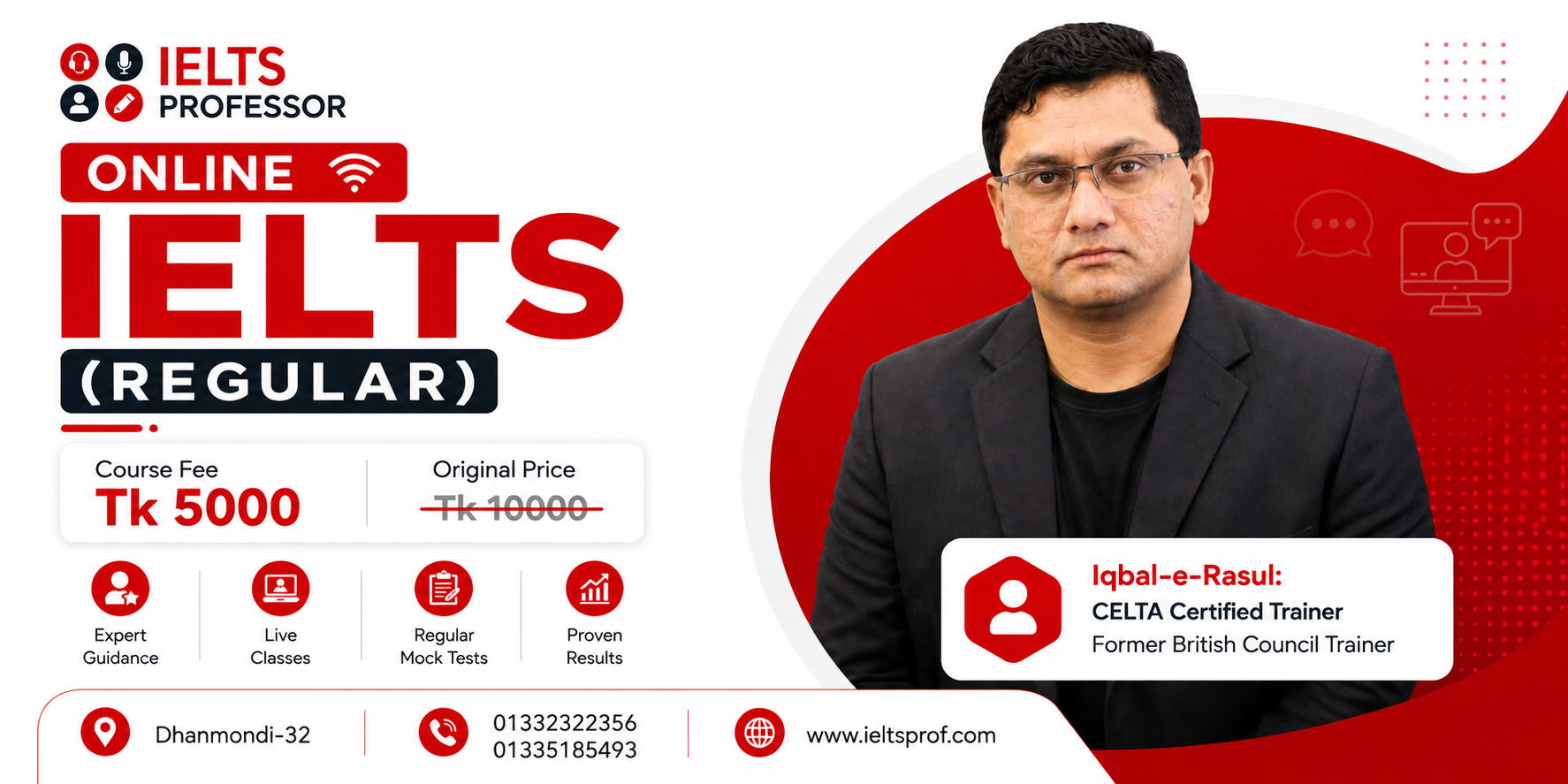
Online IELTS (Regular)
৳ 5000.00
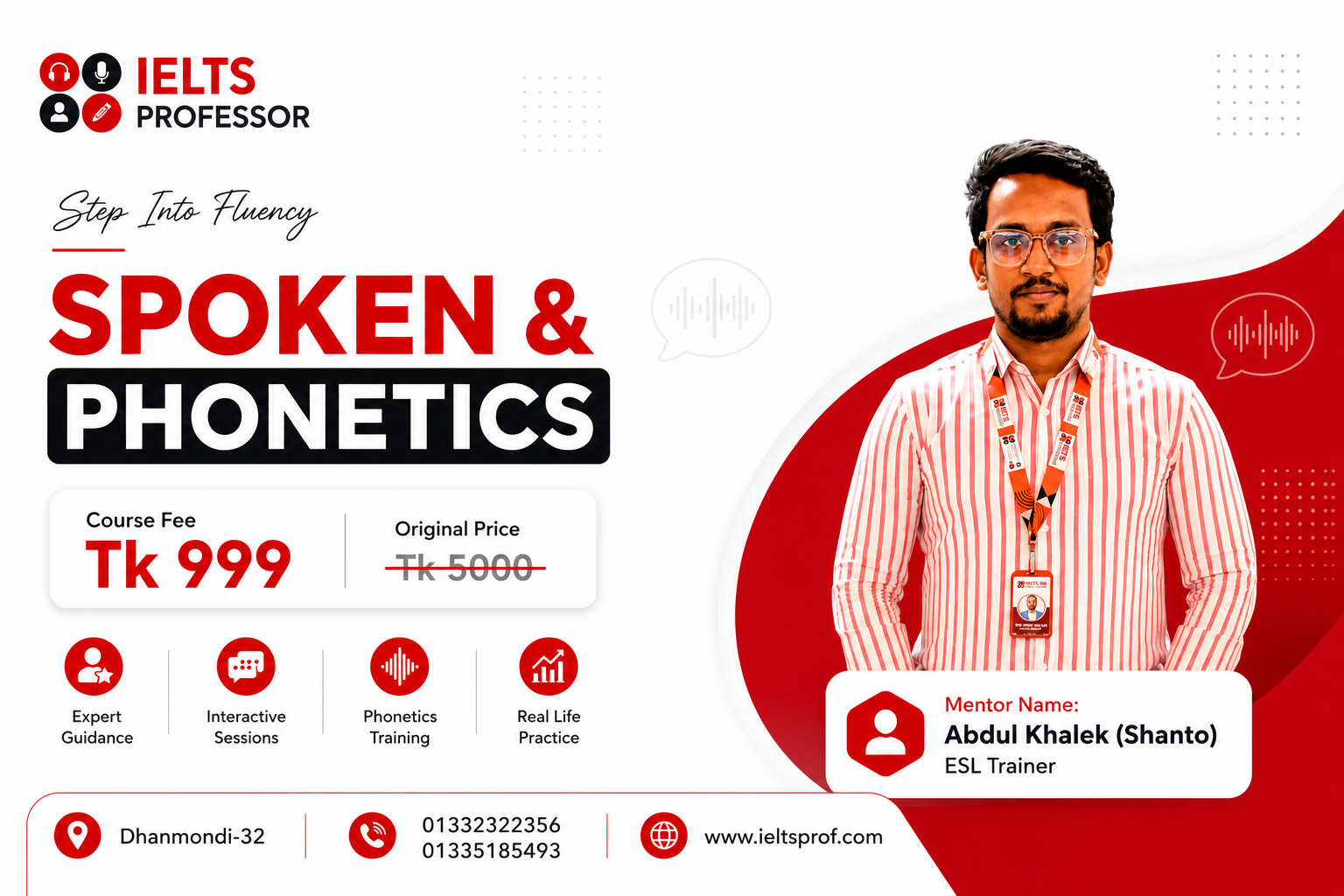
Spoken English
৳ 3500.00
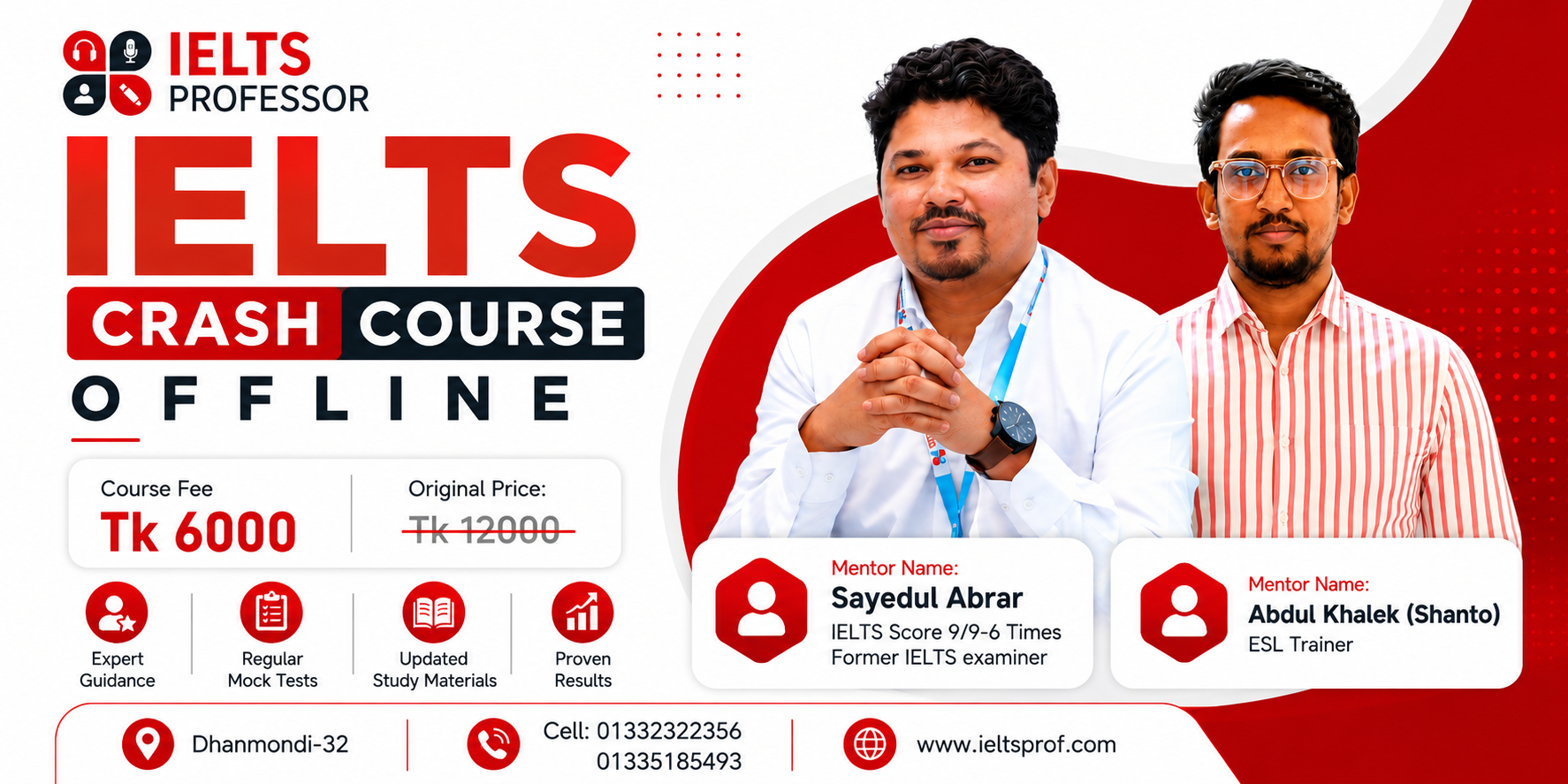
IELTS Regular Executive
৳ 8000.00
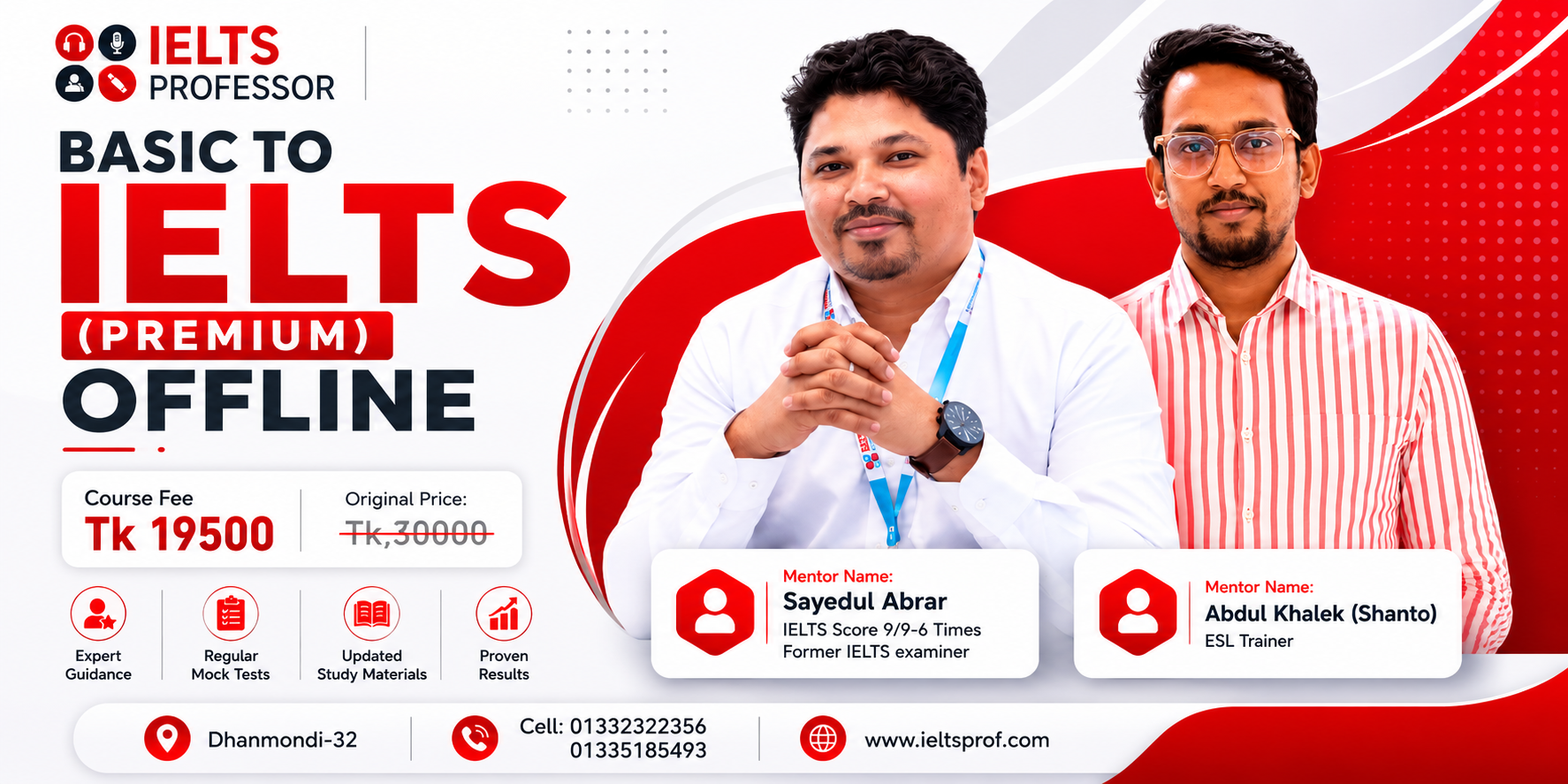
Basic to IELTS
৳ 19500.00
IELTS Crash Course
৳ 6000.00
All in One Vocabulary
৳ 200.00
Premium 7+ IELTS Offline
৳ 14000.00