Call us:


A simple method, 12 academic words with Bangla meanings, and a 30-day plan you can start today.
Imagine the day your IELTS result arrives. You open the email and the number in front of you opens a door: the university you wanted, the city you have only seen in photos, the first morning walking to your own classroom. For many students in Bangladesh, that dream is one score away. And for many of them, the thing quietly holding the score back is not grammar or effort. It is vocabulary.
Not because they know too few words. Because they know words the wrong way: memorised in a list, forgotten by morning, and impossible to use when the pen is in their hand.
This guide shows you how to improve vocabulary for IELTS in a way that lasts. It is written for Bangladeshi learners, with Bangla meanings where they help, and it avoids the usual promises. No magic numbers. No shortcuts. A method that works because it fits how memory works.
Quick answer: how do you improve vocabulary for IELTS?
- Learn fewer words, more deeply. For each word, learn its meaning, 3 to 5 synonyms, one or two opposites, its word forms (noun, verb, adjective) and one sentence you wrote yourself.
- Learn words in context, not as isolated lists. A short story or paragraph is easier to remember than a column of definitions.
- Use every new word within 24 hours in a speaking answer or a written sentence.
- Review on a schedule: after one day, three days, one week and three weeks.
- Practise with real IELTS tasks, because vocabulary only counts when you can use it under time pressure.
The rest of this article explains each point step by step.
Why vocabulary matters in IELTS
IELTS tests four skills: Listening, Reading, Writing and Speaking. Vocabulary matters in all four, but in two of them it is marked directly.
In Writing and Speaking, one of the four marking criteria is Lexical Resource: the range and accuracy of the words you use. The four criteria carry equal weight, so Lexical Resource accounts for a quarter of your Writing score and a quarter of your Speaking score. You can read how examiners describe each band on the official IELTS website.
In Reading and Listening there is no vocabulary mark, but vocabulary decides how much you understand. IELTS rarely uses the exact words from the passage in the question. It paraphrases. If you know that impact, effect and consequence belong to the same family, you recognise the answer even when the question uses a different word from the text. That is why a student with a strong vocabulary often reads faster and loses less time.
How many words do you need for IELTS?
There is no official number, and anyone who gives you one for a particular band is guessing. What the band descriptors reward is not the size of your vocabulary but how precisely, naturally and flexibly you use it.
That said, you need a solid base of academic words. A well-known starting point is the Academic Word List (AWL), compiled by the researcher Averil Coxhead, which groups 570 word families that appear again and again in university texts. Words such as analyse, assess, evidence, factor, policy and significant come from this kind of core. Learning a few hundred of these properly will do more for your score than memorising thousands of rare words you will never use.
Why memorising word lists does not work
Many students start with a list: 500 words, 1,000 words, 2,500 words, sometimes with Bangla meanings next to each one. A list is a fine place to find words. It is a poor way to learn them. Here is why.
- You forget quickly. A word you met once, with no context, has nothing to attach to. Without review, most of it fades within days.
- You know the meaning but not the use. You can say impact means প্রভাব, but you may not know it can be a noun and a verb, or which words normally come with it.
- One meaning, many contexts. Synonyms are rarely identical. Effect, influence and consequence sit differently in a sentence. A list cannot show you that.
- It feels productive, so you keep doing it. Reading a list for an hour feels like work. Using ten words in a paragraph for ten minutes is work, and it is what moves your score.
A method that works: connect words instead of collecting them
The most reliable way to remember a word is to connect it to other words you already half-know. A simple way to do this is a spider map: write one word in the middle of a page and draw branches from it.
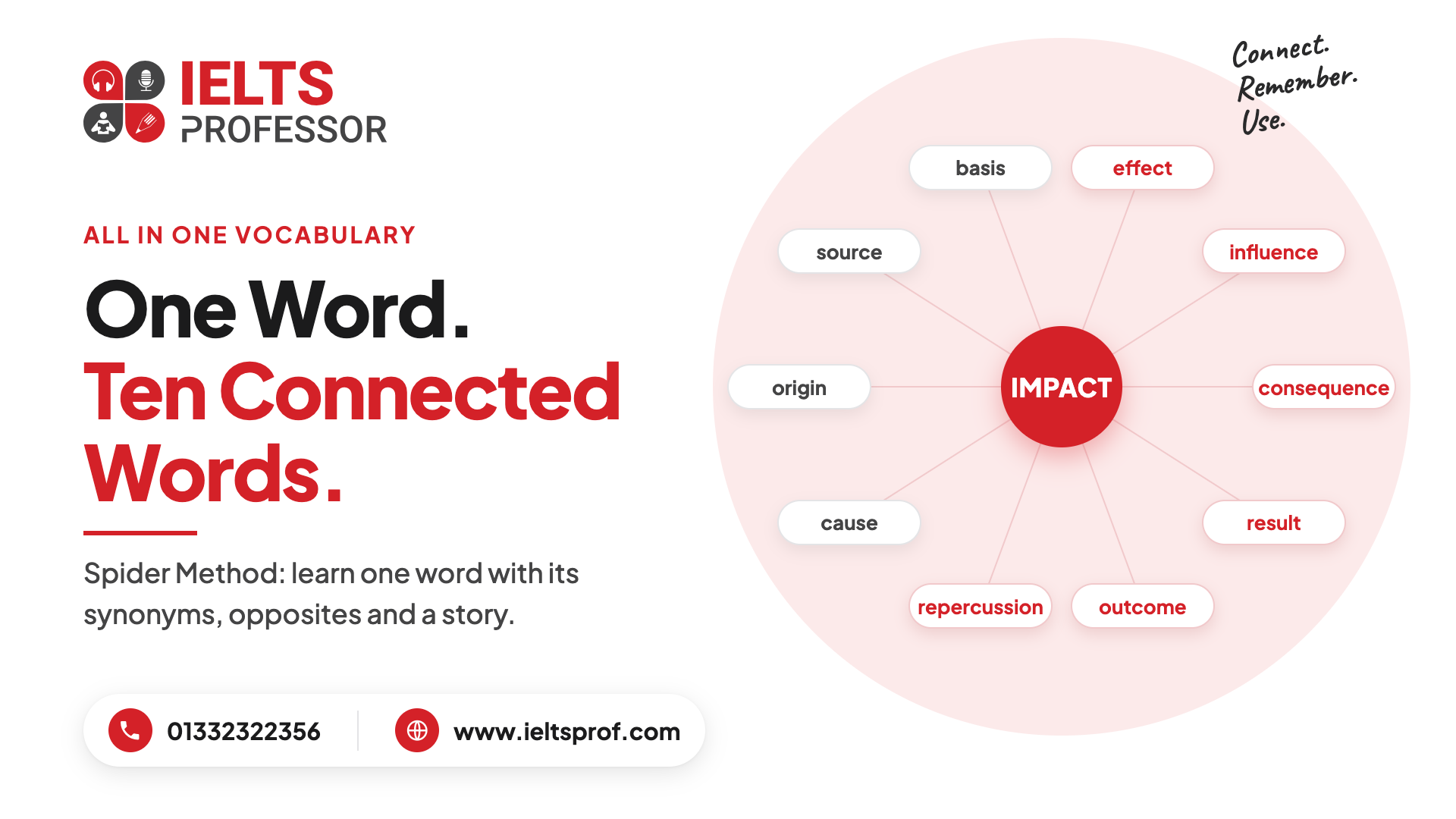
Take the word Impact. Put it in the centre, then add:
- Six synonyms: effect, influence, consequence, result, outcome, repercussion
- Four contrasting words: cause, origin, source, basis
- Meaning: the effect or influence of one thing on another (বাংলা: প্রভাব)
- A sentence: The new law will impact the environment. (নতুন আইনটি পরিবেশের উপর প্রভাব ফেলবে।)
Now one word is no longer alone. It has ten neighbours. The next time you meet outcome in a Reading passage, it already belongs to a group you know. When you write an essay on pollution, you can choose between effect, consequence and impact instead of repeating one word four times.
This is the idea behind the Spider Method used in IELTS Professor's All in One Vocabulary book: one core word, ten connected words, a Bangla meaning, an example, and a short IELTS-style story in which all the connected words appear in context.
12 academic words with Bangla meanings and synonyms
Here is a small sample of high-frequency academic words, with Bangla meanings, synonyms and an example. Try writing your own sentence for each one before you move on.
| Word | Bangla meaning | Useful synonyms | Example sentence |
|---|---|---|---|
| Impact | প্রভাব | effect, influence, consequence | Social media has a significant impact on teenagers. |
| Benefit | সুবিধা, উপকার | advantage, gain, profit | Regular exercise has many health benefits. |
| Analyse | বিশ্লেষণ করা | examine, study, break down | The researchers analysed the data carefully. |
| Assess | মূল্যায়ন করা | evaluate, appraise, judge | The course assesses students through exams and essays. |
| Identify | চিহ্নিত করা | recognise, detect, pinpoint | Identify your weak areas before you plan your study. |
| Indicate | নির্দেশ করা, ইঙ্গিত দেওয়া | show, suggest, reveal | The graph indicates a steady rise in temperature. |
| Evidence | প্রমাণ | proof, confirmation, indication | There is little evidence to support that claim. |
| Factor | উপাদান, কারণ | element, component, aspect | Cost is a key factor when choosing a university. |
| Policy | নীতি, নীতিমালা | strategy, guideline, regulation | The government introduced a new education policy. |
| Concept | ধারণা | idea, notion, theory | Sustainability is a difficult concept to define. |
| Establish | প্রতিষ্ঠা করা | set up, found, form | The university was established over fifty years ago. |
| Significant | গুরুত্বপূর্ণ, উল্লেখযোগ্য | important, notable, substantial | There was a significant increase in sales. |
British and American spelling are both accepted in IELTS (analyse and analyze). Choose one and use it consistently.
Learn the word forms, not just the word
A word usually has more than one form, and IELTS Writing rewards you for using the right one. A single idea can be expressed as a verb, a noun or an adjective.
| Verb | Noun | Adjective |
|---|---|---|
| analyse | analysis | analytical |
| benefit | benefit | beneficial |
| identify | identification | identifiable |
| establish | establishment | established |
| indicate | indication | indicative |
| emphasise | emphasis | emphatic |
Compare these two sentences:
- Many people think that technology is good for education.
- Technology can bring significant benefits to education, and its impact on learning is increasingly beneficial.
The second sentence is not longer for the sake of being longer. It shows range and accuracy, which is exactly what the Lexical Resource criterion looks for. Always check that the form you choose fits the grammar of your sentence.
Learn words in context
A word sticks when it lives inside a situation. Instead of memorising establish alone, read it inside a sentence about a young entrepreneur who establishes a small business. Your brain stores the situation, and the word comes with it.
Good sources of context for IELTS learners:
- Cambridge IELTS practice books: the Reading passages and Listening scripts are written in the style of the real test.
- Short news and magazine articles on education, health, environment, technology and work, the same topics IELTS uses again and again.
- Short stories that use your target words, where each word appears in a natural situation you can picture.
When you meet a new word, do not just look it up. Copy the whole sentence into your notebook.
Vocabulary for each skill
Writing. Use accurate, topic-related words and varied expressions, but do not stuff your essay with rare words. A simple word used correctly scores better than a difficult word used wrongly. Practise with the model-and-rewrite habit described in our guide on how to improve IELTS Writing band score.
Speaking. Natural beats impressive. Use words you can pronounce and have used before. Paraphrase when you forget a word: a place where people borrow books is far better than silence. For topic ideas, see IELTS Speaking topics of 2026.
Reading. Train yourself to spot paraphrases. When you finish a passage, underline three words and write a synonym for each. Our guide to IELTS Reading strategies for beginners shows how this fits into a timed routine.
Listening. Learn the spelling of common academic words, and notice synonyms between the question and the speaker. A correct word with a wrong spelling loses the mark.
Collocations: the words that travel together
Native speakers do not choose words one at a time. They use pairs and chunks that sound natural. Learn these along with your core words:
- have a significant impact on, a positive or negative impact
- bring benefits, enjoy the benefits of
- a key factor, contributing factors
- conduct research, carry out an analysis
- provide evidence, strong evidence
- introduce a policy, a government policy
When your sentences use natural pairs, your language sounds fluent even at moderate speed.
A 30-day plan: ten minutes a day
You do not need hours. You need a repeatable routine. Here is a simple plan.
| Week | Daily routine (about 10 minutes) | Goal |
|---|---|---|
| Week 1 | Pick 1 new word. Draw its spider map: meaning, 3-5 synonyms, 1-2 contrasting words, one sentence you write yourself. | 7 words learned deeply |
| Week 2 | New word each day, plus review the previous day's word. Write the noun, verb and adjective forms. | 7 more words, forms practised |
| Week 3 | New word each day. Review Week 1 words. Use two words from this week in a 5-sentence paragraph. | Words move from reading to writing |
| Week 4 | Review all words. Write one short Task 2 paragraph using at least six of your words correctly. Say two words aloud in a 1-minute Speaking answer every day. | Words move into speaking |
How to review: look at each word again after one day, three days, one week and three weeks. If you cannot recall it, relearn it with a new sentence. This is called spaced repetition, and it works because each review catches the word just before you would forget it.
By the end of 30 days you will have learned about 25 to 30 words properly. That is a modest number. It is also far more useful than 300 words you half remember.
Mistakes that keep students stuck
- Learning rare words first. Start with high-frequency academic words, not words that appear once in a thousand pages.
- Using a word you do not fully understand. If you are not sure of the meaning, form or usual partners, do not use it in an exam answer.
- Wrong word form. Writing The analyse showed... instead of The analysis showed... costs accuracy.
- Translating word by word from Bangla. English phrases are often built differently. Learn the English phrase as a whole.
- Ignoring spelling. Spelling affects Writing and, in Listening, can decide whether an answer is marked correct.
- Passive learning. Reading lists, watching videos or highlighting notes feels like progress but rarely builds recall. Writing and saying the words does.
- Never testing yourself. Cover the meaning and try to recall it. If you cannot, you have found what to study.
How to choose a good IELTS vocabulary book
Whatever you choose, look for a few things:
- Core academic words, not just a very long list.
- Meaning, synonyms and an example for each word, with Bangla support if you need it.
- Context: sentences or short stories, not only definitions.
- Word forms: verb, noun and adjective, with sentences.
- A routine you can follow every day, not just a reference.
IELTS Professor's All in One Vocabulary was built around this idea. It takes 100 academic words and connects each one to six synonyms and four contrasting words, which gives 1,100 connected words in total. Each word has a Bangla meaning and a short IELTS-style story. The book is written by Sayedul Abrar Sir | Ex IELTS Examiner | IELTS 9/9 (6 times) | IELTS Professor. You can read about it on the All in One Vocabulary course page and try the free sample at ebook.ieltsprof.com/vocabulary before you decide.
Put your vocabulary to the test
Learning words is only half the job. You also need to use them under exam conditions. Practise with timed tasks, and if you want an experience close to the real test, try the IELTS Professor Real Exam Practice Portal. For a bigger picture of how to organise your preparation, read how to prepare for IELTS at home and how to get a 7+ band score in IELTS.
Summary
- Vocabulary is marked directly in Writing and Speaking (Lexical Resource, 25% of each score) and helps you understand Reading and Listening.
- There is no magic word count. Depth, accuracy and natural use matter more than a long list.
- Connect words with a spider map: meaning, synonyms, contrasting words, forms and your own sentence.
- Learn in context, use new words within 24 hours, and review after 1 day, 3 days, 1 week and 3 weeks.
- Ten focused minutes a day for 30 days is a realistic start.
- Results depend on your own practice. No book, course or method can promise a particular band score.
বাংলায় সংক্ষেপে
IELTS-এ Vocabulary শুধু শব্দের তালিকা মুখস্থ করার বিষয় নয়। Writing ও Speaking-এ Lexical Resource মোট নম্বরের এক-চতুর্থাংশ, আর Reading ও Listening-এ শব্দ চিনলে প্যারাফ্রেজ ধরা সহজ হয়। তাই প্রতিটি শব্দ শিখুন চার ভাবে: অর্থ, Synonym, শব্দের রূপ (Verb-Noun-Adjective) এবং নিজের লেখা একটি বাক্য। শব্দ প্রসঙ্গসহ পড়ুন, ২৪ ঘণ্টার মধ্যে ব্যবহার করুন, আর ১ দিন, ৩ দিন, ১ সপ্তাহ ও ৩ সপ্তাহ পরে আবার দেখুন। প্রতিদিন ১০ মিনিট, ৩০ দিন: এই ছোট অভ্যাসই শুরুর জন্য যথেষ্ট। ফলাফল আপনার নিজের অনুশীলনের ওপর নির্ভর করে।
Frequently asked questions
How do I increase my vocabulary for IELTS?
Learn a small number of academic words deeply instead of a long list. For each word, note the meaning, three to five synonyms, the word forms and a sentence you write yourself. Read and listen to real IELTS-style material, use each new word within 24 hours, and review it after one day, three days, one week and three weeks.
How many words do I need for IELTS band 7?
There is no official number for any band. IELTS rewards accuracy, range and natural use, not the size of your word list. A solid base of academic words, such as those in the Academic Word List, used correctly in Writing and Speaking, matters more than thousands of words you cannot use.
Is memorising an IELTS vocabulary list enough?
Not on its own. A list helps you find words, but you remember and use them when you see them in context, connect them to synonyms and word forms, and practise them in sentences, paragraphs and speaking answers.
Should I use difficult words in IELTS Writing?
Only if you are sure of their meaning, form and usual partners. A simple word used correctly scores better than a rare word used wrongly. Aim for precise and natural language, not decoration.
Can I improve my IELTS vocabulary in 30 days?
You can build a strong habit and learn around 25 to 30 words deeply in 30 days with ten focused minutes a day. How much your score changes depends on your starting level and how much you practise using the words.
Do I need different vocabulary for Speaking and Writing?
The core words overlap, but the style differs. Writing needs more formal, academic wording. Speaking needs natural words you can say fluently. Learn the word and its forms once, then practise it in both ways.
Is the Academic Word List enough for IELTS?
It is a very good base, not the whole picture. You also need topic vocabulary (for example education, environment and health), common collocations, and the skill of paraphrasing.
Where can I get a free sample of the All in One Vocabulary book?
IELTS Professor offers a free sample on the book's page at ebook.ieltsprof.com/vocabulary, so you can see the spider maps, Bangla meanings and stories before deciding.
Find Your Courses

IELTS A to Z
৳ 1990.00

7+ IELTS Offline Regular
৳ 8000.00
Online IELTS (Regular)
৳ 5000.00
Spoken English
৳ 3500.00
IELTS Regular Executive
৳ 8000.00
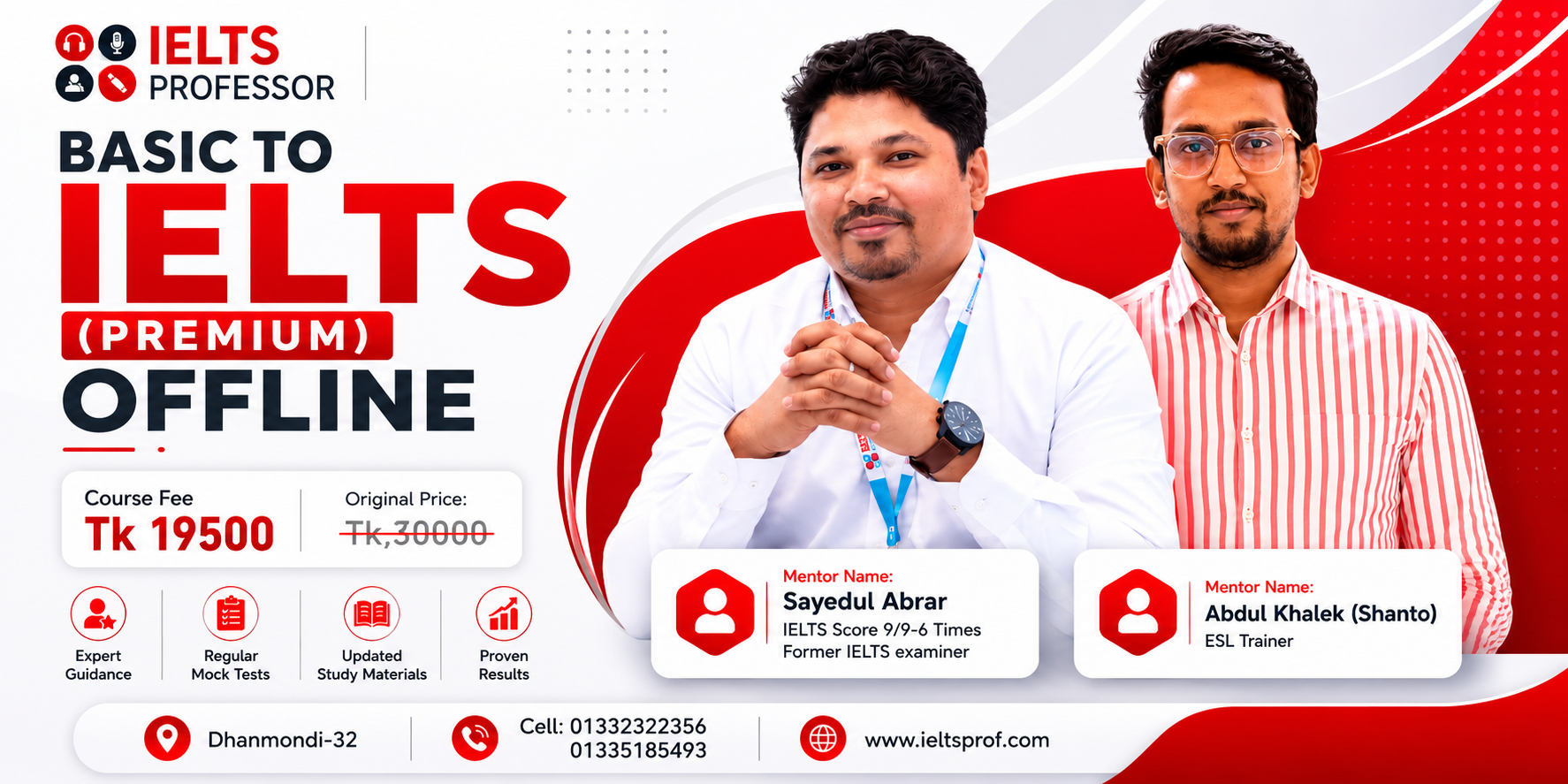
Basic to IELTS
৳ 19500.00
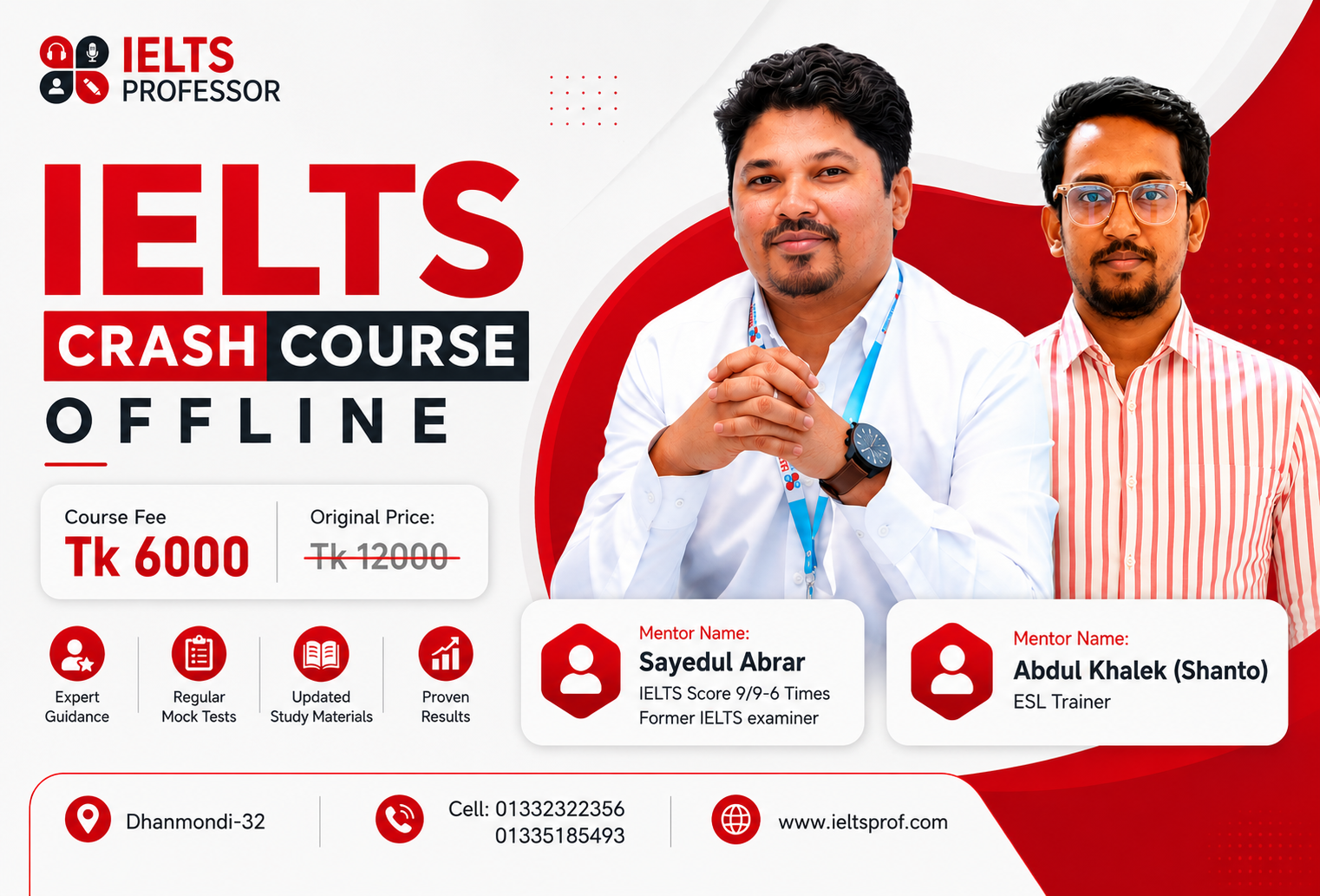
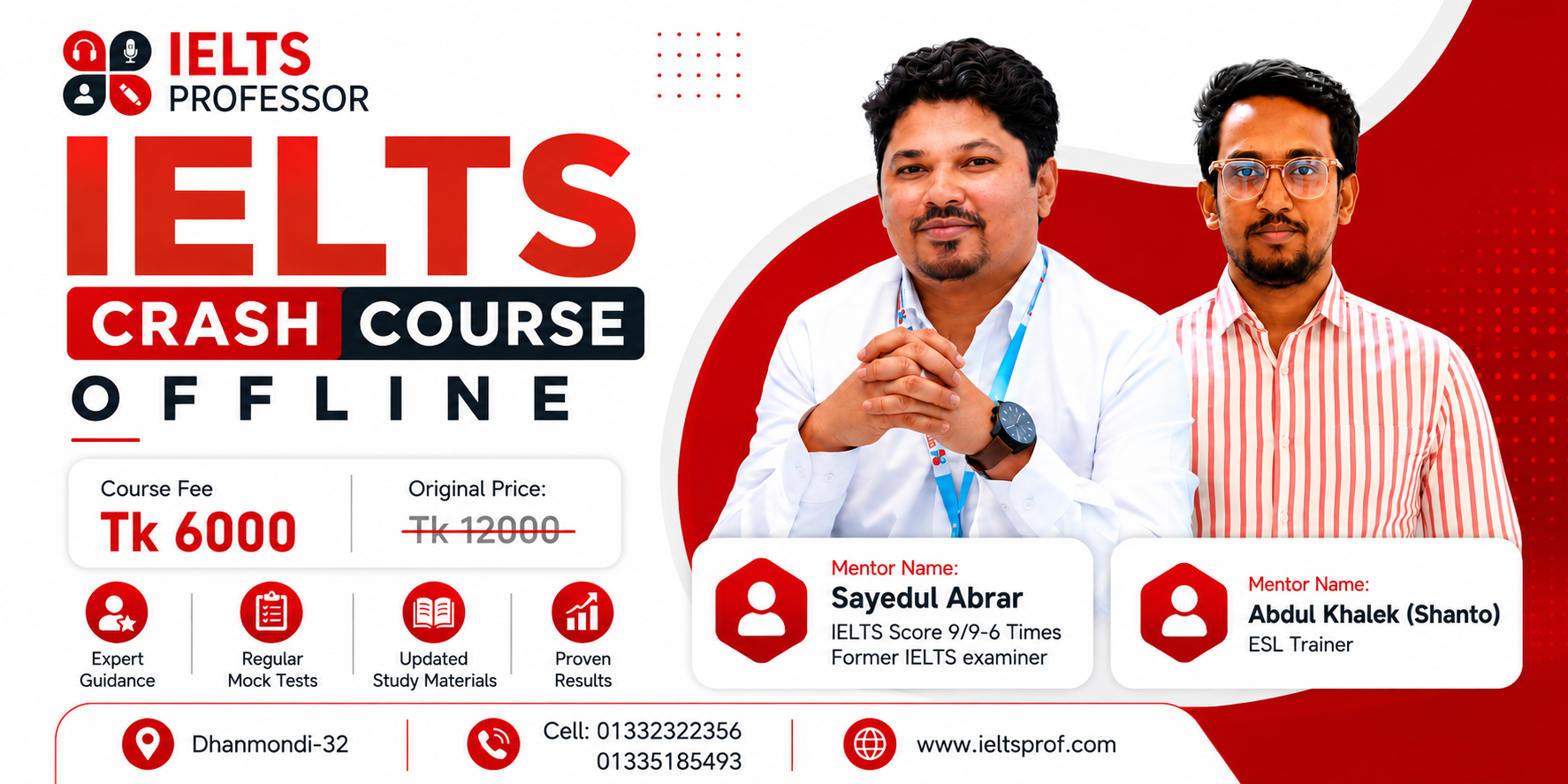
IELTS Crash Course
৳ 6000.00
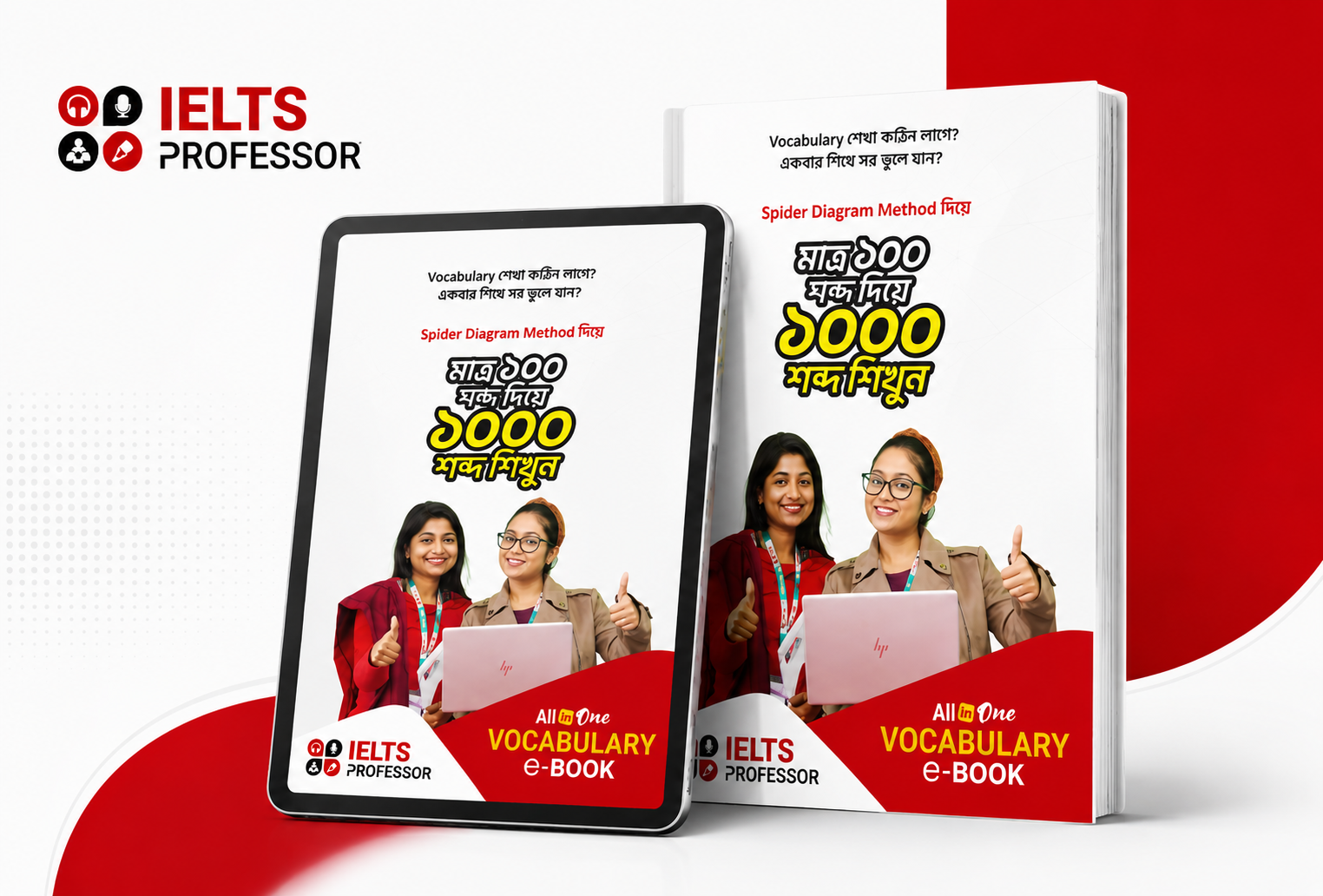
All in One Vocabulary
৳ 249.00

Premium 7+ IELTS Offline
৳ 14000.00