Call us:


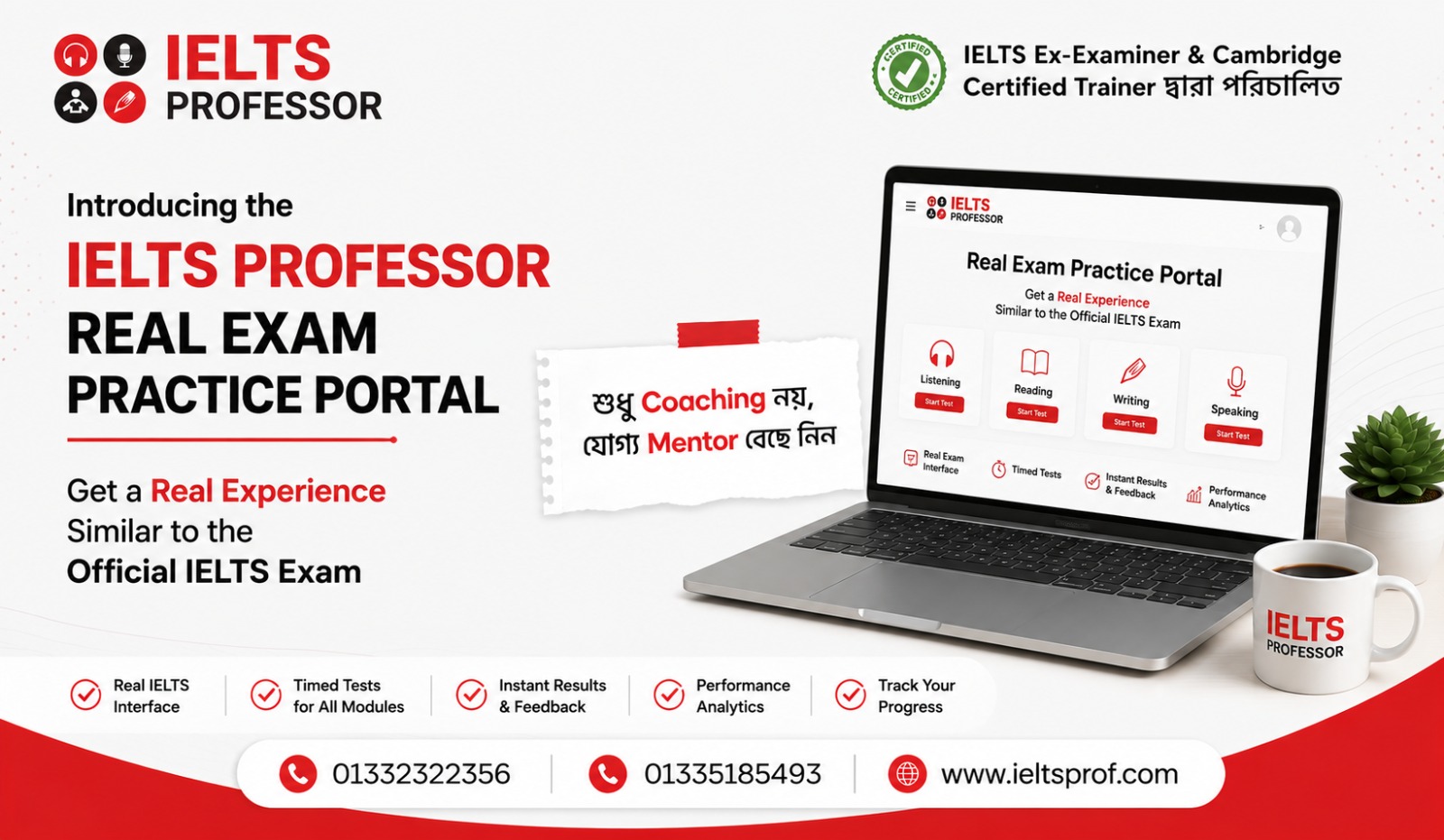
Preparing for IELTS is not only about learning grammar,
memorising vocabulary, or completing a few practice questions. A student may
understand English well but still lose marks because of poor time management,
unfamiliar test screens, nervousness, or weak exam strategy. This is especially
common among Bangladeshi candidates who have limited opportunities to practise
under realistic examination conditions. Introducing the IELTS Professor Real
Exam Practice Portal presents a practical answer to these challenges.
The portal is designed to bring exam-style practice into a
student’s daily preparation. It aims to provide a Real IELTS Exam Interface,
Timed Mock Tests, Instant Band Analysis, Detailed Feedback, Progress Tracking,
and access from different devices. Instead of practising without direction,
learners can understand their present level, recognise their repeated mistakes,
and build a clear improvement plan.
This approach is important because IELTS is a high-stakes international English test. More than four million IELTS tests were reportedly taken worldwide in a recent year, and over 12,500 organisations recognise the test. These numbers show how important IELTS has become for international education, employment, migration, and professional registration.
Why Realistic IELTS Practice Matters
Imagine a student named Farhan from Cumilla. He studies
English for three months, watches many lessons, and completes several Reading
passages. At home, he normally finishes one passage in 25 or 30 minutes. He
feels confident.
On the real test day, however, the clock continues to move
while he checks the same difficult question repeatedly. He spends too much time
on Passage 2 and has only 12 minutes left for Passage 3. He leaves several
answers incomplete.
Farhan’s problem was not only English. His main problem was
the absence of realistic, timed practice.
The official IELTS Trial Test is also conducted under timed
conditions because test familiarity can help candidates understand the
structure and approach the actual examination with greater confidence.
A realistic practice portal can help students learn:
- How
quickly they need to read
- When
they should skip a difficult question
- How to
manage the final minutes
- How to
move between questions
- How
pressure affects their concentration
- Which
question types consume the most time
- Whether
their performance remains stable during a full test
This is why Introducing the IELTS Professor Real Exam
Practice Portal: Get a Real Experience Similar to the Official IELTS Exam
is more than a collection of questions. Its value lies in recreating important
parts of the examination experience.
Understanding the Needs of Bangladeshi IELTS Students
Bangladeshi IELTS candidates come from many backgrounds.
Some study in English-medium institutions, while others complete their
education mainly in Bangla. Some live in Dhaka and can attend regular classes.
Others live in district towns where access to expert guidance may be limited.
Their goals are also different. One student may need IELTS
for a bachelor’s degree abroad. Another may be applying for a master’s
programme. Someone else may need a score for migration, professional
registration, or employment.
Despite these differences, many candidates face similar
difficulties.
Limited access to realistic mock tests
Students often practise from books, social media posts,
videos, and downloaded question sheets. These resources may be useful, but they
do not always recreate the complete testing process.
Financial pressure
IELTS preparation can involve course fees, travel costs,
books, mock tests, accommodation, internet expenses, and the official test fee.
For a middle-income family, these costs may create considerable pressure.
Because of this, some students try to take the official test
before they are fully prepared. A poor result may then lead to another test
fee, more preparation expenses, and emotional stress.
Weak time-management habits
Many candidates practise one question type at a time without
following the official time limit. They may complete a Reading passage slowly
and still count it as successful. During the real exam, however, they must work
under strict time conditions.
Lack of detailed feedback
A score alone does not always explain the problem. A student
may receive a low Writing score but remain unsure whether the weakness came
from task response, grammar, vocabulary, paragraph structure, idea development,
or coherence.
Cultural hesitation
Some Bangladeshi students feel uncomfortable speaking
openly, expressing personal opinions, or disagreeing politely. These habits can
affect Speaking performance. IELTS often requires candidates to explain,
compare, justify, speculate, and discuss unfamiliar subjects.
A good practice environment should therefore do more than
provide questions. It should help candidates become comfortable with the
behaviour expected in an international examination.
Real IELTS Exam Interface
One of the central features of the portal is the Real IELTS
Exam Interface. This feature can help learners become familiar with the visual
and practical experience of computer-based testing.
IELTS on computer is available in major Bangladeshi cities,
including Dhaka, Chattogram, and Sylhet. Students who plan to take the
computer-based version should therefore practise more than English knowledge.
They should also become comfortable reading from a screen, typing answers,
moving between questions, reviewing responses, and monitoring time.
A realistic interface can reduce confusion on test day.
Candidates can learn where information appears, how sections are organised, and
how to complete tasks without wasting valuable minutes.
Consider Nusrat, a hypothetical student from Bogura. She was
comfortable writing essays by hand, but her typing speed was low. During her
first online mock test, she wrote only 215 words for Writing Task 2. She knew
what she wanted to say, but she spent too much time searching for letters and
correcting typing errors.
After regular computer-based practice, her typing became
more natural. She also learned to leave a few minutes for checking grammar and
spelling. The improvement came not only from better English but also from
better control of the test interface.
That is the practical purpose behind Introducing the
IELTS Professor Real Exam Practice Portal. Familiarity can save time, reduce stress, and allow
students to focus on their actual language performance.
Timed Mock Tests and Exam Discipline
Timed Mock Tests are essential because time pressure changes
how a student performs.
A learner may answer 35 Reading questions correctly when no
limit is applied. The same learner may answer only 27 correctly within the
official time. This difference reveals an important truth: untimed ability and
exam ability are not always the same.
Timed practice can teach candidates to:
- Divide
time between tasks
- Avoid
becoming trapped by one difficult question
- Make
quick but reasonable decisions
- Maintain
concentration for a longer period
- Complete
all sections within the limit
- Review
answers efficiently
- Control
panic during the final minutes
A full mock test also helps students understand mental
tiredness. Many candidates perform well at the beginning but lose focus later.
A complete exam-style session develops the concentration needed to continue
working accurately.
For example, Rakib from Narayanganj regularly practised
Listening clips of five or ten minutes. His results were strong. However,
during his first full mock test, he missed several answers near the end because
his attention dropped.
He then began taking full-length Listening tests twice a
week. He reviewed not only wrong answers but also the moments when his
concentration decreased. After several weeks, his accuracy became more stable.
This illustrates why Timed Mock Tests should not be treated
only as score-checking tools. They are training sessions for attention,
decision-making, confidence, and discipline.
Instant Band Analysis for Better Decisions
Many IELTS candidates continue studying without knowing
their approximate performance level. They may say, “I think I am around Band
7,” but that belief may be based on one easy test or an informal opinion.
Instant Band Analysis can give students a faster view of
their performance after completing an objective section or mock activity. This
information can help them identify patterns.
For instance, a learner might discover that:
- Listening
is regularly around Band 7
- Reading
changes between Band 5.5 and 6
- Writing
remains weaker than the receptive skills
- Matching
Headings causes repeated difficulty
- Sentence-completion
questions produce spelling errors
- Performance
falls when the student takes a full-length test
IELTS reports an overall band score and separate scores for
Listening, Reading, Writing, and Speaking. The current official test statistics
also present performance by individual skill because strength in one area does
not automatically mean strength in every area.
Instant analysis should therefore be viewed as a diagnostic
tool. It can guide preparation, but students should still understand that
automated or estimated practice results are not official IELTS scores.
The best use of band analysis is to ask three questions:
- What
is my present level?
- Which
skill is holding back my overall result?
- What
should I practise next?
When students can answer these questions clearly,
preparation becomes more efficient.
Detailed Feedback That Explains the Problem
A score tells a student where they stand. Detailed Feedback
should help explain why they received that score and what they need to do next.
This is particularly important for Writing and Speaking.
These skills cannot be improved effectively through correct-answer checking
alone.
A candidate may write an essay with strong vocabulary but
receive a lower evaluation because the response does not fully answer the
question. Another student may have good ideas but organise them poorly. A third
candidate may use memorised expressions that sound unnatural.
Useful Writing feedback may examine:
- Whether
the question has been fully answered
- Whether
ideas are clearly developed
- Whether
paragraphs follow a logical order
- Whether
linking words are used naturally
- Whether
vocabulary is accurate and suitable
- Whether
grammar errors reduce clarity
- Whether
the required word count has been met
- Whether
examples support the main argument
Useful Speaking feedback may examine:
- Fluency
and hesitation
- Vocabulary
range
- Grammar
accuracy
- Pronunciation
- Development
of answers
- Repetition
- Memorised
responses
- Ability
to explain opinions
Detailed Feedback becomes most valuable when the learner
acts on it. Students should keep a correction notebook and record common
weaknesses. If the same issue appears repeatedly, it should become a priority.
For example, if a teacher or assessment repeatedly notes
that a student gives underdeveloped ideas, the student should practise building
answers with a simple pattern:
Statement, explanation, example, and result.
This turns feedback into practical improvement rather than
passive information.
Progress Tracking and Long-Term Improvement
IELTS progress is rarely a straight line. A student may
improve one week, perform poorly the next week, and then recover. One low score
does not always mean the learner is becoming weaker.
Progress Tracking can provide a broader picture. Instead of
judging ability from one test, students can observe performance over several
weeks.
The portal may help learners monitor:
- Number
of tests completed
- Average
score
- Best
and lowest scores
- Skill-by-skill
performance
- Frequently
missed question types
- Time
taken to complete tasks
- Improvement
over a selected period
- Areas
that remain inconsistent
Suppose Jannatul wants an overall Band 7 for postgraduate
study. Her first results show:
- Listening:
7
- Reading:
6
- Writing:
5.5
- Speaking:
6.5
Without tracking, she might continue spending most of her
time on Listening because it feels comfortable. A progress dashboard would make
the real problem visible. Writing needs the greatest attention, followed by
Reading.
She could then adjust her weekly plan:
- Two
days for Writing Task 2
- One
day for Writing Task 1
- Two
days for timed Reading
- One
full mock test
- One
day for review and correction
After four weeks, she could compare the new results with the
earlier record. This is a more scientific approach than studying according to
mood.
AI-Based Performance Insights
AI-based analysis can make preparation more personal by
detecting repeated performance patterns. It may help students recognise
mistakes that are difficult to notice through self-study.
For example, a system might identify that a learner:
- Performs
poorly on True, False, Not Given questions
- Changes
correct answers during review
- Loses
accuracy near the end of long tests
- Uses
the same vocabulary repeatedly
- Makes
frequent spelling mistakes
- Writes
long introductions but weak body paragraphs
- Struggles
when the topic is unfamiliar
- Needs
too much time for one task type
These observations can help a student create a targeted
practice plan.
However, learners should use AI analysis responsibly.
Automated feedback can support learning, but it should not completely replace
qualified human guidance, particularly for Writing and Speaking. Language
contains meaning, tone, logic, and context. Some parts of a response require
professional judgement.
A balanced approach is often most effective:
- Use
automated analysis for regular practice
- Use
expert feedback for deeper correction
- Compare
both forms of guidance
- Track
whether suggested changes improve later performance
The aim is not to depend blindly on technology. The aim is
to use technology to study more intelligently.
Practice Anytime, Anywhere
Practice Anytime, Anywhere is especially useful for
Bangladeshi learners who cannot attend a physical centre every day.
A university student may have classes during the daytime. An
employee may return home late. A candidate living outside Dhaka may need
several hours to travel to a coaching centre. Female students may also face
family or transport limitations that reduce their ability to attend evening
sessions.
Access from computers, tablets, and smartphones can make
practice more flexible. A learner may complete a short exercise during a break,
review mistakes on a phone, and take a full test on a laptop at home.
British Council preparation resources also support online
and self-paced practice, including practice tests, videos, exercises, and
computer familiarisation materials. This reflects a wider change in IELTS
preparation: students now expect learning tools to be available beyond the
physical classroom.
Still, mobile access should be used wisely. A phone may be
suitable for reviewing vocabulary or checking feedback, but a laptop or desktop
computer is usually more appropriate for full computer-based mock tests.
How Bangladeshi Students Can Use the Portal Effectively
Real Exam Practice
Portal can be
most useful when students follow a structured method.
Begin with a diagnostic test
Take one complete test before beginning intensive
preparation. Do not spend several days preparing specifically for it. The
purpose is to understand your natural starting point.
Identify the weakest skill
Do not assume that all four skills need equal attention.
Review the results and find the skill that creates the greatest barrier to your
target score.
Create a realistic weekly plan
A student with university classes or employment may not be
able to study four hours every day. A shorter, consistent plan is better than
an unrealistic schedule that is quickly abandoned.
A practical plan may include:
- Four
focused study sessions each week
- One
timed sectional test
- One
full mock test every one or two weeks
- One
correction and review session
- Regular
Speaking practice
- Short
daily vocabulary revision
Review every test
Never finish a mock test, look at the band estimate, and
immediately start another test. Review is where much of the learning happens.
For every wrong answer, ask:
- Why
was my answer wrong?
- Did
I misunderstand the question?
- Did
I miss a keyword?
- Was
spelling the problem?
- Did
time pressure affect me?
- What
rule or strategy should I remember?
Repeat difficult question types
If Matching Headings causes problems, complete several
focused exercises before taking another full test. If Writing Task 1 is weak,
practise planning and organising responses instead of writing random essays
every day.
Practise under honest conditions
Do not pause the timer, check a dictionary, read answers
early, or receive help during a mock test. A false score can create dangerous
confidence.
A Story of Gradual Improvement
Let us consider the hypothetical journey of Mehedi, a
business graduate from Rajshahi.
Mehedi wanted to apply for a master’s programme in
Australia. He needed an overall Band 7, with no individual score below 6.5. His
first mock results were Listening 6.5, Reading 5.5, Writing 5.5, and Speaking
6.
He felt discouraged and considered booking the official test
immediately, hoping that luck would help him. His older brother advised him to
wait and prepare more systematically.
Mehedi began using exam-style practice. The Progress
Tracking section showed that he repeatedly lost marks in Reading because he
spent too long on difficult questions. Detailed Feedback also showed that his
Writing responses contained ideas but lacked clear development.
He followed a six-week plan. He practised Reading under
strict time limits, kept an error notebook, typed two essays each week, and
reviewed the same mistakes before starting new work. He also recorded his
Speaking answers and listened for hesitation and repetition.
At the end of six weeks, his mock performance became more
stable. He did not improve because of one secret technique. He improved because
realistic practice showed him what was wrong, and regular feedback helped him
correct it.
That is the deeper promise of Introducing the IELTS
Professor Real Exam Practice Portal: Get a Real Experience Similar to the
Official IELTS Exam. It encourages candidates to replace guesswork with
evidence.
Managing Financial Constraints
Financial pressure is a real concern for many Bangladeshi
families. Students should therefore make every practice session valuable.
A thoughtful financial strategy includes:
- Taking
diagnostic tests before paying for the official exam
- Avoiding
repeated bookings without measurable improvement
- Using
digital materials carefully instead of buying many similar books
- Sharing
study resources legally with friends
- Creating
a small peer-practice group
- Focusing
spending on areas where expert feedback is most necessary
- Setting
aside the test fee gradually
- Considering
travel and accommodation costs before selecting a test centre
The purpose of an online practice portal is not simply
convenience. It can reduce unnecessary travel and help students evaluate
readiness before making another major financial commitment.
Students should book the actual test when their recent mock
results are stable, not when one unusually high score appears.
Building Confidence Without Creating False Confidence
Confidence is necessary, but false confidence can be
harmful.
Real confidence comes from repeated evidence. A candidate
should feel confident because they have completed timed tests, reviewed
mistakes, improved weak areas, and produced stable results.
False confidence may come from:
- Repeating
familiar questions
- Completing
tests without time limits
- Receiving
help during practice
- Memorising
essays
- Ignoring
low scores
- Taking
only easy tests
- Comparing
performance with weaker students
A realistic portal can support healthy confidence by showing
both progress and remaining weaknesses. It can remind students that improvement
is possible while also keeping expectations honest.
Preparing for the Human Side of IELTS
Technology can prepare candidates for the interface and test
structure, but IELTS is still a language assessment. Students need meaningful
communication skills.
Speaking preparation should involve real conversation.
Candidates can practise with teachers, classmates, family members, or study
partners. They should learn to answer naturally rather than reciting memorised
scripts.
Writing preparation also needs human thinking. Students must
develop ideas, understand questions, organise arguments, and communicate
clearly.
IELTS is described as a four-skill test covering Listening,
Reading, Writing, and Speaking. Official results provide separate skill scores
because each ability represents a different part of language use. (IELTS)
Therefore, Introducing the IELTS Professor Real Exam
Practice Portal: Get a Real Experience Similar to the Official IELTS Exam
should be used as part of a complete preparation process that includes language
development, strategy, feedback, and communication practice.
Who Can Benefit from the Portal?
The portal may be especially useful for:
- First-time
IELTS candidates
- Students
preparing for computer-based IELTS
- Candidates
retaking the test
- University
students with limited free time
- Working
professionals
- Learners
outside major cities
- Students
who need regular mock tests
- Candidates
who struggle with time management
- Learners
who want to monitor improvement
- Students
seeking more structured preparation
It may also support teachers by giving them a clearer view
of student performance. Instead of relying only on classroom impressions,
instructors can use test records and repeated patterns to plan focused lessons.
Final Preparation Checklist
Before booking the official test, ask yourself:
- Have
I completed several full timed tests?
- Are
my recent scores reasonably stable?
- Can
I finish Reading within the time limit?
- Can
I type Writing responses comfortably?
- Do I
understand my common mistakes?
- Have
I received useful feedback on Writing?
- Have
I practised Speaking with real people?
- Can
I remain focused during a full test?
- Do I
know my target score for each skill?
- Have
I prepared for test-day stress?
When most answers are yes, you are probably moving from
general preparation toward genuine test readiness.
Summary
Official IELTS Exam offers a
structured way to practise through an exam-style interface, timed mock tests,
instant analysis, detailed feedback, progress tracking, and flexible device
access. For Bangladeshi students facing time, financial, location, or
confidence challenges, the portal can make preparation more focused. Its
greatest value will come from honest practice, careful review, consistent
improvement, and balanced use of expert guidance.
Frequently Asked Questions
1. Is the IELTS Professor Real Exam Practice Portal an
official IELTS examination platform?
- The portal is presented as an exam-practice system designed
to provide an experience similar to the IELTS testing environment.
- It should not be confused with the official IELTS
examination or an official Test Report Form.
- Scores produced during practice should normally be treated
as estimates or indicators of current performance.
- Only an authorised IELTS test result can be used for
university, immigration, or professional applications.
- However, realistic practice can help candidates become
familiar with time limits, interfaces, and question formats.
- Students should use the portal for preparation and book
their official exam through an authorised test provider.
2. Can the portal guarantee my desired IELTS band score?
- No responsible preparation system can guarantee a particular
official band score.
- Your result depends on your English ability, preparation
quality, test-day performance, and consistency across four skills.
- The portal may help by identifying weaknesses, measuring
progress, and providing structured mock tests.
- A learner must still study vocabulary, grammar,
pronunciation, reading skills, listening skills, and writing organisation.
- Detailed feedback must also be reviewed and applied instead
of being read once and forgotten.
- The portal can improve preparation quality, but the final
outcome remains dependent on the candidate’s performance.
3. Is it suitable for complete beginners?
- A beginner can use the portal, but complete beginners may
first need basic language development.
- Mock tests alone cannot teach every grammar rule, common
word, sentence pattern, or pronunciation skill.
- A beginner should combine portal practice with lessons,
simple reading, listening activities, and guided speaking.
- The first diagnostic test may produce a low score, but that
should not be seen as failure.
- It can provide a starting point and show which areas need
the most attention.
- As the learner improves, exam-style practice can gradually
become a larger part of the weekly routine.
4. How often should I take a full mock test?
- Most learners do not need to complete a full test every day.
- One complete mock test every one or two weeks may be enough
during the early stage of preparation.
- Between full tests, students should study weak areas and
practise specific question types.
- Closer to the official test date, one or two full mock
sessions per week may be useful.
- Every mock test should be followed by detailed review,
correction, and strategy adjustment.
- Taking many tests without analysing mistakes can create
tiredness without producing meaningful improvement.
5. Can I practise effectively using only a mobile phone?
- A mobile phone can be useful for reviewing feedback,
studying vocabulary, and completing short exercises.
- However, it may not reproduce the full experience of an
IELTS computer-based examination.
- For complete mock tests, a laptop or desktop computer is
generally more suitable.
- A larger screen can help students practise reading passages,
typing essays, and moving between questions.
- Students who plan to take IELTS on computer should practise
regularly with a physical keyboard.
- Mobile access is valuable for flexibility, but it should
support rather than replace full computer-based practice.
6. How can the portal help me improve my Writing score?
- The portal may help by giving structured tasks, time limits,
band-related analysis, and detailed feedback.
- Students should examine comments about task response,
organisation, vocabulary, grammar, and idea development.
- They should then rewrite weak paragraphs instead of
immediately moving to another essay.
- Keeping a record of repeated mistakes can make the
improvement process more focused.
- Automated feedback can be useful for regular practice, but
expert human review remains valuable.
- A strong Writing plan should include planning, writing,
correction, rewriting, and comparison over several weeks.
7. Can it improve my Speaking ability?
- The portal can support Speaking preparation by providing
prompts, practice opportunities, or performance guidance.
- However, speaking develops most effectively when learners
communicate with real people regularly.
- Candidates should practise answering naturally, extending
ideas, and explaining opinions without memorised scripts.
- Recording answers can help them notice hesitation,
repetition, grammar mistakes, and unclear pronunciation.
- A teacher or practice partner can also identify problems
that the speaker may not recognise alone.
- The best approach combines portal-based tasks,
self-recording, human conversation, and professional feedback.
8. What should I do when my mock scores keep changing?
- Changing scores are common, especially during the early
stages of preparation.
- Different topics, question types, concentration levels, and
test difficulty can affect performance.
- Do not judge your ability from one unusually high or low
result.
- Track several tests and calculate your normal performance
range over a few weeks.
- Review whether certain question types or time-management
problems cause repeated score drops.
- When recent results become more stable, you will have a more
reliable picture of your readiness.
9. How long should a Bangladeshi student prepare before
taking IELTS?
- There is no single preparation period that is suitable for
every candidate.
- A student with strong English may need several weeks of
focused exam practice.
- Another learner may need several months to build grammar,
vocabulary, writing, and speaking confidence.
- Take a diagnostic test and compare the result with the score
required by your institution or authority.
- Then create a realistic plan based on the size of the gap
and your available study time.
- Book the official test when repeated results show stable
readiness, not simply because friends are taking it.
10. Is the portal useful for students living outside Dhaka?
- Yes, online access can be especially useful for students
living in districts or remote areas.
- They may not have easy access to specialised IELTS centres,
regular mock tests, or experienced instructors.
- A digital portal can reduce travel time and allow practice
according to personal schedules.
- Students still need a stable internet connection and a
suitable device for full-length tests.
- They can also create online study groups for Speaking
practice and discussion.
- For deeper Writing or Speaking guidance, occasional online
sessions with a qualified teacher may be helpful.
11. How can I prepare when my budget is limited?
- Begin by taking a diagnostic test so you understand exactly
where help is needed.
- Avoid buying many books or joining several courses that
provide similar content.
- Use one structured preparation system consistently and
review every completed test carefully.
- Form a small study group to practise Speaking and exchange
ideas without additional cost.
- Spend money selectively on expert feedback, especially for
Writing and Speaking weaknesses.
- Most importantly, avoid booking the official examination
before your performance becomes reasonably stable.
12. Should I trust Instant Band Analysis completely?
- Instant Band Analysis can provide a useful estimate,
particularly for Listening and Reading practice.
- However, practice scores should not be treated as official
IELTS results.
- Writing and Speaking evaluation may involve language
quality, logic, meaning, and human judgement.
- Use instant analysis to identify trends, weaknesses, and
possible areas for improvement.
- Compare automated results with feedback from experienced
IELTS instructors whenever possible.
- The most reliable sign of readiness is consistent
performance across several realistic tests and assessments.
13. What should I do after receiving a low mock-test score?
- First, avoid making an emotional decision or booking another
test immediately.
- Separate your result by skill and identify where most of the
lost marks came from.
- Check whether the problem involved language knowledge, time
management, concentration, or test strategy.
- Review every wrong answer and write down the reason for the
mistake.
- Practise the weakest question type for several days before
taking another full mock test.
- A low score can become useful information when it leads to a
clear and practical improvement plan.
14. Can I use the portal for both Academic and General
Training IELTS?
- Students should select materials that match the version of
IELTS they plan to take.
- Listening and Speaking have major similarities, but the
Reading and Writing requirements are not identical.
- Academic candidates need practice suited to academic
passages, data descriptions, diagrams, and formal essays.
- General Training candidates need appropriate Reading texts
and letter-writing tasks.
- Using the wrong practice version may create confusion and
waste valuable preparation time.
- Before starting, confirm your required IELTS type with the
university, employer, immigration body, or professional organisation.
15. When should I book my official IELTS test?
- Book the official test when your recent mock results are
close to or above your required scores.
- One excellent result is not enough; look for stability
across several realistic practice sessions.
- Make sure no individual skill remains below the minimum
required by your chosen organisation.
- You should also be able to complete each section within the
time limit without outside assistance.
- Consider application deadlines, result-processing time,
possible retesting needs, travel, and financial preparation.
- A careful booking decision reduces unnecessary stress and
gives you the best chance to perform confidently.
Find Your Courses

IELTS A to Z
৳ 1990.00

7+ IELTS Offline Regular
৳ 8000.00

Online IELTS (Regular)
৳ 5000.00

Spoken English
৳ 3500.00

IELTS Regular Executive
৳ 8000.00

Basic to IELTS
৳ 19500.00
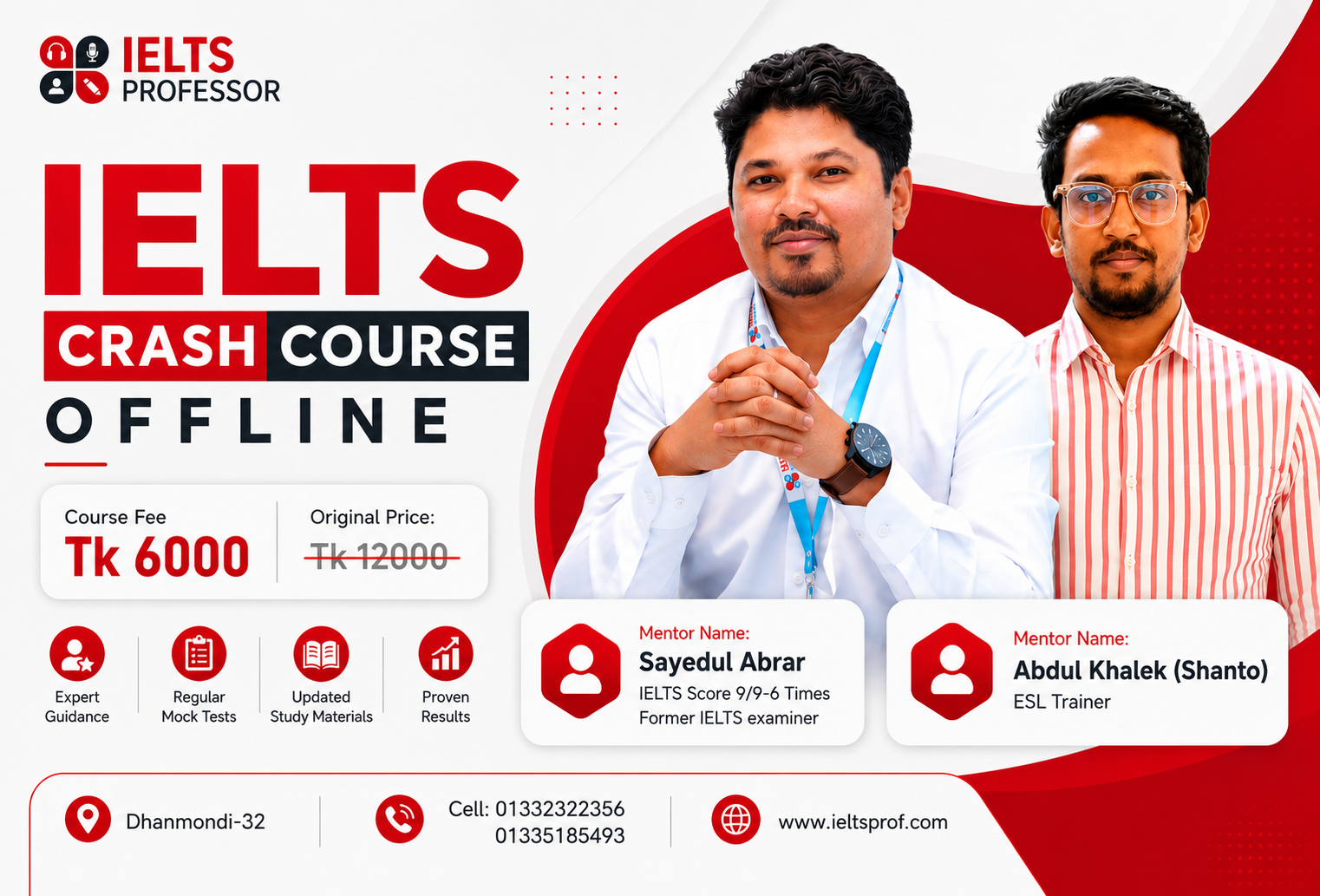
IELTS Crash Course
৳ 6000.00
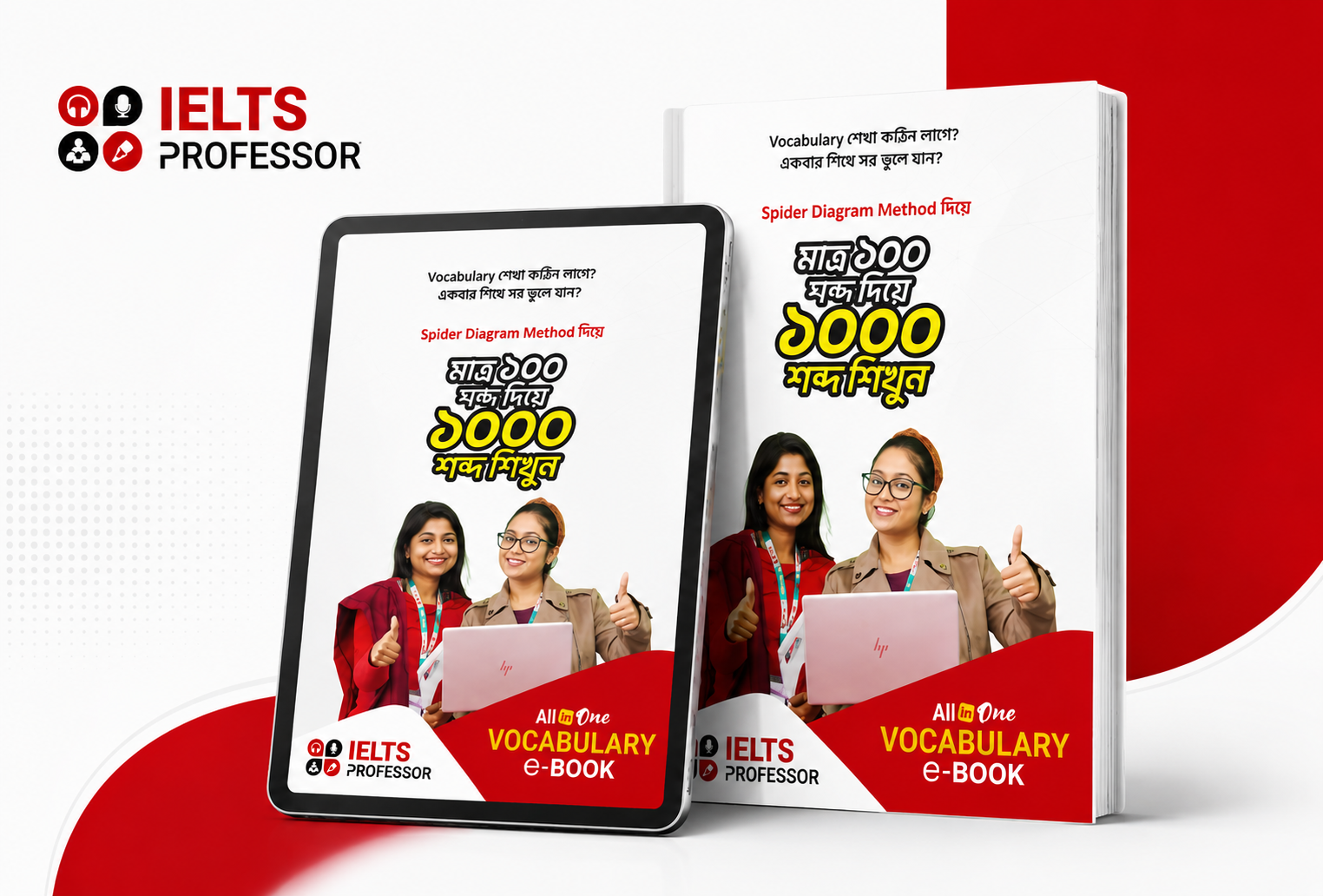
All in One Vocabulary
৳ 200.00

Premium 7+ IELTS Offline
৳ 14000.00