Call us:


Preparing for IELTS is not only about learning English. It is about understanding a test, managing time, correcting weak areas, and building confidence under pressure. Many Bangladeshi students begin their preparation with a simple online search for an IELTS crash course in Dhaka. However, choosing a course without understanding personal needs can waste both time and money.
This matters greatly in Bangladesh. Many students have university deadlines, visa plans, full-time jobs, family duties, or limited financial resources. Some have studied English for years but have rarely spoken it in daily life. Others understand grammar but struggle to develop ideas in Writing Task 2. A learner may be strong in reading yet become nervous during the speaking interview.
This guide explains how to make that decision carefully. It
also shows how Bangladeshi students can use coaching, mock tests, self-study,
teacher feedback, and realistic planning to reach their required band scores.
Why IELTS Preparation Feels Difficult for Bangladeshi
Students
IELTS assesses four skills: Listening, Reading, Writing, and
Speaking. Scores are reported on a nine-band scale, including half bands. The
test is accepted by thousands of educational institutions, employers,
professional bodies, and immigration authorities. More than four million IELTS
tests were taken globally in 2023, showing how widely the test is used.
Yet IELTS can feel unfamiliar to Bangladeshi students
because their school examinations are often based on memorising answers. IELTS
does not reward memorised essays, decorative words, or unnecessarily long
sentences. It rewards clear communication, accurate understanding, organised
ideas, suitable vocabulary, and control of grammar.
Consider the hypothetical story of Rafi, a final-year
engineering student from Mirpur. He received a conditional admission offer that
required an overall band score of 6.5. He believed his English was good because
most of his textbooks were written in English. During his first mock test,
however, he scored 5.0 in Writing.
Rafi’s problem was not a complete lack of English. He did
not answer every part of the question. His paragraphs lacked clear central
ideas, and he used difficult words incorrectly. A focused course helped him
identify these issues. After several weeks of practice, rewriting, and
feedback, his writing became simpler but much more effective.
This is why IELTSCoaching Near Me should be viewed as a question of diagnosis. Before
joining any programme, a student should know what is actually holding the score
back.
What Is an IELTS Crash Course?
An IELTS crash course is a short and intensive preparation
programme. It usually serves students who already have some English ability but
need fast, structured preparation before a test date, university deadline, or
visa application.
A strong crash programme normally includes:
- An
initial assessment or diagnostic test
- A
clear explanation of the IELTS format
- Timed
Listening and Reading practice
- Writing
Task 1 and Task 2 instruction
- Speaking
interviews and feedback
- Vocabulary
and grammar correction
- Full-length
mock tests
- Personal
guidance for weak areas
- A
final revision and test-day plan
The British Council explains that IELTS Listening and
Reading each contain 40 questions, with raw marks converted into band scores.
Writing and Speaking are assessed through detailed criteria rather than simple
right-or-wrong marking.
Therefore, a crash programme must do more than distribute
practice sheets. It should teach students why an answer is wrong, why an essay
remains at Band 5.5, and what specific changes are needed to move toward Band
6.5 or 7.0.
Who Should Join an IELTS Crash Course in Dhaka?
An IELTS crash course in Dhaka may be suitable when a
student has a limited preparation period but already understands basic English.
It may work well for:
- Students
with an examination date within four to eight weeks
- Applicants
facing university admission deadlines
- Previous
test-takers who missed their target by 0.5 or 1 band
- Professionals
who cannot attend a long programme
- Learners
who understand English but lack test techniques
- Candidates
who need intensive mock tests and feedback
- Students
who become distracted during self-study
However, a crash course may not be enough for a beginner who
struggles to understand basic English sentences. Such a student may first need
a foundation course before beginning intensive IELTS preparation.
Imagine Nabila, an HSC graduate from Narayanganj. She joined
a two-week course because one of her friends had received Band 7.0. Nabila soon
realised that she could not follow many reading passages and lacked basic
sentence control. The course was not bad, but it was not suitable for her
level.
After discussing the problem with a teacher, she completed a
foundation programme and then joined an intensive course. Her progress became
steadier because she followed the correct learning sequence.
IELTS Crash Course in Dhaka and IELTS Coaching Near Me:
Choosing the Right Programme
Searching for IELTS coaching near me is convenient,
especially in a crowded city. Long travel through Dhaka can reduce study time
and create physical exhaustion. However, distance should not be the only
selection factor.
A nearby centre is useful only when the teaching quality
matches the student’s needs.
Before paying any fee, ask these questions:
- Is
there a placement or diagnostic test?
- How
many students are placed in one class?
- Who
checks the writing scripts?
- Is
individual speaking practice available?
- How
many full mock tests are included?
- Are
mock tests conducted under timed conditions?
- Will
the teacher explain band descriptors?
- Are
missed classes replaceable?
- Is
there a separate support system for weak students?
- Are
course promises realistic?
A professional institution should not guarantee a band score
without assessing the learner. Improvement depends on starting level,
attendance, home practice, feedback quality, study time, and performance on the
actual examination day.
Why Location Still Matters in Dhaka
Location may not determine teaching quality, but it affects
consistency. A student travelling two hours each way may eventually miss
classes, arrive tired, or stop completing homework.
Dhanmondi is accessible from several major residential and
educational areas. Students around Mohammadpur, Sukrabad, Jigatola, Kalabagan,
Farmgate, New Market, Lalmatia, and parts of central Dhaka may find the area
manageable. IELTS Professor operates in the Dhanmondi and Sukrabad area, making
it one option for students comparing local programmes. Its published
information identifies its location near Metro Shopping Mall in Dhanmondi.
Still, students should visit or contact any centre before
enrolling. Ask about current instructors, batch size, schedules, writing
correction, speaking practice, and mock-test arrangements. A convenient address
is helpful, but a meaningful learning system is more important.
What a Good IELTS Coaching Programme Should Teach
Understanding the Test Before Practising
Many students begin by solving random tests. This often
creates frustration because they repeat mistakes without understanding them.
A good course first explains:
- The
purpose of each module
- The
question types
- The
scoring method
- The
time limits
- Common
traps
- The
difference between Academic and General Training
- The
difference between knowledge and test performance
Once these basics are clear, practice becomes more
productive.
Listening Skills
Bangladeshi students sometimes expect every speaker to use
the same accent. IELTS recordings may include different standard English
accents. Learners must focus on meaning rather than becoming afraid of
pronunciation differences.
Useful listening habits include:
- Reading
questions before the recording begins
- Predicting
the type of missing word
- Watching
for singular and plural forms
- Checking
spelling
- Recognising
corrections made by speakers
- Moving
forward after missing one answer
- Practising
with earphones and speakers
A crash course should teach students to analyse mistakes. A
wrong answer may come from weak spelling, loss of attention, limited
vocabulary, or failure to follow the conversation.
Reading Skills
Many learners try to understand every word in a passage.
This wastes time.
IELTS reading requires students to locate information,
recognise paraphrasing, understand the writer’s position, and manage time. A
teacher should demonstrate how one idea may appear in the question and passage
through different words.
Students need practice in:
- Skimming
for the general meaning
- Scanning
for specific details
- Matching
headings
- True,
False, and Not Given questions
- Yes,
No, and Not Given questions
- Sentence
completion
- Summary
completion
- Time
management
Writing Skills
Writing is often the greatest challenge for Bangladeshi
test-takers. Students may memorise introductions, use unnatural vocabulary,
write very long sentences, or fill paragraphs with general statements.
IELTS Writing is assessed through specific criteria. These
include task achievement or task response, organisation, vocabulary, grammar,
and accuracy. Official IELTS band descriptors explain what examiners look for
at different score levels.
A useful writing class should include:
- Question
analysis
- Idea
development
- Paragraph
planning
- Introductions
and conclusions
- Topic
sentences
- Supporting
explanations
- Relevant
examples
- Grammar
correction
- Vocabulary
in context
- Rewriting
after feedback
The teacher’s correction should explain patterns. Simply
writing “grammar mistake” beside a sentence is not enough.
Speaking Skills
Many Bangladeshi students fear being judged for their
accent. IELTS does not require a British or American accent. The candidate
needs understandable pronunciation, natural development of ideas, suitable
vocabulary, grammar control, and reasonable fluency.
A student should not memorise full speaking answers.
Examiners may change the question or ask follow-up questions, making memorised
speech sound unnatural.
A good course should provide:
- One-to-one
speaking simulations
- Part 1
practice
- Cue-card
planning
- Part 3
discussion practice
- Pronunciation
support
- Fluency
exercises
- Recorded
answers
- Personal
feedback
IELTS Crash Course in Dhaka and IELTS Coaching Near Me: A
Student Success Story
Let us consider the realistic story of Farhana, a pharmacy
graduate from Cumilla who moved temporarily to Dhaka for IELTS preparation. Her
target was Band 7.0, but she had only six weeks before an application deadline.
Her first mock results were:
- Listening:
6.5
- Reading:
6.0
- Writing:
5.5
- Speaking:
6.0
Farhana initially wanted to complete two full tests every
day. Her instructor advised against this. She needed correction more than
repetition.
Her study plan changed. She practised one writing task
daily, but she rewrote it after receiving feedback. She recorded speaking
responses every evening. She kept a notebook of reading paraphrases and
analysed each listening mistake.
By the final week, her mock performance became more stable.
She did not become a different person or learn thousands of new words. She
learned how to use the English she already knew more accurately.
Her story illustrates the real purpose of IELTS Crash
Course in Dhaka . Intensive preparation works
best when it replaces panic with a clear process.
A Practical Four-Week Crash Plan
Week One: Diagnosis and Foundation
Take a full mock test and identify the weakest skill.
Study the test format, scoring system, question types, and
timing. Review basic grammar errors that appear repeatedly in writing and
speaking.
Do not rush to complete too many tests.
Week Two: Skill Development
Practise each skill separately.
Complete reading passages with detailed review. Listen to
recordings and study transcripts after answering. Write both Task 1 and Task 2.
Record speaking responses and listen to them critically.
Week Three: Timed Practice
Start working under real time limits.
Complete full Listening and Reading sections. Write both
tasks within 60 minutes. Attend speaking simulations. Review error patterns
every evening.
Week Four: Mock Tests and Final Correction
Take full mock tests under realistic conditions.
Avoid learning large amounts of new material. Focus on
familiar methods, sleep properly, prepare identification documents, confirm the
test schedule, and reduce unnecessary stress.
Financial Challenges and Affordable Preparation
IELTS preparation creates a serious financial concern for
many Bangladeshi families. Students may need to pay for coaching,
transportation, books, mock tests, examination registration, university
applications, document processing, and visa-related services.
A candidate should prepare a budget before joining a
programme.
To control costs:
- Compare
course content rather than advertisements
- Ask
whether mock tests are included
- Use
official free preparation materials
- Borrow
books instead of buying many editions
- Join
a batch that matches the current level
- Avoid
paying for repeated courses without diagnosis
- Combine
coaching with disciplined self-study
- Use
public transport when practical
- Share
speaking practice with a reliable partner
- Take
the real examination only after stable mock performance
The cheapest course is not always the most affordable
choice. A weak programme may lead to another examination attempt, causing
greater expense.
Cultural and Psychological Barriers
Some students hesitate to speak because they fear classmates
will laugh at their mistakes. Others were taught that a good student must
always give a perfect answer. This belief creates silence and anxiety.
Language learning requires visible mistakes. A learner who
speaks, receives correction, and tries again usually improves faster than
someone who waits for perfect grammar.
Family expectations can also create pressure. Parents may
assume that one month of coaching guarantees Band 7.0. Students should explain
that IELTS results depend on present ability and daily practice.
Female students may face additional travel or scheduling
concerns. Choosing a safe location, suitable class time, and reliable transport
can improve attendance. Online support may also help when travelling at night
is difficult.
Common Mistakes During Intensive Preparation
Students often damage their progress by:
- Memorising
full essays
- Using
uncommon words without understanding them
- Ignoring
spelling mistakes
- Practising
without feedback
- Taking
mock tests every day without reviewing errors
- Changing
strategies repeatedly
- Studying
late at night and sleeping poorly
- Comparing
scores constantly with friends
- Booking
the examination too early
- Expecting
coaching to replace home practice
A crash course gives direction, but improvement still
happens through individual effort.
IELTS Crash Course in Dhaka and IELTS Coaching Near Me:
Final Decision Checklist
Before enrolling, evaluate the programme using a simple
checklist.
A suitable course should offer:
- A
realistic assessment
- Qualified
and active instructors
- Manageable
class size
- Regular
writing correction
- Individual
speaking opportunities
- Timed
mock tests
- Clear
study materials
- Progress
tracking
- Practical
homework
- Honest
guidance about test readiness
Students comparing IELTS Professor in Dhanmondi with other
coaching options should apply the same standards to every institution. Personal
needs should guide the decision rather than social media popularity alone.
Summary
IELTS Coaching Near Me
is not simply about finding the nearest classroom. It is about choosing focused
instruction, honest assessment, useful feedback, realistic mock tests, and a
study plan that matches the learner’s level. Bangladeshi students can improve
their results by controlling costs, overcoming speaking anxiety, reviewing
mistakes, and combining coaching with disciplined daily practice.
Frequently Asked Questions
1. Can I prepare for IELTS in one month?
- Yes, one month may be enough for a student who already has a reasonable level of English.
- The first step should be a full diagnostic test.
- Your weak modules must receive more time than your strong modules.
- Daily writing and speaking feedback will be especially important.
- A beginner may need a longer foundation period.
- Do not book the examination until mock scores become reasonably stable.
2. How do I choose the best IELTS crash course in Dhaka?
- Begin by checking whether the course offers a placement test.
- Ask who teaches the classes and who checks writing scripts.
- Find out how much personal speaking practice is provided.
- Confirm the number of full mock tests included in the fee.
- Compare class size, travel time, and course schedule.
- Choose evidence of teaching quality rather than unrealistic promises.
3. Is IELTS coaching near me always the best option?
- A nearby centre can save travel time and reduce tiredness.
- However, location does not guarantee effective instruction.
- A distant centre with strong feedback may be more useful than a weak nearby class.
- You should balance teaching quality with practical travel concerns.
- Attend a counselling session or trial class when available.
- Select the programme that you can attend regularly and seriously.
4. Is IELTS Professor in Dhanmondi suitable for every
student?
- IELTS Professor in Dhanmondi may be convenient for learners living nearby.
- However, no single institution is automatically suitable for every candidate.
- Students should check the current teachers, class size, schedule, and feedback process.
- They should also discuss their target band and examination timeline.
- A diagnostic assessment can show whether a crash or foundation course is needed.
- The final decision should be based on personal learning requirements.
5. Can a crash course guarantee Band 7.0?
- No responsible course can guarantee a particular IELTS score.
- Teachers can explain strategies, identify mistakes, and provide structured practice.
- The final result also depends on your current English ability.
- Attendance, homework, health, confidence, and exam-day performance matter.
- Be careful when an institution promises a band without testing your level.
- Look for measurable progress in mock tests instead of verbal guarantees.
6. How many hours should I study every day?
- Most crash-course learners need about two to four focused hours daily.
- The exact amount depends on the starting score and available time.
- Long hours are not useful when the learner is tired or distracted.
- Divide study time among practice, correction, vocabulary, and review.
- Include short breaks to maintain concentration.
- Consistency is more effective than one exhausting study session.
7. How can I improve IELTS Writing quickly?
- Start by learning how to analyse the exact question.
- Plan the main ideas before writing complete paragraphs.
- Use clear sentences instead of forcing difficult vocabulary.
- Ask a qualified teacher to identify repeated weaknesses.
- Rewrite corrected tasks so that feedback becomes active learning.
- Practise both Task 1 and Task 2 within the official time limit.
8. Why does my writing score remain at Band 5.5?
- You may be answering only part of the question.
- Your ideas may be relevant but not sufficiently explained.
- Paragraphs may lack clear central points or logical connections.
- Grammar mistakes may reduce accuracy throughout the response.
- Memorised sentences can also sound unnatural or irrelevant.
- Use detailed feedback to identify which assessment criterion is limiting you.
9. How can I improve my speaking without a partner?
- Record answers on your mobile phone every day.
- Listen again and notice pauses, repetition, and unclear pronunciation.
- Practise extending simple answers with reasons and examples.
- Speak about familiar topics such as study, work, family, and transport.
- Compare later recordings with earlier ones to observe progress.
- Teacher-led mock interviews are still helpful for realistic pressure.
10. Should I take computer-delivered or paper-based
IELTS?
- Choose the format that matches your strongest working habits and local availability.
- Computer-based testing may suit candidates who type quickly and edit comfortably.
- Paper-based testing may feel easier for students who prefer handwriting.
- The language skills and scoring standards remain based on IELTS requirements.
- Practise using the exact format you plan to take.
- Confirm the available test options before making the booking.
11. How many mock tests should I complete?
- Quality of review is more important than the total number.
- A learner may take one diagnostic test at the beginning.
- Later, one or two full mock tests per week may be useful.
- During the final week, additional timed practice can build confidence.
- Every wrong answer should be examined carefully.
- Repeated testing without correction may simply repeat the same weaknesses.
12. Can weak grammar prevent me from getting Band 7?
- Grammar is important, but perfect grammar is not required.
- You need a useful range of sentence structures with good control.
- Frequent errors can reduce clarity and lower the score.
- Focus first on mistakes that appear repeatedly in your work.
- Practise accurate simple and compound sentences before complex structures.
- Grammar should support meaning rather than make writing unnecessarily
complicated.
13. What should I do if my family cannot afford expensive
coaching?
- Begin with an honest assessment of your current ability.
- Use official preparation resources and free practice materials carefully.
- Spend money mainly on services that provide meaningful correction.
- A smaller course with feedback may be better than an expensive large batch.
- Create a speaking group with serious friends.
- Prepare fully before paying for the real examination.
14. How can I manage IELTS preparation with a job or
university?
- Create a weekly schedule around fixed work or class hours.
- Use mornings or evenings for short, focused study sessions.
- Complete longer mock tests during weekends or holidays.
- Carry reading passages or vocabulary notes during daily travel.
- Inform your teacher when work deadlines affect attendance.
- A realistic routine is more sustainable than an overly ambitious plan.
15. What should I do during the final seven days?
- Review familiar strategies instead of changing your complete method.
- Complete a small number of timed tests and analyse the results.
- Revise common spelling, grammar, and vocabulary errors.
- Practise speaking naturally without memorising new scripts.
- Confirm the venue, schedule, identification documents, and travel plan.
- Sleep properly so that your attention remains strong on test day.
Final Thoughts
The main lesson of IELTS Crash Course in Dhaka and IELTS
Coaching Near Me is simple. Fast preparation does not mean careless
preparation. Students need diagnosis, guided practice, correction, repetition,
and emotional balance. Whether you study in Dhanmondi or another part of Dhaka,
the right programme should help you understand your weaknesses and build an
achievable path toward your target score.
Find Your Courses

IELTS A to Z
৳ 1990.00
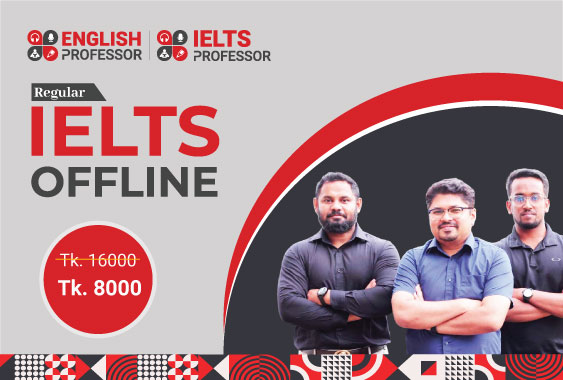
7+ IELTS Offline Regular
৳ 8000.00
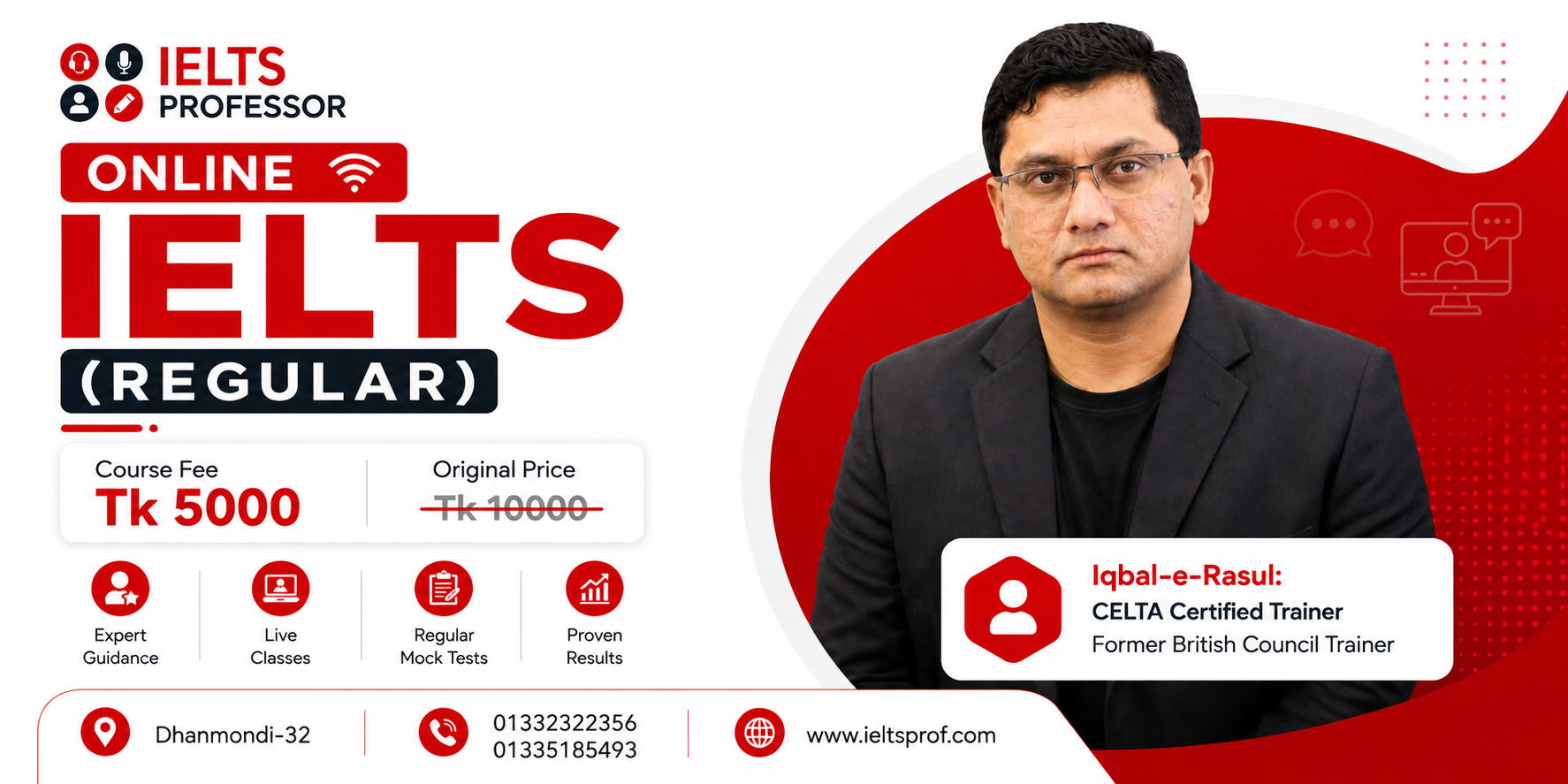
Online IELTS (Regular)
৳ 5000.00

Spoken English
৳ 3500.00
IELTS Regular Executive
৳ 8000.00
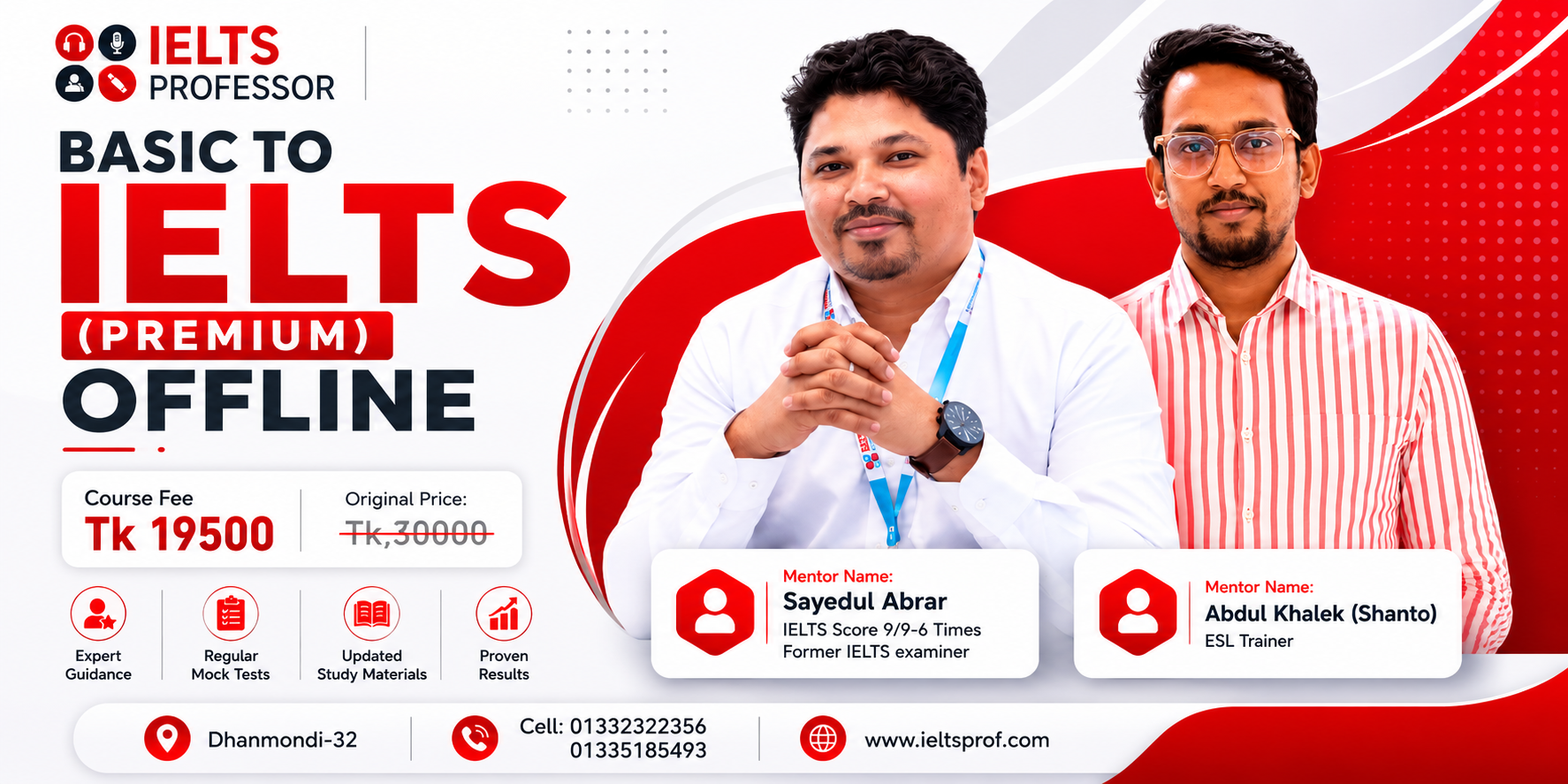
Basic to IELTS
৳ 19500.00
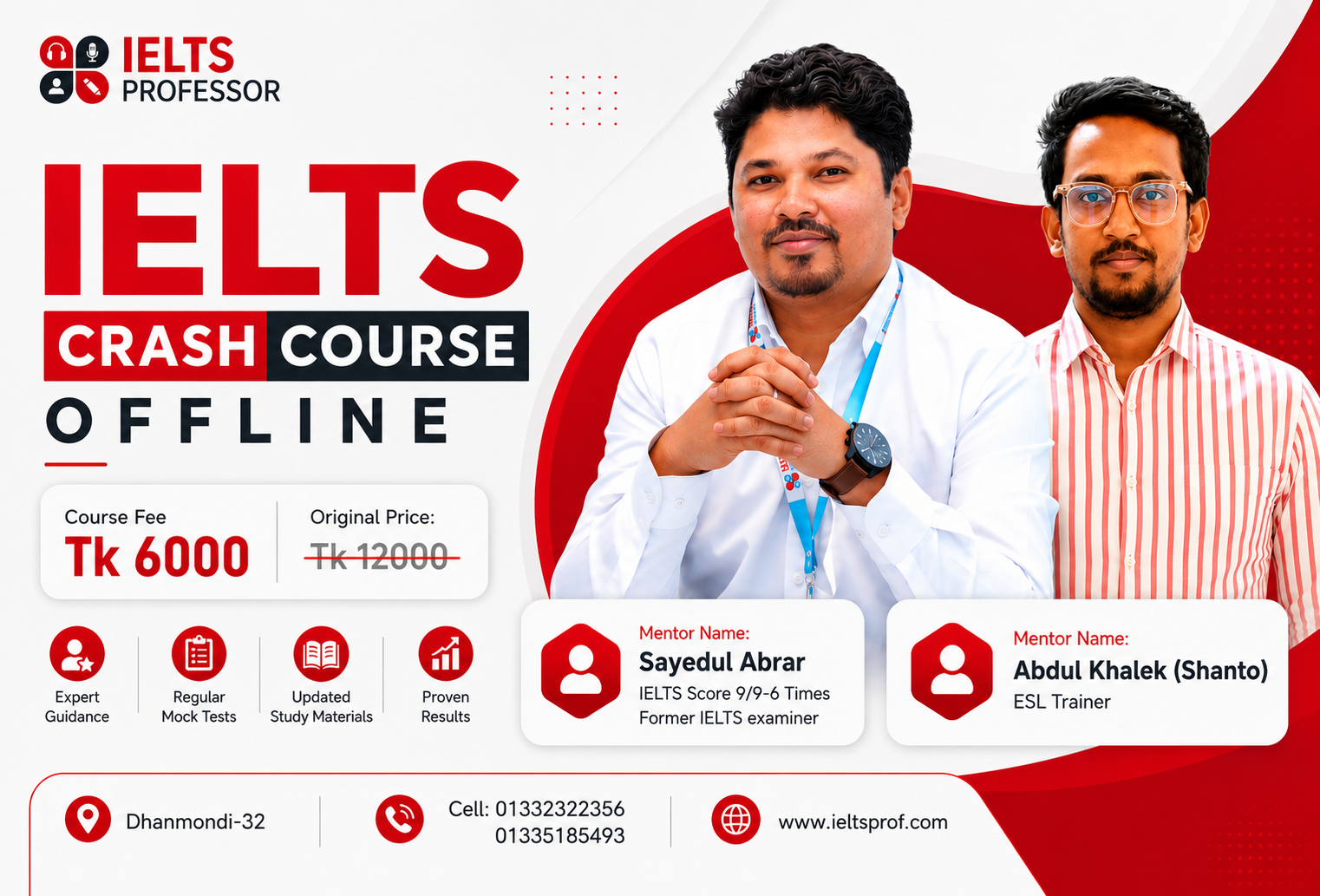
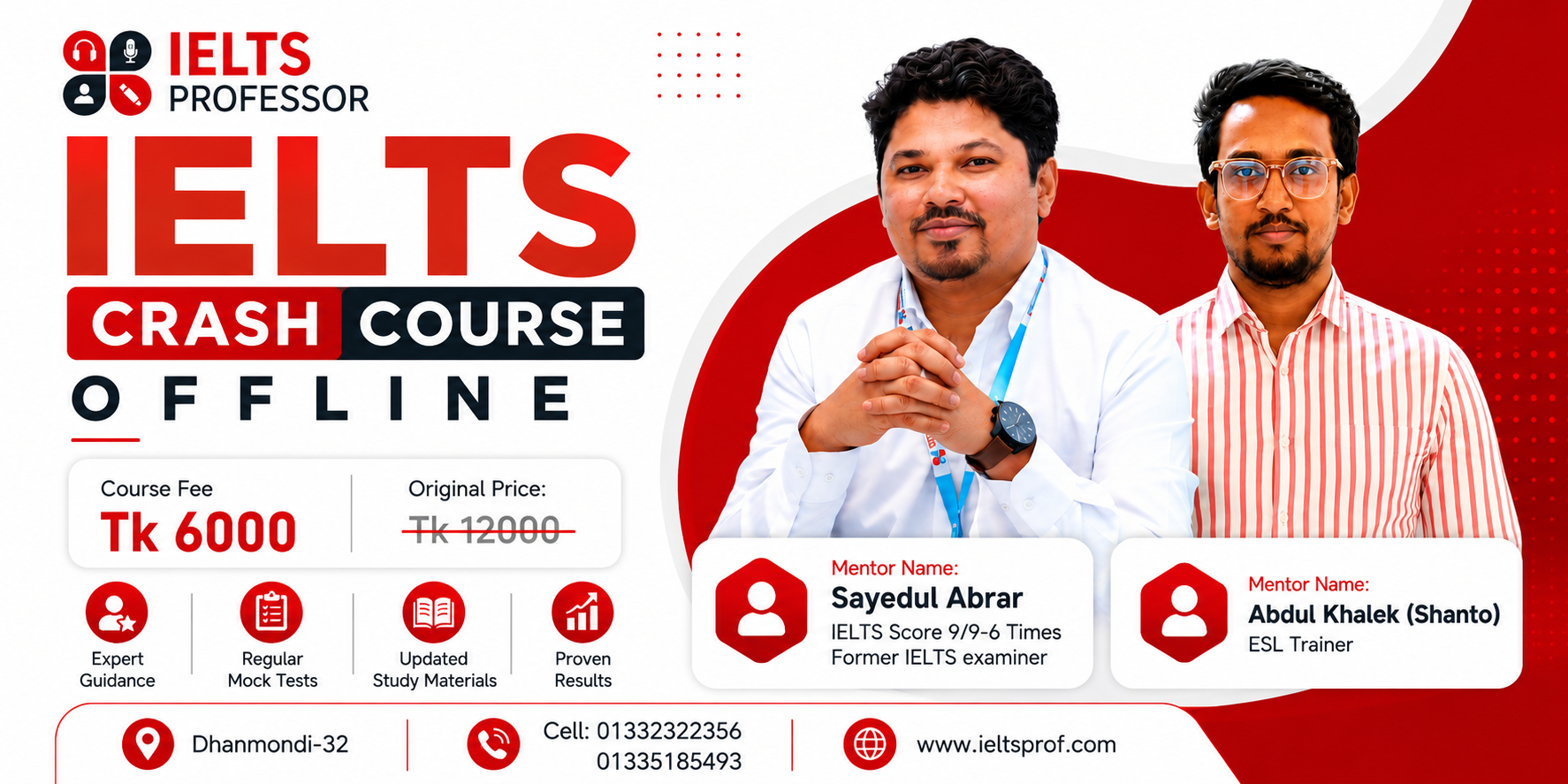
IELTS Crash Course
৳ 6000.00
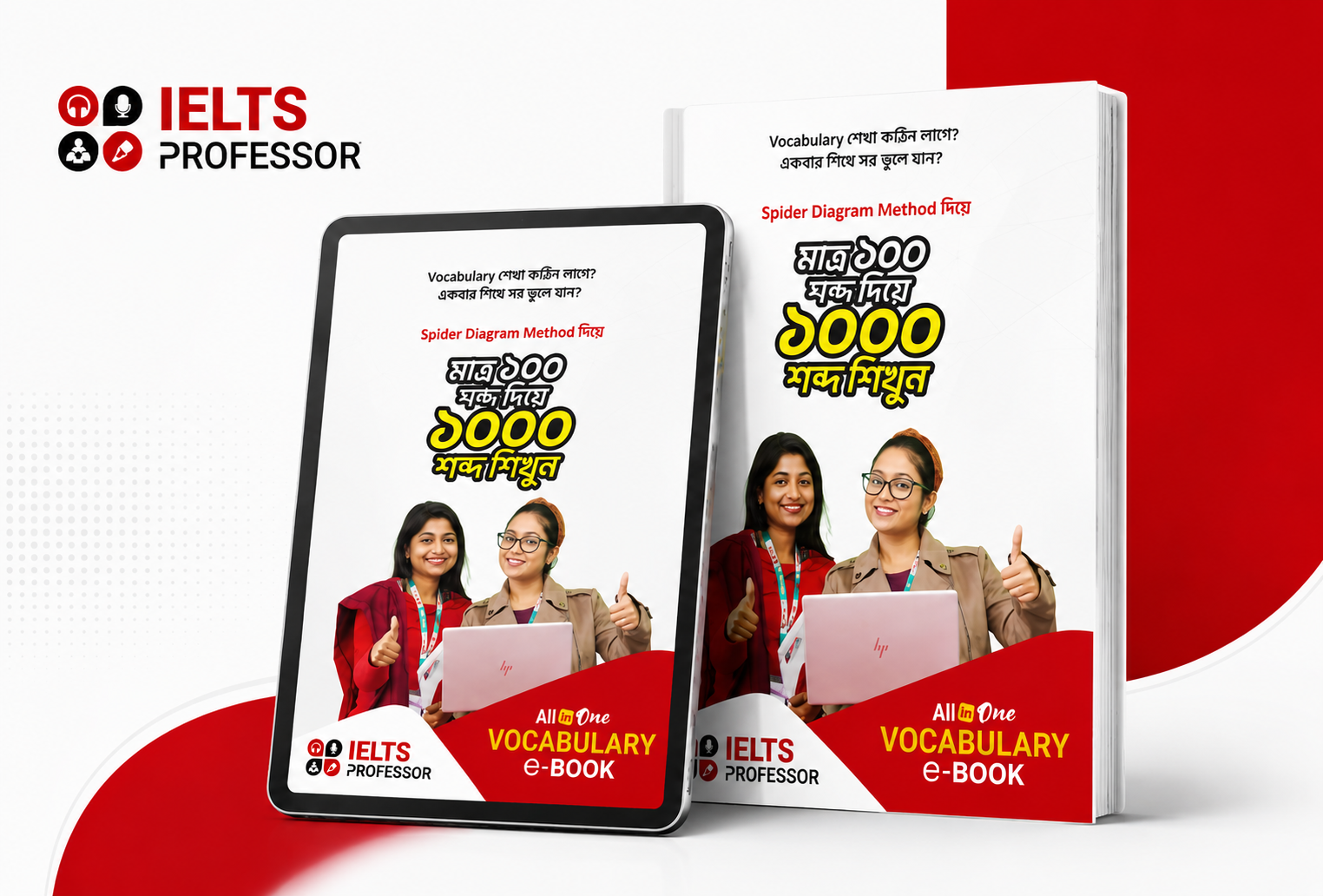
All in One Vocabulary
৳ 200.00

Premium 7+ IELTS Offline
৳ 14000.00