Call us:


The IELTS speaking topics of 2026 are important for
Bangladeshi students who plan to study, work, or settle abroad. Many learners
feel nervous about the Speaking test because they do not know what the examiner
may ask. Some students try to memorise hundreds of model answers. Others
collect recent cue cards from social media and believe that the same questions
will appear in their test. However, effective IELTS preparation requires a
deeper and more practical approach.
The Speaking test measures whether a candidate can communicate ideas naturally. It does not only measure grammar or difficult vocabulary. The examiner also listens to pronunciation, fluency, logical development, and the ability to explain an opinion. IELTS states that the Speaking test takes around 11 to 14 minutes and contains three parts. The format is the same for IELTS Academic and IELTS General Training.
The main purpose of IELTS Speaking Topics of 2026: A
Practical Guide for Bangladeshi Students is not to help you memorise
answers. It is to help you build flexible stories, examples, opinions, and
useful language that you can adapt during the real test.
Understanding the IELTS Speaking Test in 2026
Before studying topics, you should understand the structure
of the test.
Part 1: Introduction and familiar questions
Part 1 normally lasts four to five minutes. The examiner
asks questions about familiar matters such as your home, studies, work, free
time, family, hometown, food, weather, music, or daily routine. British Council
practice materials suggest that candidates may face around two topic groups
with several questions in each group.
Typical questions may include:
- Are
you a student or do you work?
- What
do you like about your hometown?
- How do
you normally spend your free time?
- Do you
enjoy cooking?
- What
kind of weather do you prefer?
- Do you
often use public transport?
Your answers should normally contain two or three connected
sentences. A one-word answer does not show enough English ability.
Part 2: The individual long turn
In Part 2, you receive a task card. You usually have one
minute to prepare and may speak for up to two minutes. The card gives you a
topic and several points that you can discuss.
For example:
Describe a teacher who influenced you.
You should say:
- Who
the teacher was
- What
subject the teacher taught
- What
you learned from the teacher
- Why
the teacher influenced you
The examiner is not checking whether every detail is
factually perfect. The examiner wants to hear whether you can organise and
extend your ideas.
Part 3: Deeper discussion
Part 3 is connected to the Part 2 subject, but the questions
become broader and more analytical. You may need to compare the past and
present, discuss social changes, explain causes, predict the future, or suggest
solutions.
For example, after describing a teacher, you may be asked:
- What
qualities make someone a good teacher?
- Has
technology changed the role of teachers?
- Should
teachers be highly paid?
- Why
do some students respect teachers more than others?
Part 3 tests your ability to discuss abstract ideas and
support opinions with reasons and examples.
Are the IELTS Speaking Topics of 2026 Official
Predictions?
No website, teacher, coaching centre, or social media group
can guarantee the exact questions you will receive. IELTS uses a wide question
bank, and topics may be changed, reused, or presented in different forms.
Official and recognised preparation sources regularly
mention broad themes such as personal information, hobbies, work, education,
travel, family, technology, hometowns, entertainment, and daily activities.
Therefore, treat any list of IELTS speaking topics of
2026 as a preparation map, not as a leaked examination paper. Prepare ideas
around broad themes so that you can answer unfamiliar questions naturally.
Theme 1: People and Relationships
People and relationships remain among the most common
Speaking themes. These questions allow the examiner to see how well you can
describe personality, behaviour, influence, and emotional connections.
Possible Part 1 topics include:
- Family
members
- Friends
- Neighbours
- Teachers
- Colleagues
- People
you admire
- Meeting
new people
Possible cue cards include:
- Describe
a person who taught you something useful.
- Describe
a family member you admire.
- Describe
a friend who supported you.
- Describe
an intelligent person you know.
- Describe
someone who is good at helping others.
- Describe
a person you would like to meet again.
How a Bangladeshi student can answer
Suppose Rafi, a student from Cumilla, receives the topic
“Describe a person who taught you something useful.” He chooses his elder
sister.
He may explain that she taught him how to use spreadsheet
software when he was preparing a university assignment. At first, he was
confused by formulas and charts. His sister explained each step patiently. This
skill later helped him prepare reports and manage personal expenses.
This answer works because it has a clear person, situation,
problem, action, and result.
Avoid only saying:
“My sister is helpful. She taught me Excel. I like her very
much.”
Instead, add a real event, a small difficulty, and a
personal outcome.
Theme 2: Places and Architecture
Place-based questions are highly suitable for Bangladeshi
candidates because the country offers many examples, from villages and rivers
to modern city areas and historical sites.
Common topics include:
- Your
hometown
- A
peaceful place
- A
crowded place
- A
public building
- A
historical site
- A
place near water
- A
place you want to revisit
- A
beautiful rural area
Possible cue cards include:
- Describe
a city you enjoyed visiting.
- Describe
a quiet place where you relax.
- Describe
a building you find interesting.
- Describe
a place with many trees.
- Describe
a place where you saw many people.
- Describe
a natural place you would like to visit again.
You could discuss Cox’s Bazar, Sajek Valley, the National
Parliament Building, Lalbagh Fort, Sonargaon, Ratargul, Saint Martin’s Island,
or your grandparents’ village. However, do not turn your response into a list
of tourist facts. Describe personal feelings and experiences.
Useful answer pattern
Start with the place and location.
Explain when and why you visited it.
Describe what you saw, heard, or felt.
Mention an activity you did there.
End by explaining its personal importance.
Theme 3: Life Experiences
Life-experience topics allow you to tell a story. They are
very useful because one experience can be adapted to several questions.
Possible topics include:
- A
difficult decision
- A
successful experience
- A
mistake
- A
challenge
- A
helpful conversation
- A time
you were late
- A time
you solved a problem
- A
memorable journey
- A time
you received good news
Consider the cue card “Describe a time you successfully
solved a problem.”
Nabila, a hypothetical student from Dhaka, may talk about
discovering an error in her university application. Her date of birth had been
entered incorrectly. She contacted the admission office, explained the issue
politely, attached a copy of her passport, and requested a correction. The
university updated the information before the deadline.
This story can also be used for topics about communication,
responsibility, stressful experiences, useful emails, or important decisions.
The lesson is simple: build several flexible personal
stories instead of memorising fifty separate speeches.
Theme 4: Objects and Technology
Technology is now part of education, work, communication,
transport, banking, health, and entertainment. It is therefore an important
area in IELTS Speaking Topics of 2026: A Practical Guide for Bangladeshi
Students.
Possible topics include:
- A
useful mobile application
- An
important piece of technology
- A
gift you received
- Something
you use every day
- An
electronic device other than a computer
- Online
learning
- Artificial
intelligence
- Social
media
- Digital
payments
- Technology
used by older people
Possible Part 3 questions include:
- Has
technology made people less social?
- Should
children have smartphones?
- How
may artificial intelligence change education?
- Why
do older people sometimes struggle with technology?
- Is
online information always trustworthy?
- Should
schools teach digital safety?
Balanced answers are stronger
Do not say that technology is completely good or completely
bad.
A stronger response could be:
“Technology has improved access to education because
students can attend online classes and watch recorded lessons. This is
especially helpful for learners who live outside major cities. However, long
screen time may reduce concentration, and not every student has a stable
internet connection. Therefore, technology is useful when it supports teachers
rather than fully replacing them.”
This type of answer contains a benefit, a limitation, and a
balanced conclusion.
Theme 5: Media and Entertainment
Media topics include films, music, books, podcasts,
websites, news, television, and social platforms. Official IELTS preparation
materials commonly use familiar subjects such as music, movies, and personal
preferences.
Possible cue cards include:
- Describe
a film that influenced you.
- Describe
a book you enjoyed.
- Describe
a website you regularly use.
- Describe
a song you remember well.
- Describe
a television programme you watched as a child.
- Describe
a piece of good news you heard.
When discussing entertainment, explain more than the plot.
Mention why it mattered to you.
For example, a student may describe a film about education
because it changed how she viewed examination pressure. She could explain that
the film encouraged her to focus on understanding rather than only memorising
information.
Theme 6: Work and Education
Education is one of the most useful areas for Bangladeshi
IELTS candidates. Most candidates can discuss school subjects, university life,
teachers, career plans, online courses, group assignments, and practical
skills.
Possible topics include:
- Your
field of study
- A
favourite school subject
- A
useful course
- A
difficult assignment
- A
future job
- Teamwork
- Practical
education
- Online
classes
- Professional
skills
- The
role of examinations
Possible cue cards include:
- Describe
a subject you enjoyed studying.
- Describe
a course that was useful to you.
- Describe
a job you would find fascinating.
- Describe
a skill you learned from a teacher.
- Describe
a group project you completed.
- Describe
a career you want to pursue.
A practical Bangladeshi example
Hasan studies electrical engineering at a private
university. He receives the topic “Describe a useful subject you studied.”
Rather than describing the entire engineering programme, he
selects control systems. He explains that the subject taught him how machines
respond to input and feedback. He initially found the mathematical part
difficult. After using simulation software and working with classmates, he
understood the subject more clearly.
This example shows difficulty, learning, teamwork, and
improvement. These elements make an answer sound human.
Theme 7: Hobbies and Leisure
Hobby questions may look easy, but many candidates give very
short answers because they believe their hobbies are not interesting enough.
Your hobby does not need to be unusual. You can speak about:
- Gardening
- Walking
- Photography
- Watching
football
- Reading
- Cooking
- Cycling
- Drawing
- Learning
software
- Visiting
cafés
- Spending
time with family
Possible cue cards include:
- Describe
an outdoor activity you enjoy.
- Describe
a hobby you started recently.
- Describe
a skill you want to learn.
- Describe
an activity that helps you relax.
- Describe
something you do with friends.
A simple activity can produce a strong answer when you
explain where, when, how often, with whom, and why you enjoy it.
Theme 8: Nature and Environment
Environmental topics have become increasingly useful for
discussion because they connect daily life with wider social problems.
Possible topics include:
- Weather
- Animals
- Rivers
- Trees
- Parks
- Pollution
- Climate
- Waste
- Renewable
energy
- Natural
disasters
Possible Part 3 questions include:
- Why
are green spaces important in cities?
- How
can people reduce plastic waste?
- Should
governments spend more on public transport?
- Why
are some animal species becoming endangered?
- How
does extreme weather affect ordinary families?
Bangladeshi students can use local examples such as air
pollution in Dhaka, river pollution, flooding, heatwaves, cyclones, plastic
waste, and the loss of open spaces. Keep the explanation simple and avoid
giving doubtful statistics.
Theme 9: Daily Life and Habits
Daily-life questions examine whether you can speak naturally
about familiar activities.
Common subjects include:
- Morning
routines
- Sleep
- Exercise
- Food
- Shopping
- Time
management
- Transport
- Study
habits
- Weekends
- Being
busy
- Healthy
living
Possible cue cards include:
- Describe
a healthy habit you maintain.
- Describe
a time when you were extremely busy.
- Describe
a routine that helps you study.
- Describe
something you do every morning.
- Describe
a positive change in your daily life.
A candidate might explain that he began walking for thirty
minutes after dinner. At first, he did it to reduce stress during IELTS
preparation. Later, it improved his sleep and gave him time to think.
This is more natural than making unsupported medical claims.
Theme 10: Culture and Society
Culture and society questions let candidates describe local
traditions while also discussing social change.
Possible subjects include:
- Traditional
celebrations
- Weddings
- Cultural
food
- National
events
- Community
activities
- Local
clothing
- Good
news
- Social
responsibility
- Changes
between generations
- Hospitality
Possible cue cards include:
- Describe
an important traditional celebration.
- Describe
a community event you attended.
- Describe
a traditional food you enjoy.
- Describe
a piece of good news you heard.
- Describe
a custom that visitors should understand.
Bangladeshi students may discuss Pohela Boishakh, Eid
celebrations, Nabanna, village fairs, wedding customs, family gatherings, or
International Mother Language Day.
Avoid trying to explain every historical detail. Focus on
what people do, how you participate, and why the tradition remains meaningful.
Major Challenges Faced by Bangladeshi Students
Translating from Bangla
Many learners first create a Bangla sentence in their minds
and then translate it. This creates long pauses and unnatural sentence
structures.
Practise thinking in simple English. Instead of searching
for the perfect sentence, begin with a clear one.
For example:
“I enjoy visiting my village because it is quiet.”
Then expand:
“It is surrounded by fields, and I usually go there during
university holidays.”
Fear of grammatical mistakes
Some students stop repeatedly to correct small errors. This
damages fluency.
Correct yourself only when the mistake changes your meaning.
Otherwise, continue speaking.
Limited speaking environment
Many candidates study English grammar for years but rarely
speak English outside class.
Create a low-cost speaking routine with a friend. Choose one
topic each day, record two minutes of speech, and review it together.
Financial pressure
IELTS registration, coaching, transport, university
applications, and document preparation may be expensive for Bangladeshi
families. Because of this, some candidates feel that they must achieve their
target score in one attempt.
Use official free practice materials before paying for many
courses. The British Council and IDP both provide free Speaking practice
resources. IELTS is also widely recognised internationally, with millions of
tests taken each year and acceptance by thousands of organisations.
Cultural hesitation
Some Bangladeshi students are taught that speaking strongly
about personal achievements may sound proud. Others feel uncomfortable
disagreeing with an older examiner.
In IELTS, giving an opinion is not disrespectful. You can
disagree politely:
“I understand that view, but I see the issue slightly
differently.”
A Simple Story-Building Method
Use the five-stage method below for most cue cards:
- Introduce
the person, place, object, or event.
- Explain
the background.
- Describe
a problem, feeling, or important detail.
- Explain
what happened next.
- State
why the experience mattered.
For example, for “Describe a memorable gift,” you could say:
Your uncle gave you a basic wristwatch before your Secondary
School Certificate examination. You often arrived late for coaching classes.
The gift encouraged you to manage your time. You began planning your mornings
more carefully. The watch became meaningful because it represented trust and
responsibility.
A 30-Day Preparation Plan
- During the first ten days, practise Part 1 questions. Focus on home, studies, hobbies, food, transport, weather, friends, and routines.
- During days 11 to 20, prepare one Part 2 topic from each major theme. Record yourself speaking for two minutes.
- During days 21 to 25, practise Part 3 questions. Use the structure of opinion, reason, example, alternative view, and conclusion.
- During days 26 to 30, complete full mock interviews. Review fluency, grammar, vocabulary, and pronunciation.
IELTS evaluates Speaking through four broad areas: fluency
and coherence, lexical resource, grammatical range and accuracy, and
pronunciation. Fluency involves speaking at a natural speed, limiting
unnecessary hesitation, and arranging ideas logically. (IELTS)
Connection with Canadian Study Plans
Many Bangladeshi candidates prepare for IELTS while
researching how to apply for Canada student visa from Bangladesh step bystep. These are related stages, but they are not the same process. IELTS
preparation focuses on proving language ability, while a study permit
application involves admission, financial evidence, identity documents, and
immigration requirements.
A student should first confirm the English-language
requirement of the chosen Canadian institution. After receiving admission
guidance, the student can separately research how to apply for Canada
student visa from Bangladesh step by step through official sources.
Do not assume that practising the IELTS speaking topics
of 2026 automatically guarantees admission or a visa. Language scores are
only one part of a wider academic and immigration journey.
Final Advice on IELTS Speaking Topics of 2026
IELTS Speaking Topics of 2026: A Practical Guide for
Bangladeshi Students should be used as a flexible preparation framework. Do
not memorise complete model answers. Examiners may recognise unnatural
memorisation, and a small change in the question can make a memorised response
unsuitable.
Prepare ideas, not scripts.
Collect examples from your own education, family,
neighbourhood, hobbies, travels, challenges, and goals. Use simple but correct
vocabulary. Explain your answers with reasons. Add a personal example when
possible.
Most importantly, speak regularly. Reading topic lists
silently cannot develop spoken fluency.
Summary
IELTS Speaking Topics of 2026: A Practical Guide for
Bangladeshi Students covers people, places, experiences, technology, media,
education, hobbies, nature, habits, and culture. Candidates should understand
the three-part format, prepare flexible stories, practise recorded answers, and
avoid memorised scripts. Bangladeshi students can improve through simple daily
practice, local examples, official resources, and balanced opinions.
Frequently Asked Questions
1. What are the most important IELTS speaking topics of
2026?
- The most useful themes include family, friends, hometowns, education, work, hobbies, technology, travel, culture, nature, and daily habits.
- Personal experiences such as solving a problem, making a decision, or receiving good news are also important.
- These themes can appear in different forms across all three parts of the test.
- No candidate can know the exact questions before the interview.
- Therefore, prepare flexible ideas rather than fixed speeches.
- Practising ten broad themes is usually more useful than memorising hundreds of
isolated answers.
2. Are IELTS Speaking questions the same in Academic and
General Training?
- Yes, the Speaking section follows the same format for Academic and General Training candidates.
- Both versions use a face-to-face or approved video-call interview with a trained examiner.
- The test contains three parts and normally lasts between 11 and 14 minutes.
- The topics are based on familiar experiences and wider social issues.
- The Reading and Writing sections differ between the two test types.
- The Speaking and Listening sections remain the same.
3. Can I memorise model answers for the 2026 Speaking
test?
- Memorising complete answers is not a safe strategy.
- The examiner may change one part of a familiar question.
- Your memorised speech may then become irrelevant or unnatural.
- You may also speak too quickly or use vocabulary that does not match your normal ability.
- Instead, memorise useful structures, linking phrases, and personal examples.
- This allows you to respond naturally even when the topic is unfamiliar.
4. How long should my Part 1 answers be?
- A good Part 1 answer usually contains two to four connected sentences.
- Begin with a direct response to the question.
- Then give a reason, example, or small detail.
- Do not turn every answer into a two-minute speech.
- However, one-word answers do not show enough language ability.
- Aim to speak naturally for about fifteen to twenty-five seconds when the
question allows it.
5. What should I do during the one-minute preparation
time in Part 2?
- Write only keywords, not complete sentences.
- Divide your notes into the main points shown on the task card.
- Add one event, feeling, example, or result beside each point.
- Think of a clear beginning and a meaningful ending.
- Do not spend the full minute trying to find advanced vocabulary.
- Your notes should guide your story without becoming a script that you read.
6. What happens when I do not understand a question?
- You can politely ask the examiner to repeat the question.
- For example, say, “Could you please repeat the question?”
- In Part 3, you may also ask for clarification of a word or idea.
- Do not pretend to understand and then give an unrelated answer.
- Asking once for repetition is a normal communication skill.
- However, repeated requests may show that you have difficulty understanding
spoken English.
7. Can I use examples from Bangladesh?
- Yes, local examples often make your answers more natural and memorable.
- You can discuss Dhaka traffic, village life, local festivals, rivers, university education, or family traditions.
- You do not need to use examples from Western countries.
- The examiner is assessing your English, not the international nature of your story.
- Briefly explain local terms that may be unfamiliar.
- Avoid assuming that the examiner already understands every Bangladeshi custom.
8. Will my Bangladeshi accent reduce my score?
- An accent alone does not cause a low score.
- The important question is whether the examiner can understand you clearly.
- You do not need to copy a British, American, or Australian accent.
- Focus on clear sounds, correct word stress, sentence rhythm, and natural pace.
- Record yourself and notice words that listeners may misunderstand.
- Clear Bangladeshi English can perform well when pronunciation remains
understandable and consistent.
9. How can I practise Speaking without an expensive
coaching course?
- Use free official practice questions from IELTS, British Council, and IDP.
- Choose one theme and record yourself for two minutes each day.
- Listen again and identify pauses, repeated words, and unclear sentences.
- Practise with a classmate through a phone call or online meeting.
- Exchange examiner and candidate roles after every topic.
- Consistent practice can be more valuable than attending classes without
speaking regularly.
10. What should I do when I have no personal experience
of a topic?
- You may discuss a similar experience or create a reasonable hypothetical example.
- IELTS is not testing whether every detail of your story can be proved.
- For example, you may not have met a famous person personally.
- You can describe someone you saw at an event or would like to meet.
- Keep the story logical and easy to explain.
- The quality of your English matters more than the importance of the event.
11. How can I improve fluency quickly?
- Speak every day instead of waiting until you know perfect grammar.
- Use familiar topics so that you can focus on delivery.
- Practise extending answers with reasons, examples, and results.
- Replace silent pauses with natural expressions such as “Let me think for a moment.”
- Record full mock tests under time limits.
- Fluency improves through repeated speaking, reflection, and gradual correction
rather than memorisation.
12. Which vocabulary should I learn for IELTS Speaking?
- Learn useful vocabulary by theme rather than memorising rare words.
- For education, learn words such as practical, demanding, flexible, assignment, and feedback.
- For technology, practise convenient, accessible, distracting, secure, and user-friendly.
- Learn common word combinations, not isolated dictionary meanings.
- Use new words in your own spoken sentences.
- Simple words used accurately are better than difficult words used incorrectly.
13. How should I answer difficult Part 3 questions?
- Begin by giving a clear opinion.
- Explain the main reason behind that opinion.
- Add a real or hypothetical example.
- Then recognise another possible view when the subject is complex.
- Finish with a balanced conclusion or practical suggestion.
- This structure helps you develop ideas logically without sounding memorised.
14. Can poor grammar stop me from receiving a good
Speaking score?
- Grammar is one of the assessment areas, but it is not the only one.
- You are also assessed on fluency, vocabulary, and pronunciation.
- Several small mistakes do not automatically destroy your performance.
- Try to use both simple and complex sentences accurately.
- Do not stop after every mistake to rebuild the sentence.
- Continue communicating unless the mistake seriously changes your intended
meaning.
15. How does IELTS preparation connect with applying for
Canada?
- IELTS may be required by a Canadian college, university, professional body, or immigration route.
- However, the required test type and score depend on the specific institution or programme.
- After checking admission requirements, students can research how to apply for Canada student visa from Bangladesh step by step separately.
- They should use official institutional and Canadian government information for that process.
- A strong IELTS score supports a study plan but does not guarantee a visa.
- Academic suitability, finances, documentation, and immigration requirements
also matter.
Find Your Courses
IELTS A to Z
৳ 1990.00
7+ IELTS Offline Regular
৳ 8000.00
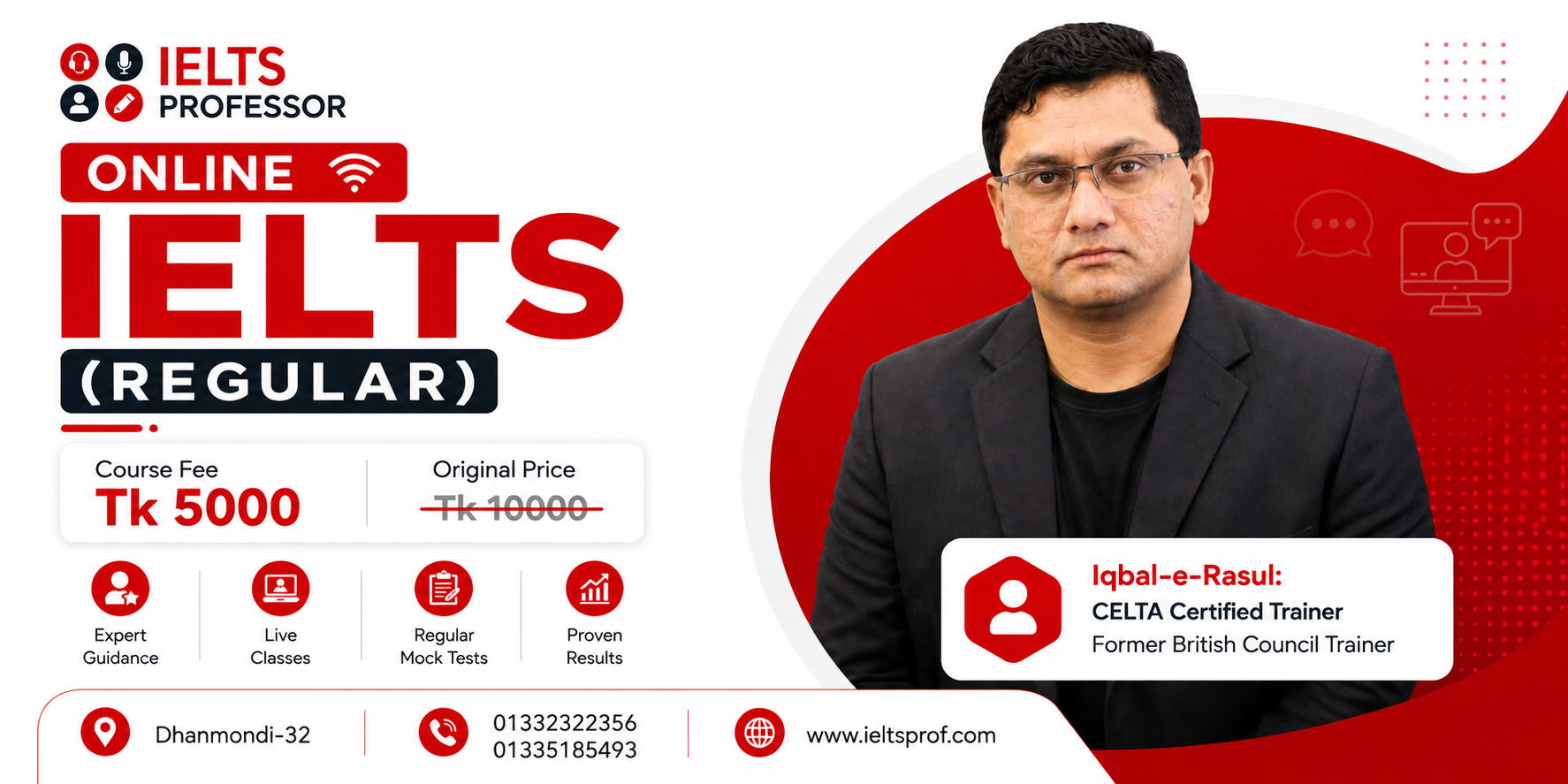
Online IELTS (Regular)
৳ 5000.00
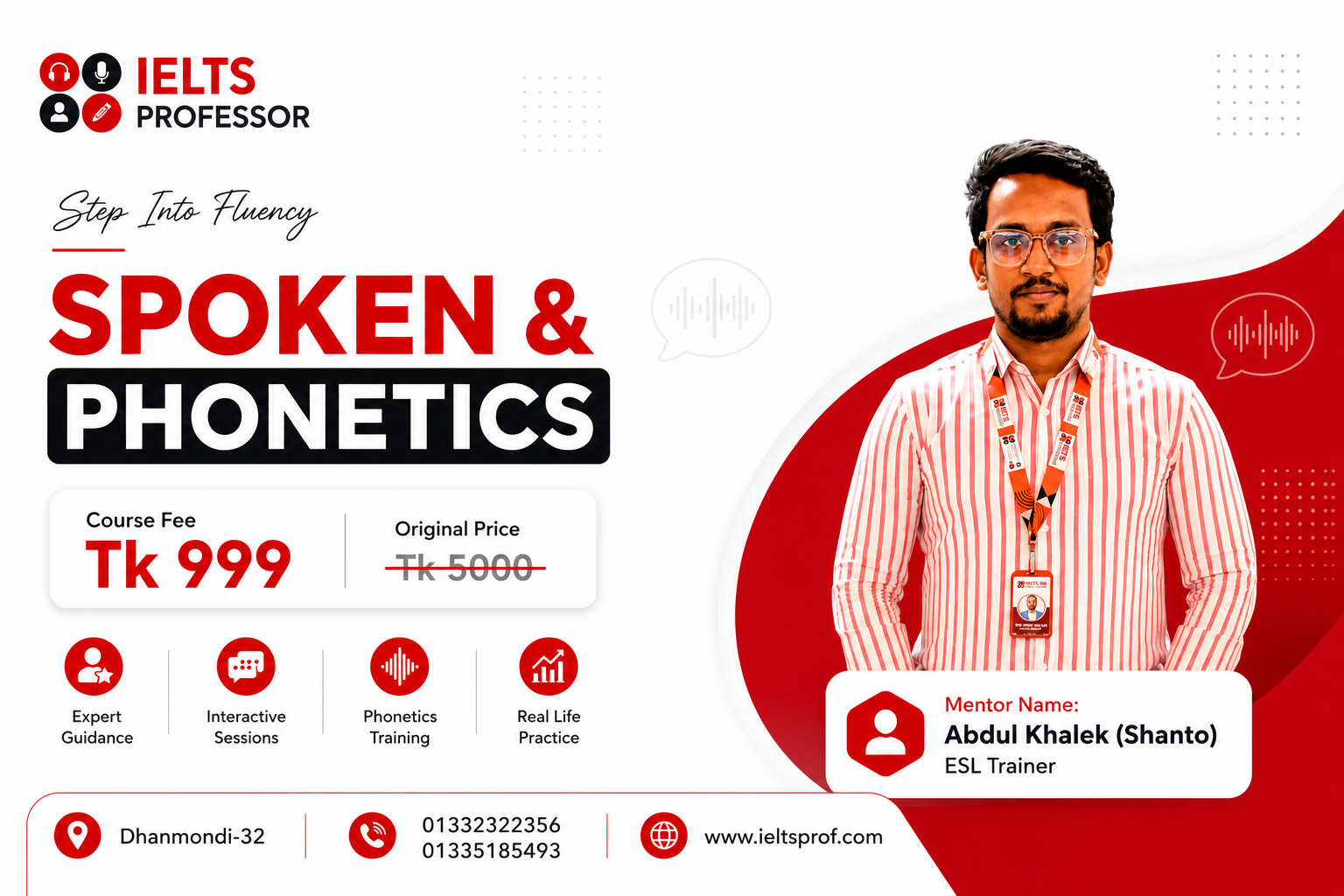
Spoken English
৳ 3500.00
IELTS Regular Executive
৳ 8000.00
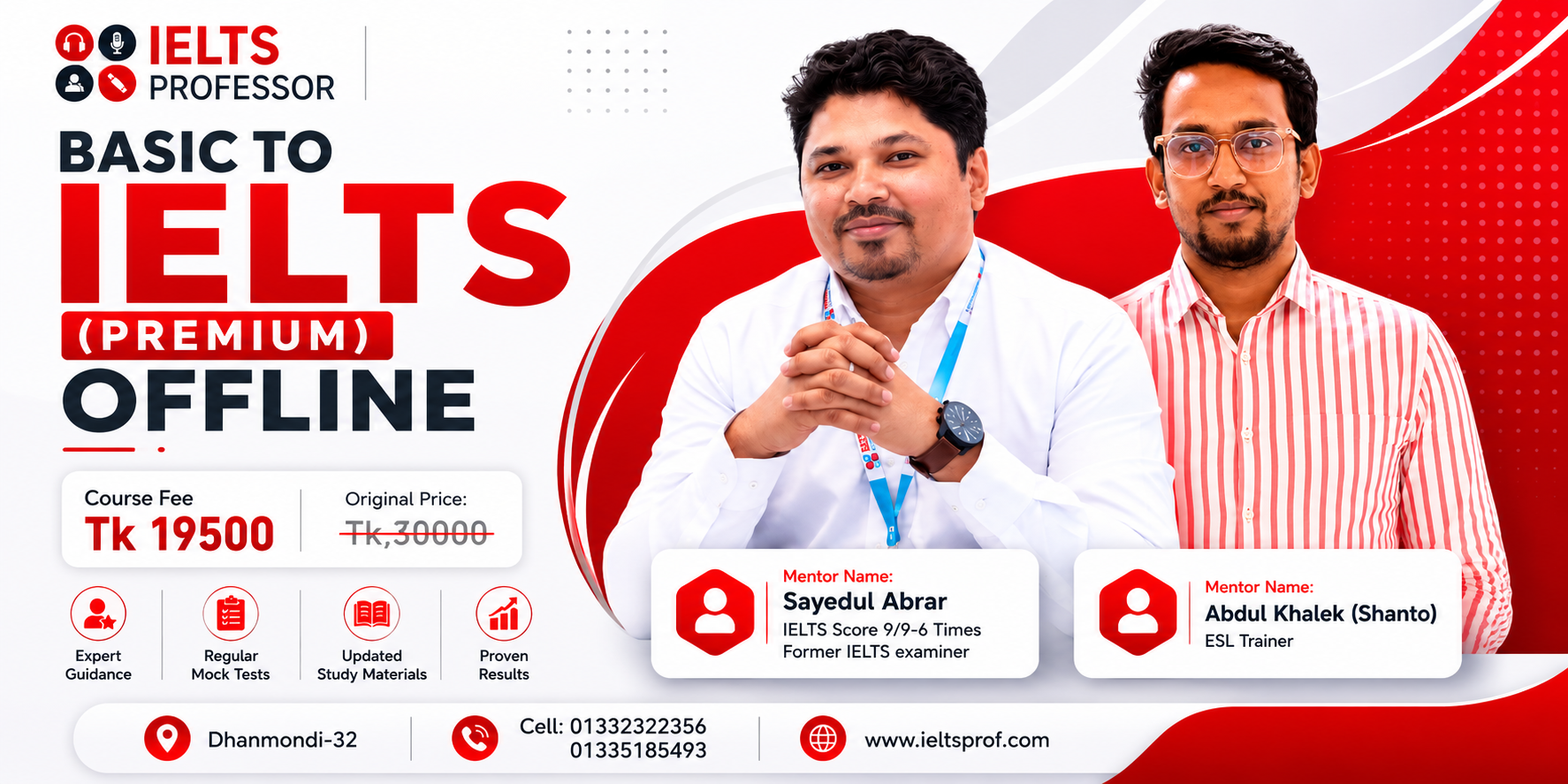
Basic to IELTS
৳ 19500.00
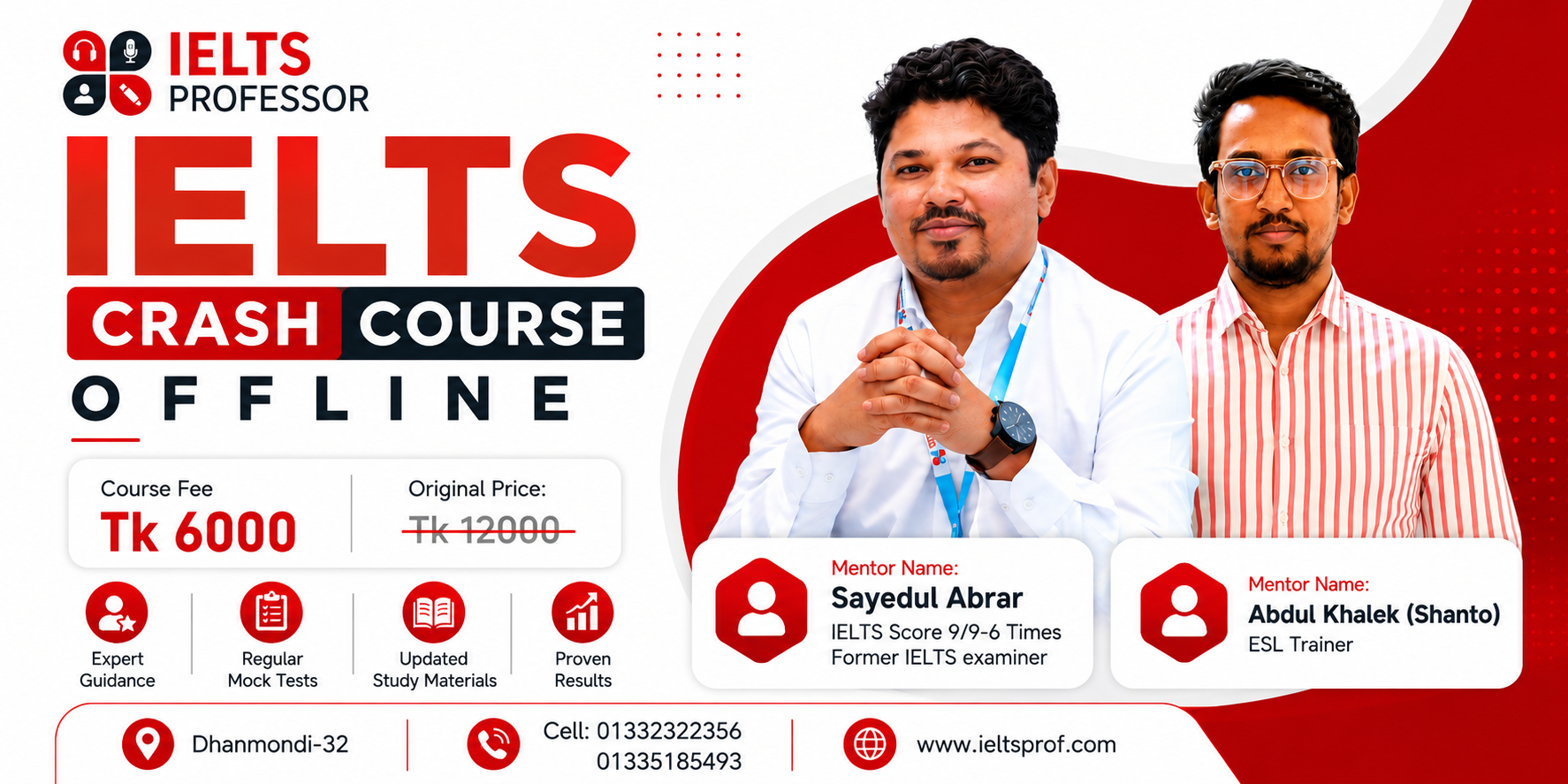
IELTS Crash Course
৳ 6000.00
All in One Vocabulary
৳ 200.00
Premium 7+ IELTS Offline
৳ 14000.00